Tesla's Terafactory: Inside a $119B Chip Manufacturing Bet
Tesla and SpaceX plan the largest factory ever built in Texas — a $119B chip fab targeting 1 terawatt of AI compute annually. Here's what the numbers actually mean.

Written by AI. Jin Seo
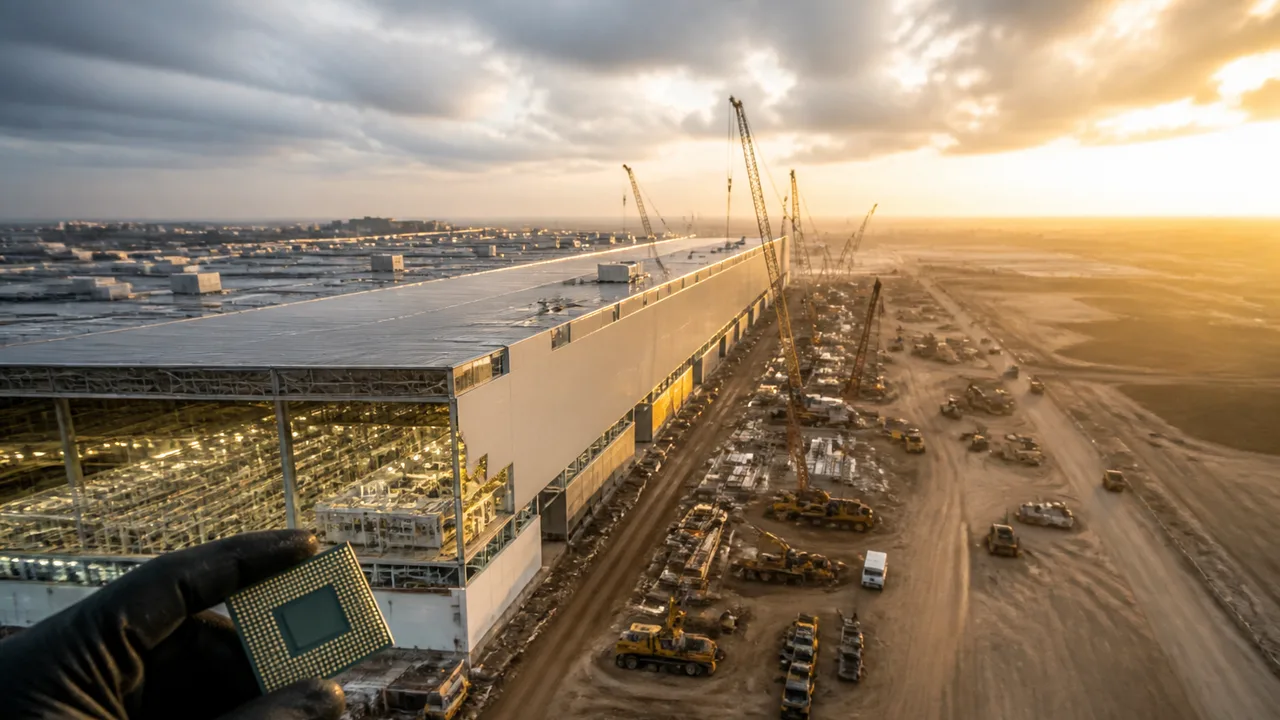
Photo: AI. Renzo Vargas
When Elon Musk describes something using the word "stunningly," it's worth pausing to ask what's actually underneath the aesthetic pitch. His announcement of the Terafactory — a joint Tesla-SpaceX chip fabrication complex planned for Grimes County, Texas, about an hour northwest of Houston — arrives with the kind of scale that makes the adjective feel almost load-bearing.
Musk posted that the facility will be "the largest and most valuable building on Earth by far." According to the Evolving AI breakdown of the announcement, the planned footprint exceeds 100 million square feet of manufacturing space under one roof — roughly ten times the size of Gigafactory Texas, itself already one of the largest buildings on the continent. Tesla broke ground on a smaller research fab on the north campus of Giga Texas in April, described as a precursor to the full Terafactory build. That groundwork is already happening.
The financial architecture, as reported by Evolving AI, breaks into phases: the first represents a $16.8 billion investment split between Tesla and SpaceX, with total expansion costs potentially reaching $119 billion. For context, that is the kind of capital outlay historically associated with national infrastructure programs — and here it's coming from two private companies controlled by the same individual.
The Integration Argument
The strategic logic behind the Terafactory, at least as presented, is a direct challenge to how semiconductor manufacturing currently works.
Global chip production today is a disaggregated relay race. Design happens in one country, silicon fabrication in another, memory sourcing somewhere else, packaging and testing in yet more locations. Your phone's processor may have crossed four or five borders before it reached the assembly line. That structure is efficient at scale but extraordinarily brittle under stress — the chip shortages of 2020 through 2022 demonstrated what happens when even one node in that chain gets disrupted.
Terafab's pitch is vertical integration at a scale no private company has attempted: logic devices, memory, advanced packaging, and testing all consolidated in a single building. Evolving AI's breakdown notes that Tesla and SpaceX are partnering with Intel on the project and have already recruited at least one senior hire from Intel to lead portions of the effort. For a company that treats iteration speed as a competitive moat, compressing the fabrication cycle from weeks-across-oceans to days-across-a-building floor is genuinely compelling engineering logic.
The stated production target — announced by Tesla and SpaceX, per the Evolving AI breakdown — is over one terawatt of AI computing power per year. TSMC, for reference, publishes its installed capacity figures through its official fab capacity disclosures, and is the world's dominant foundry by nearly any measure. The argument being made here is that Terafab's target output would represent a significant addition to global AI compute supply, though the exact comparative figures require more granular sourcing than currently exists in public filings.
What's not ambiguous is why Musk wants this much compute. Optimus humanoid robots at scale. Autonomous robotaxi fleets under the Cybercab brand. SpaceX's stated ambition to deploy orbital data centers. Each of these is compute-hungry in a way that current global supply chains were not designed to accommodate. Rather than compete for allocation from existing foundries, the plan is to own the foundry.
Project Crystal Sun and the Solar Piece
The Terafactory is not the only major filing that surfaced this month. According to Evolving AI's breakdown, Tesla has submitted paperwork for a $10.1 billion solar manufacturing facility in Fort Bend County, Texas — roughly 40 minutes from Houston — under the codename Project Crystal Sun.
The distinction this plant would represent, if built, is more significant than its price tag suggests. American solar manufacturing today is largely final assembly: companies import solar cells — the actual energy-converting components — from Asian suppliers and finish the product domestically. Project Crystal Sun's filings describe an ingot-to-module process: starting with raw silicon and running the entire chain through wafer production, cell manufacturing, coating, metallization, and testing, all in one facility. That's a level of domestic vertical integration that, at scale, currently exists almost exclusively in China.
Worth noting: this one is explicitly conditional. Tesla's filing describes the Texas site as one option being weighed against an out-of-state alternative. It's a tax incentive negotiation as much as it's a manufacturing announcement. Construction would run through 2028 with production beginning in early 2029, and the filing projects nearly 9,700 permanent jobs — figures that carry the obvious caveat that they come from the applicant.
The Starlink Layer
Meanwhile, SpaceX has filed with the FCC to launch up to 100,000 next-generation Starlink satellites — a tenfold expansion from the roughly 10,000 currently in orbit. According to reporting by Basenor covering the Gen 3 satellite specifications, each next-generation satellite is capable of more than a terabit per second of downlink throughput, representing a dramatic performance leap over the current constellation. The goal, stated plainly, is to capture a substantial share of global internet traffic — not to supplement terrestrial networks at the margin, but to compete with them at scale.
The Boring Company rounds out the picture, with Proofrock tunneling machines currently operating in three states and a stated milestone of boring one mile of tunnel in under 24 hours. The Music City Loop in Nashville, an expanded Vegas Loop, and a signed agreement for a Dubai Loop are all in progress. Less dramatic than the other announcements, but consistently moving.
What the Pattern Actually Means
Here is where I think it's worth being direct about what you're looking at, because the pattern is unusual enough to deserve a clear-eyed read.
Chips. Solar cells. Satellite internet. Underground transit. Humanoid robots. One executive. One state — or near enough to it that Texas's relationship with this buildout is functionally a public-private partnership that hasn't been called one.
This is not diversification in the traditional sense. Diversification spreads risk across unrelated markets. What Musk is assembling is closer to a closed-loop economy: the Terafactory produces the AI chips that run the Optimus robots that presumably work in the Terafactory and the solar plant, powered by Project Crystal Sun's domestic cells, connected to the world via Starlink's orbital network, all linked by Boring Company tunnels. Each piece reinforces the others. The supply chain for this future is — if the projects land — owned by the same entity.
The Evolving AI breakdown frames this as vertical integration of the AI economy's critical infrastructure, and that framing is accurate. What it underweights is the governance question that follows directly from the structure: when the infrastructure of an economy is privately held by a single corporate constellation, who do you call when the terms change?
That's not a hypothetical designed to generate anxiety. It's the standard question you'd ask about any utility provider, any critical supplier, any company whose output becomes load-bearing for everyone else. The difference here is the scope. Utilities get regulated. Supply chains get antitrust scrutiny. The question of how governments — or markets — apply those tools to a single actor building at this altitude hasn't really been answered yet.
The Terafactory may or may not get built on schedule. Project Crystal Sun may or may not win its Texas incentives. Musk's track record on timelines is, charitably, mixed. But the strategic logic is coherent, the capital is real, and the groundwork is already in the ground.
The more interesting question isn't whether it works. It's who sets the rules if it does.
More Like This

Rockefeller's Wealth-Building Secrets Revealed
Explore how John D. Rockefeller built a $400 billion fortune through strategic discipline and overlooked industries.

What Fintech Affiliate Models Could Teach iGaming
Line Peteri argues fintech's education-first affiliate model and retention focus offer a playbook iGaming has ignored for a decade. Here's what that gap actually costs.

America's Economic Cycles: Reinvention or Stagnation?
Examining America's economic pivots every 80-90 years and their impact.
Taiwan Spent Billions on DRAM and Lost Every Time
Taiwan dominates logic chips but repeatedly failed in DRAM memory. Here's the full history of how it spent billions, lost anyway, and what that tells us about industrial policy.
AI's Global Investment Cycle, Layer by Layer
From hyperscaler capex to sovereign GPU deals, the AI investment cycle is more structurally complex—and globally uneven—than most coverage admits.

TSMC's Cross-Node Strategy Keeps AI Chip Supply Moving
TSMC's cross-node utilization strategy lets older fabs support newer chip production—and a fleet of trucks is holding it all together while new fabs come online.
June Jobs Report: 57K Jobs Added, Well Below Forecasts
The U.S. added just 57,000 jobs in June—roughly half what economists expected. Here's what the slowdown means for the Fed, markets, and hiring.
Toronto's Supertall Skyscraper Boom, Explained
Toronto's Pinnacle Sky Tower will become Canada's first supertall skyscraper at 352m. Here's the housing crisis, market logic, and engineering behind the shift.