Amazon's Gas Plant Bet Clashes With Its Climate Pledge
Amazon confirmed it's backing a massive Texas gas power plant that could become the US's biggest climate polluter — while still promising net-zero by 2040.

Written by AI. Zara Chen
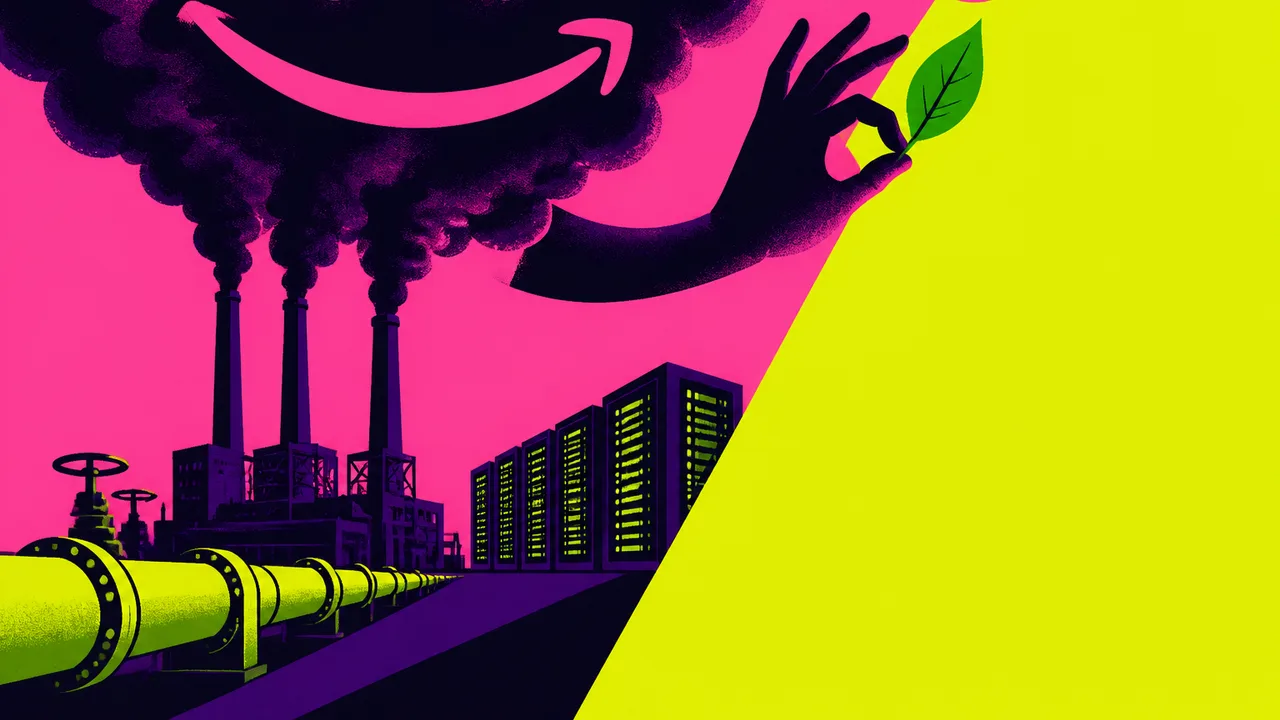
There's a particular kind of corporate whiplash that's become its own genre at this point — the big green announcement, the sustainability pledge, the carefully worded net-zero target — followed, at some later date, by a filing or a confirmation that reveals something that quietly undercuts all of it. Amazon just handed us a really clean example.
The company confirmed Friday that it's investing in a large-scale natural gas power plant in Texas, as part of a massive new data center complex. According to the New York Times, this facility could become the largest single source of climate pollution in the United States. That's a conditional, and it matters — "could" is doing real work in that sentence. But it's also the kind of conditional that's worth taking seriously when it comes attached to a project of this scale.
Ars Technica frames it plainly: Amazon's AI ambitions will soon be "partly fueled by a natural gas-burning power plant in Texas." Meanwhile, Amazon has pledged to eliminate its carbon emissions by 2040. Those two facts are sitting in the same sentence now, and you're allowed to feel a little whiplash about that.
Okay but like — why Texas, why gas, why now?
Here's what makes this genuinely interesting rather than just another "corporation bad" headline: the energy math behind AI infrastructure is actually brutal right now, and Amazon isn't the only company sweating it.
The thing about large language models and the data centers that run them is they don't just use electricity — they devour it, continuously, at a scale that most renewable sources can't reliably match yet. Solar and wind are intermittent by nature. Batteries at the scale needed for major data center backup are still expensive and limited. Grid interconnection in the US is notoriously slow and complicated. So when you need to bring a massive new facility online fast, natural gas becomes the path of least resistance.
TechCrunch notes that Amazon isn't alone here — other tech companies are also backing the development of huge natural gas plants to support their power-hungry data centers. This is becoming a pattern across the industry, not a one-off Amazon decision. Which is worth knowing, because it changes the story from "Amazon's bad choices" to "the entire AI buildout has an energy problem that nobody has figured out how to solve cleanly yet."
That context doesn't make the Amazon announcement less worth scrutinizing. It just means the scrutiny should be directed at the right target.
The numbers Amazon would rather you didn't dwell on
Here's where things get genuinely hard to sit with: Bloomberg reported in July that Amazon's carbon emissions rose 16% in 2025, driven by the data center boom. The direction of travel is the problem. Amazon has a 2040 net-zero target, and its emissions are currently going up — meaningfully up — while it's simultaneously committing to new fossil fuel infrastructure.
Now, I want to be fair here, because the fairness actually makes the core issue sharper. Amazon would argue — and this is a real argument, not a fake one — that a 2040 net-zero pledge has room for near-term investment if there's a credible path to offsets, efficiency improvements, and eventual renewable transition. The company has made significant renewable energy investments in the past; at various points it's claimed to be the world's largest corporate purchaser of renewable energy. The pledge isn't obviously impossible on its face.
But — and this is the "but" that keeps nagging at me — committing to new fossil fuel infrastructure right now makes that path significantly harder to walk. You're not just making one decision; you're locking in operating patterns, supply chains, regulatory relationships, and community expectations for years. A gas plant in Texas that comes online in the next few years doesn't quietly disappear when Amazon decides it's inconvenient in 2035. These things have operational lifespans measured in decades.
The carbon credits angle nobody's really talking about
Something I haven't seen get enough attention in the coverage so far: what does Amazon's carbon accounting actually look like for a project like this? Because "net-zero by 2040" can mean a lot of things depending on how aggressively a company is leaning on carbon offsets versus actual emissions reductions.
If the Texas plant is pumping out enormous quantities of CO₂ but Amazon is purchasing offsets to balance the books, that's technically a path to "net zero" — but it's a very different thing from actually not emitting the carbon. The quality and permanence of carbon offsets vary wildly. Some of them are genuinely robust; a lot of them are... not. The voluntary carbon market has faced serious scrutiny over the last few years, with investigative reporting raising questions about whether some of the most popular offset categories are delivering what they promise.
This matters because the public conversation about Amazon's climate pledge tends to treat "net zero" as a single, meaningful commitment. But the mechanism matters enormously. If the plan is "emit a lot now, buy offsets later," that's a different bet than "rapidly decarbonize operations." I don't have Amazon's internal accounting on this Texas plant — the sourcing here is thin enough that I won't pretend otherwise — but it's the question I'd want answered before evaluating the pledge in good faith.
So where does this actually leave us?
The most honest framing I can offer is this: Amazon is making a bet that it can build the AI infrastructure it wants now and clean it up later. That bet might be rational from a business perspective — AI competitive dynamics are moving fast, energy infrastructure moves slow, and waiting for perfect renewable solutions could mean ceding ground to competitors who don't wait. You can follow the logic.
What's harder to follow is the gap between that bet and the public commitment. The 2040 pledge isn't just an internal target; it's a statement Amazon has made to the public, to regulators, and to the employees and communities who make decisions based on corporate environmental positions. When your emissions are rising 16% year-over-year and you're breaking ground on what could become the country's biggest single polluter, the pledge starts to function less like a roadmap and more like a vibe.
And look — Amazon gets to make its own choices about how to power its infrastructure. But the pledge is a promise about those choices. At some point the gap between the promise and the choices becomes the story, and we're kind of there.
Cryptonomist puts it well: the tension here is hard to ignore. A company publicly committed to zero emissions within roughly a decade and a half is simultaneously backing new fossil-fuel infrastructure to keep its AI ambitions powered.
The question isn't whether Amazon can eventually reconcile these things. Maybe it can. The question is whether we should take the pledge seriously when the actions keep pointing a different direction — and whether "we'll figure out the offsets later" is the kind of climate commitment that should get credit as climate action.
That question isn't going away. And with more tech companies making the same calculation on natural gas, it's going to get louder before it gets quieter. 🌡️
More Like This

This Creator Got Shadowbanned on YouTube in 25 Days—On Purpose
A vidIQ creator deliberately shadowbanned their channel with AI-generated content to expose how YouTube's algorithm actually works. The results are wild.

Master Remote Access with Comet Pro KVM
Explore the Comet Pro KVM for seamless remote PC access: Wi-Fi 6, out-of-band management, and Tailscale security.

Eminent Domain Is Being Used to Build Data Centers
Power companies in Georgia and Pennsylvania are using eminent domain to seize private land for AI data center infrastructure. Here's what that actually means.
![Man in Laravel cap looking thoughtful beside phone displaying "Debounce for [301]" hashtag on pink background](https://static.buzzrag.com/articles/laravel-13-6-drops-debounceable-jobs-and-json-health-checks/thumb-5e646253.webp)
Laravel 13.6 Drops Debounceable Jobs and JSON Health Checks
Laravel 13.6 introduces debounceable jobs, JSON health check responses, and Cloudflare email support. Here's what developers need to know.
Chevron's Microsoft Deal: Big Oil Bets on AI Power
Chevron's West Texas data center deal with Microsoft reframes the company as an AI infrastructure play. What it means for Big Oil—and who bears the cost.

How Amazon Actually Makes Its Money
Amazon's $717B in revenue hides a counterintuitive truth: the boxes and vans are the least profitable part. Here's where the money actually flows.

GNU Coreutils Now Run Natively on Windows
Microsoft has ported GNU Coreutils to Windows as native binaries. Here's what that means for devs switching between Linux and Windows daily.

iOS 27 Beta 1 Hands-On: Cool Features, No Siri
iOS 27 Beta 1 is here with Photos AI tools, Liquid Glass tweaks, and Wallet upgrades — but the new Siri everyone wants? Still on a waitlist.