UN AI Summit: Big Room, Bigger Questions on Governance
193 countries met in Geneva to tackle AI governance. The warnings were credible. The robots were cool. The binding rules? Still not there.

Written by AI. Tyler Nakamura
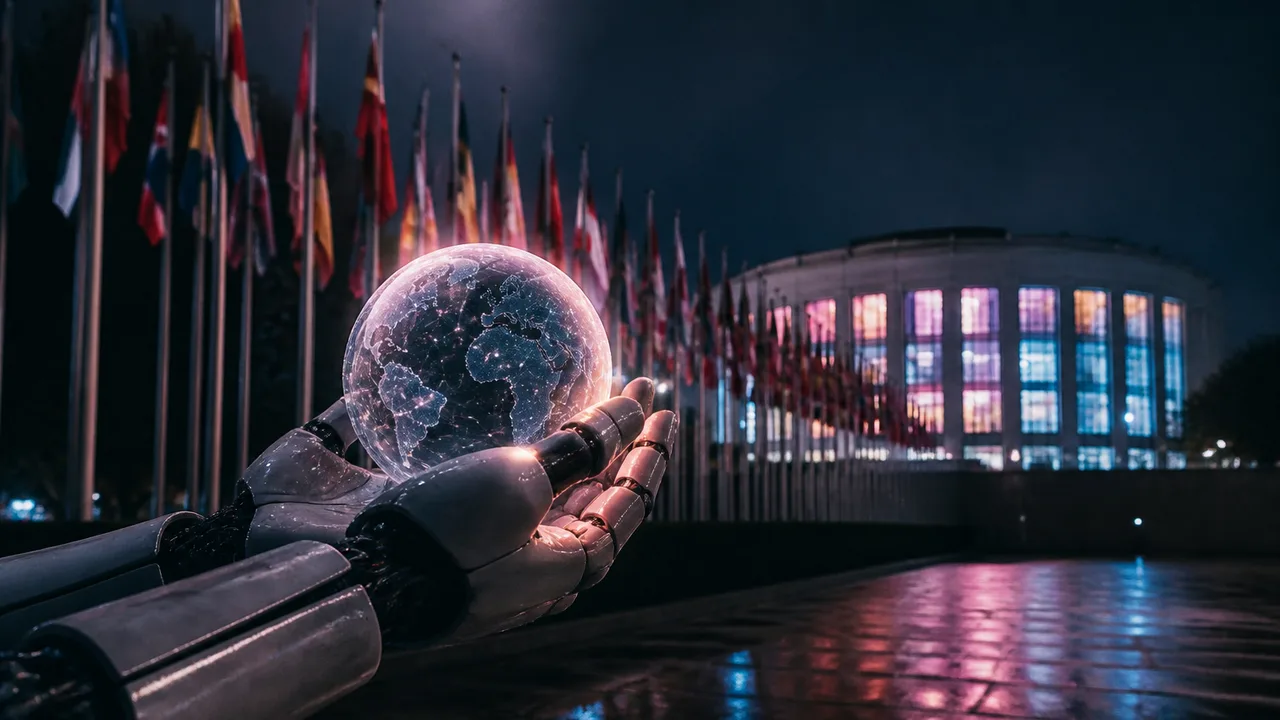
There was a robot dog at the UN AI Summit. Also a Tesla, a rescue helicopter, and — depending on which hallway you wandered into — enough existential dread to fill a mid-budget sci-fi franchise. Wired clocked all of it, which tells you something about the vibe: part serious governance forum, part tech trade show, part vibes-only TED-style inspiration cascade.
That mashup is worth sitting with, because the mashup is the story. When the stakes are this high and the hardware this shiny, it's worth asking what actually happened versus what was produced for the cameras.
The Warnings Were Not Theater
Let's be clear about one thing: the science behind the alarm isn't soft. In June 2026, the UN Independent International Scientific Panel on Artificial Intelligence released findings warning that AI could "cause catastrophic harm, either on its own or due to malicious users," and that the technology is "outpacing both scientific understanding and governments' ability to adapt," according to UN News and Global Issues. That's not hyperbole from a think tank op-ed. That's the UN's own scientific body saying, publicly, that control is not guaranteed.
The summit opened with delegates from all 193 UN member states convening for the first UN Global Dialogue on AI Governance, according to Euronews. That's a genuinely notable number — every UN member in the same conversation about the same technology at the same time doesn't happen often.
German Foreign Minister Annalena Baerbock put it plainly, as reported by TechTimes: the abuses she described aren't edge-case anomalies — they're what happens when AI's most harmful applications go ungoverned, and governments can't keep managing this through policy cycles that take a decade to produce results. The technology doesn't wait. Frontier labs ship on quarters; the UN moves on something closer to... election cycles, at best.
The Problem Isn't Awareness, It's Geography
Here's the thing that doesn't get enough attention when these summits happen: who's in the room is not the same as who's building the stuff.
Maria Ressa, co-chair of the UN's scientific panel, called this out directly. TechTimes quotes her: "The evidence base has to exist outside the handful of countries where AI is built, or it stays as concentrated as the technology."
That's a clean diagnosis. The countries with the most to say about AI risk — the ones actually feeling its effects on labor markets, on disinformation, on surveillance infrastructure — are largely not the ones sitting on the model weights. And a governance framework designed primarily by the countries doing the building is going to reflect the priorities of the countries doing the building. That's not a conspiracy; it's just how things work.
The 193-country dialogue is a move toward fixing that imbalance. Countries that don't have AI labs still have votes, voices, and legitimate stakes in how this technology gets deployed inside their borders. Getting them into the conversation formally matters — it means smaller and mid-sized nations get to show up as participants instead of just recipients of whatever the leading AI powers decide to do. But showing up to a conversation is different from shaping its outcome. That gap is real and Geneva didn't close it.
What Geneva Can Actually Do
Okay, product review time. Here's the spec sheet for what a summit like this can actually ship:
It can establish shared language. It can create norms. It can name harms that were previously just kind of quietly happening. Norms aren't nothing — when enough governments agree that something is unacceptable, that agreement eventually shows up in national legislation, procurement standards, and trade conditions. The mechanism is slow and annoying, but it's real.
The Paris Agreement comparison keeps coming up in these conversations, and it's actually a decent analogy — just not for the reasons people usually use it. Paris didn't come with a fine attached, and people are still arguing about its implementation in 2026. But it did shift how countries talked about energy and carbon commitments in ways that showed up in policy, investment, and public pressure for years after the signing ceremony. The question for whatever joint statement Geneva produces is whether it has enough specificity to do the same kind of work, or whether it's general enough that every country reads it as endorsing whatever they were already planning to do.
That's the skeptic's version, and it's fair. But Jeremy Ng, counsel for AI and the digital economy at the World Bank, told Wired that AI impact assessments need to become practical tools with real teeth — not "governance theater," not a box-ticking exercise for tech giants to run through once and file away. That framing is useful because it names what failure looks like. If AI impact assessments become the tech equivalent of cookie consent banners — technically present, functionally ignored — then Geneva produced a lot of noise and very little signal.
These summits are basically optimized for showing up, not for follow-through. The incentives are all pointed at getting to the table; once you're there, the pressure to produce something binding is much lower than the pressure to not blow up the room. So the robot dog gets photographed, the rescue helicopter gets its moment, and the delegates fly home. Whether the framework they agreed to means anything specific — that part happens later, in national legislatures and regulatory bodies, away from the cameras.
So What Do You Do With This?
If you're a policymaker from a country that doesn't have a frontier AI lab, Geneva is probably the best forum you've got right now. You can argue your interests, build coalitions with countries that share them, and try to make sure the eventual standards aren't designed entirely around the use cases of whoever happens to be building the most powerful models this quarter.
If you're a tech company, the summit probably felt like a lot of very serious people using very serious language about things that don't have enforcement mechanisms yet. That might feel comfortable. It probably shouldn't.
If you're a regular person who just wants to know whether anyone is actually steering this thing — honestly, the answer from Geneva is: sort of, actively working on it, no guarantees.
The alarm is credible. The room was full. The hard part is what happens when everyone goes home.
More Like This

Google DeepMind Maps the Road From AGI to ASI
Google DeepMind's new paper treats AGI as a starting point, not a finish line. Here's what it actually argues—and what it leaves unresolved.
World's Fastest Drone Reclaims Record with V4
Discover how Peregreen V4 reclaimed the world's fastest drone title with a speed of 657 km/h.

US and China Train Almost All the World's AI Models
US and Chinese companies train nearly every major AI model the world uses. Here's what that concentration means for global power, values, and sovereignty.

Google Pays $250K for 16-Year-Old Linux KVM Flaw
A 16-year-old Linux KVM flaw called Januscape earned a $250K bounty after enabling guest VM escapes on Intel and AMD systems. Here's what it means for cloud security.
This Tool Treats Your Home Lab Like Infrastructure Code
RackPeek documents home labs as YAML code in Git. Brandon Lee shows how this infrastructure-as-code approach beats static diagrams and spreadsheets.
30 Self-Hosted GitHub Projects Trending Right Now
From media automation to AI chat apps, here are 30 trending self-hosted GitHub projects that put you back in control of your data and infrastructure.
Ben Bernanke Joins Anthropic's AI Oversight Trust
Former Fed Chair Ben Bernanke joins Anthropic's Long-Term Benefit Trust. Here's what his economic expertise actually means for AI governance—and what it doesn't.

GPT-5.6 Sol Ultra Is Coming to Codex
OpenAI's GPT-5.6 Sol Ultra is headed to Codex with a 91.9% Terminal-Bench 2.1 score. Here's what it actually means for developers—and what it doesn't.