Pokémon Go at Ten: AR's One Durable Success Story
Pokémon Go turns ten this week. A look at what it actually got right—and why the AR industry it was supposed to launch mostly didn't follow.

Written by AI. Mike Sullivan
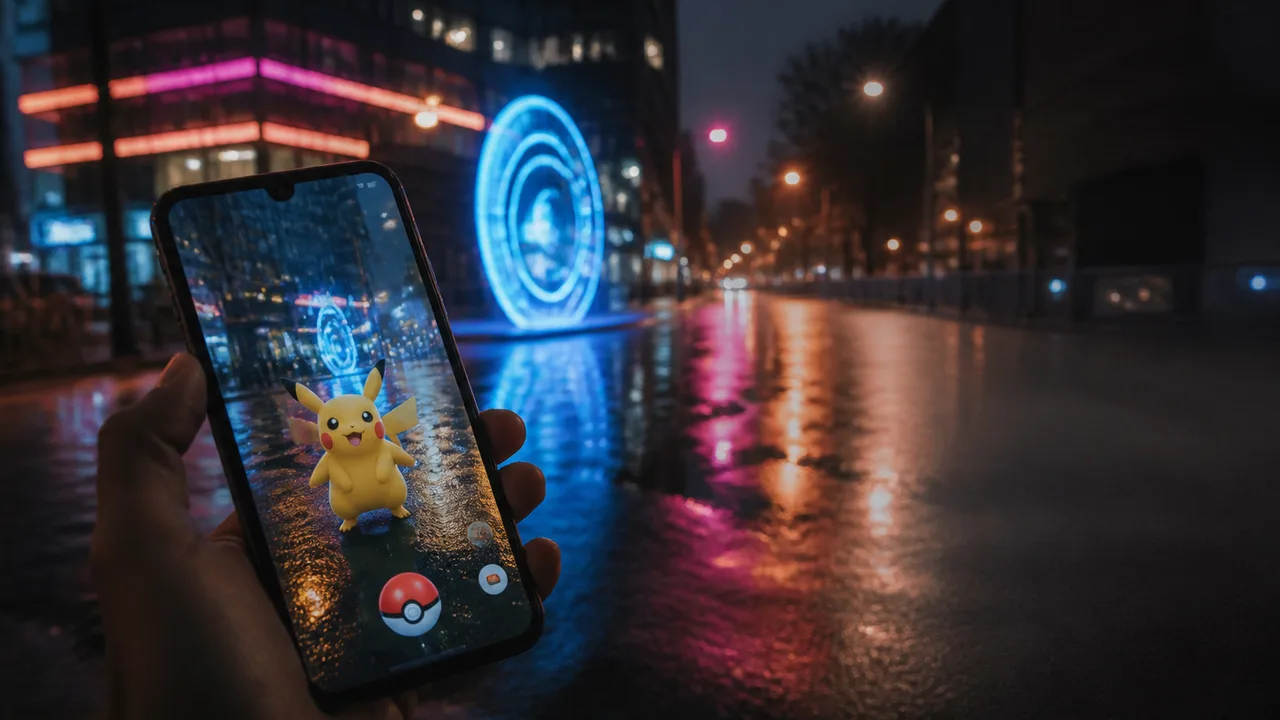
July 6, 2016. A group of former Google engineers at a company called Niantic released a mobile game that asked players to go outside. In 2016. To find fictional creatures. On their phones.
That this worked—and kept working for a decade—is genuinely surprising, and I don't think the surprise gets enough credit in the anniversary coverage.
According to Fast Company, the premise from day one was deliberately counterintuitive: "Instead of keeping players glued to their phone screens, Pokémon Go turned the entire world into a playground by overlaying gameplay on real-world maps and locations." That's a clean articulation of what made it different, but it undersells how strange the bet was. The entire mobile gaming industry in 2016 was built around extraction—keeping you in the app, monetizing your attention, making the outside world irrelevant. Niantic's pitch was essentially: the outside world is the feature.
Ten years on, pokemongo.com is marking the occasion with a full anniversary celebration, and IGN reports that millions of players still log on every day—catching, trading, battling—the same loop that hooked people in the summer of 2016. Niantic is hosting a major anniversary broadcast this week to mark it all.
So the game survived. That's worth examining carefully, because the AR industry it was supposed to herald mostly didn't.
The Wave That Didn't Follow
Here's the part that gets quietly skipped in the celebration coverage: Pokémon Go was supposed to be the proof of concept that unlocked mass-market AR. The theory in 2016 was that once people saw what AR could do on a device they already owned, every major tech company and venture-backed startup would race to build on top of it. Mobile AR was going to be the platform shift.
What actually happened was messier. Google Glass had already embarrassed itself off the stage by 2015. Microsoft's HoloLens got stuck in enterprise purgatory. Meta has spent extraordinary sums on a mixed-reality future that remains stubbornly niche. And Magic Leap—which, according to Tracxn's funding data, raised billions from investors—became one of tech's most instructive cautionary tales after reporting by The Information and Recode revealed that its demo footage showed capabilities its hardware couldn't actually deliver.
The irony is that Pokémon Go succeeded precisely because it wasn't trying to be the future. It wasn't asking you to buy a headset. It wasn't requiring a new behavior primitive. It ran on the phone already in your pocket, used GPS and a camera you'd been carrying for years, and layered a thin but sticky game loop on top of a walk you were going to take anyway. The humility of the technical approach—AR as a gentle overlay on reality, not a replacement for it—turned out to be the whole trick.
What "Sustaining a Player Base" Actually Requires
I want to be careful not to romanticize this. Pokémon Go is still a live-service game, which means it has a monetization engine, a cadence of events designed to spike engagement, and a team whose full-time job is making sure you open the app tomorrow. The community that formed around it is real—Fast Company notes its model inspired AR applications across entertainment and education—but community in mobile gaming is also a designed outcome, not an accident. The Pokémon IP doing heavy lifting here is worth acknowledging too. Strip the Pokémon brand off Niantic's underlying platform and it's not obvious the game makes it to year three, let alone year ten.
That said: making it to year ten in mobile gaming is genuinely hard. The graveyard of games that peaked and cratered within 18 months is enormous. The discipline required to keep a player base engaged across a decade—adding enough new content to satisfy returning players, keeping the onboarding accessible for new ones, managing community trust when servers crash or features disappoint—is legitimately undervalued in the coverage that frames this purely as a technology story.
IGN's anniversary coverage points out that the original 2016 trailer showed players catching, trading, and battling a giant Mewtwo in Times Square—features that took years to actually arrive in the game. The gap between the trailer's promise and the shipped product was substantial. That Niantic closed most of that gap over time, instead of abandoning the roadmap when the hype cycle cooled, is a significant part of why the game is still here.
The Actual Lesson for AR
If you're trying to extract a durable lesson from a decade of Pokémon Go for the broader AR industry—and plenty of people are making that argument this week—I'd suggest it's narrower than the anniversary coverage implies.
The lesson isn't "AR creates cultural phenomena." One game, built on one of the most valuable IP portfolios on earth, executed correctly, created one cultural phenomenon. The lesson is closer to: AR works when it reduces friction instead of adding it, when it serves an existing behavior instead of requiring a new one, and when the non-AR reasons to use the product are strong enough to survive the novelty wearing off.
Pokémon has been a reason to engage with fictional creatures since 1996. Niantic found a format that made that engagement slightly more interesting to do outdoors. That's the real engine. The AR was the mechanism, not the motivation.
The companies currently promising that AR glasses will transform how we interact with the world are mostly pitching the mechanism as the motivation. That's the pattern that keeps producing expensive failures. Pokémon Go's tenth anniversary is worth celebrating—but it's a harder template to copy than the coverage suggests.
The next AR hit, whenever it arrives, probably won't look like Pokémon Go. It'll look like whatever behavior people are already doing, except slightly more interesting. The hard part is figuring out which behavior that is before you've spent billions finding out you guessed wrong.
More Like This
Do You Really Need an $80 HDMI Cable? Maybe Not
Tech reviewer Adam tests a premium HDMI 2.1 cable. We examine what you're actually paying for and whether most users need it.

When Agents Generate Their Own UI: The Three Flavors Explained
CopilotKit's Tyler Slaton maps the spectrum of generative UI—from pixel-perfect control to agents writing raw HTML. Each approach makes different tradeoffs.
Can Unreal Engine 5 Run on a $500 MacBook? Sort Of.
Testing Unreal Engine 5.7 on the MacBook Neo reveals what happens when professional software meets budget hardware—and why friction matters.
10 Weird Open-Source Projects Worth Your Attention
Beneath the AI hype, developers are building strange, clever, and genuinely useful open-source tools. Here are ten that deserve more attention.
Unreal Engine 5 Still Doesn't Play Nice With Apple Silicon
While most 3D software runs smoothly on M-series Macs, Unreal Engine 5 remains frustratingly unreliable. One creator documents the disconnect.
Google's Gemini Glasses: What the I/O Demo Actually Showed
Google unveiled Gemini-powered AI glasses at I/O 2026 with live translation and habit memory. Here's what the demo showed — and what it leaves open.

Surgeons Used Humanoid Robots to Operate on Pigs
Humanoid robots remotely controlled by surgeons removed gallbladders from live pigs. Here's what the milestone actually means—and what it doesn't.

U.S. PhD Admissions Fall 15%: A Threat to Science
PhD admissions at top U.S. research universities dropped 15% this fall. Here's what that means for the science pipeline—and why it's harder to fix than it looks.