Arm's Next Mali GPU Will Carry Neural Accelerators
Arm's Neural Dawn demo signals dedicated neural accelerators in the next Mali GPU generation, bringing desktop-style upscaling and dynamic lighting to Android.

Written by AI. Bob Reynolds
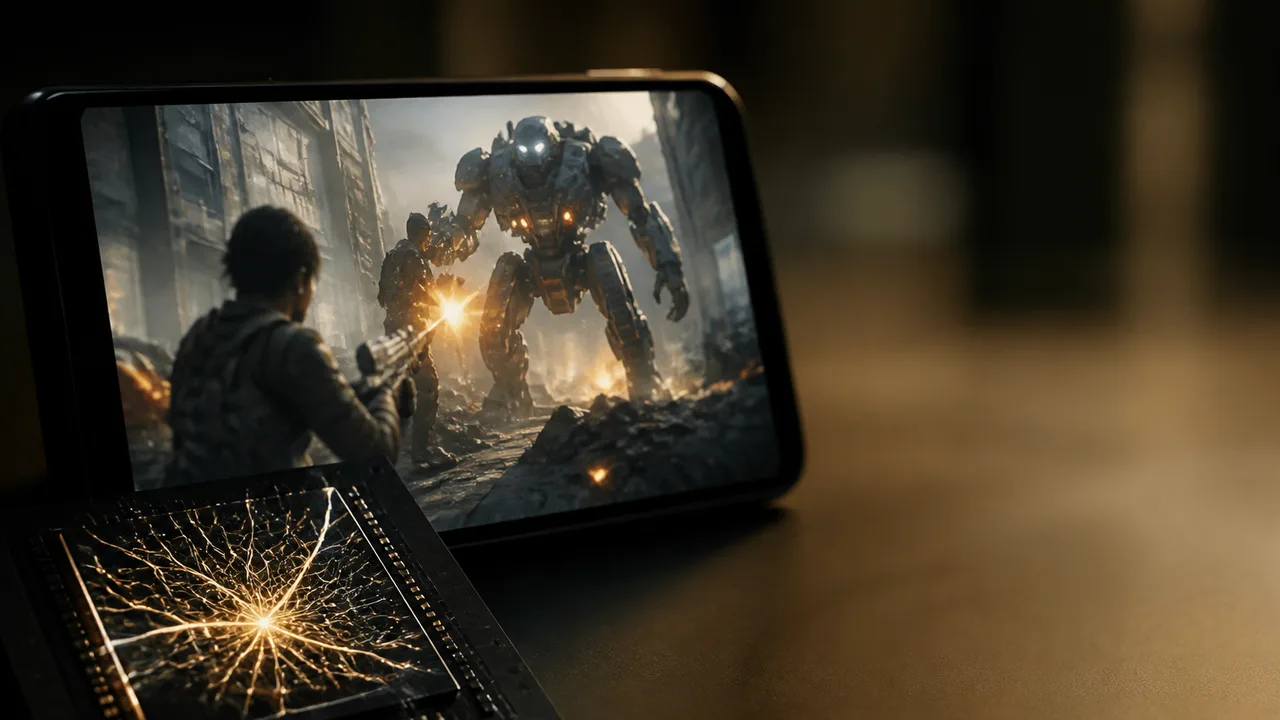
Photo: AI. Renzo Vargas
Arm doesn't sell chips. It sells blueprints. The actual silicon ends up in your phone courtesy of MediaTek, Samsung, or whoever licensed the design. That's worth keeping in mind as we parse what Arm's latest demonstration actually announces versus what it signals — because the distinction matters quite a bit here.
What Arm showed is a mobile game called Neural Dawn, built with Unreal Engine 5 and designed specifically to showcase neural technology that will arrive in the next generation of Mali GPUs. The game itself isn't the story. It's the delivery mechanism for a hardware roadmap tease dressed up as a software launch. Gary Sims of the Gary Explains channel broke it down clearly: this is simultaneously a working demo of new capabilities and an advance notice that new GPUs — and probably new CPUs — are coming later this year.
That framing is honest and worth holding onto as we look at what's actually being proposed.
What "Neural" Means Here
The word neural gets attached to so many products now that it has started to lose signal. In this context, it refers to two specific, discrete capabilities that Arm says are coming to future Mali hardware.
The first is neural super sampling and denoising. Ray tracing — the technique that simulates how light physically bounces around a scene — produces noise as a byproduct. The fewer rays you cast per frame, the noisier the image. Denoising algorithms clean that up, and neural-based denoising does it more efficiently than traditional filter approaches. This is already standard practice on desktop GPUs; the question is whether the power envelope of a mobile chip can accommodate it without destroying battery life. Arm's answer, apparently, is yes — by building dedicated hardware for the task rather than borrowing cycles from the general compute stack.
The second is neural frame rate upscaling (NFRU). This one is immediately recognizable to anyone who has followed the desktop GPU market. Nvidia calls its version DLSS. AMD calls its FSR. The concept is the same: render at a lower frame rate, then use a neural model to synthesize the in-between frames. A game running at 30 frames per second gets interpolated to 60. The GPU does half the rendering work; the neural accelerator fills the gap.
On desktop, the pitch is higher frame rates for free. On mobile, as Sims points out, the pitch is different — it's about power savings. Render 30 frames, upscale to 60, and the chip runs cooler and drains the battery more slowly. Same output, meaningfully lower cost. That's a mobile-native value proposition, and it's a sensible one.
The Lighting Angle
Neural Dawn's headline claim is more theatrical: it's described as "the world's first cinematic lighting mobile game" and the first title to implement Unreal's MegaLights system on a mobile platform.
MegaLights is a rendering path introduced in Unreal Engine 5 that allows artists to place dramatically more dynamic, shadow-casting lights in a scene than was previously practical. Neural Dawn reportedly runs between 800 and 1,000 active lights per level. To appreciate why that number is striking, you need to understand what came before it.
Traditional real-time lighting on mobile relied heavily on light maps — pre-calculated textures that simulate how static lights would illuminate a scene. You'd build the level, position your lights, then "bake" the lighting into a separate pass that could take hours to compute. The result was efficient at runtime but completely static. Move a light, change the time of day, have a story beat where someone turns off a lamp — none of that was practical. The baked map is permanent.
Dynamic lighting blows that constraint open. Artists see changes in real time. A candle flickering, a flashlight swinging through a corridor, a sunrise that actually moves — all of it becomes tractable. Arm quoted one of its representatives making the broader point: "The future of mobile graphics will not be defined solely by faster GPUs, but by the ability to combine graphics and neural compute to deliver richer experiences within a fixed power budget."
That's a carefully worded statement. It's also a competitive positioning argument. The mobile GPU market has long competed primarily on raw performance metrics. Arm is signaling that the next dimension of competition is efficiency — doing more with the same power budget rather than simply increasing the budget.
Reading the Roadmap
Sims traced the Mali GPU lineage back to the G710 in 2021, through the G715, the Immortalis series (which added ray tracing), the G925, and the current Mali G1 Ultra. The G1 Ultra delivered 20% better performance, 20% better inference throughput, 9% less energy per frame, and doubled ray tracing performance over its predecessor.
Neural accelerators were already on Arm's roadmap slide at the time of the G1 Ultra announcement — flagged as "coming in the future." That future appears to be arriving this fall, most likely as what Sims expects to be called the G2 Ultra, paired with a new C2-series CPU generation. Arm follows a fairly disciplined annual cadence on these announcements, which makes the September timing a reasonable projection rather than pure speculation.
Neural Dawn itself is an Android exclusive, tied to these upcoming Arm GPUs. That exclusivity is notable — it means the game functions as a capability gate, available only to devices running the new silicon. It's a developer relationship and a marketing instrument simultaneously.
What This Does and Doesn't Resolve
The technical case for dedicated neural accelerators in mobile GPUs is coherent. The efficiency argument is real. Upscaling and denoising are proven techniques on desktop hardware, and there's no fundamental reason they shouldn't translate to mobile given sufficient silicon commitment. Arm has the architectural track record to take seriously here.
What the demo doesn't answer is how these capabilities will propagate through the Android device ecosystem. Arm's licensees set their own timelines, their own integration choices, and their own price points. A technology that debuts in a flagship chip in late 2025 might not reach mid-range devices until 2027. Most Android users don't sit at the flagship tier. Neural Dawn's fall availability on "devices powered by upcoming Arm GPUs with neural accelerators" is a narrower install base than the announcement's framing implies.
There's also the developer side. MegaLights-level dynamic lighting changes how artists work — Sims noted this explicitly, describing the shift away from the old bake-and-wait pipeline as a genuine change in development culture. Workflow changes take time. The studios willing to build for a narrow install base of new hardware, while retraining their lighting pipelines, are probably not the ones making the titles most people actually play.
None of this is a reason to dismiss what Arm is showing. The trajectory is clear and it points somewhere interesting. But a demo game purpose-built to showcase unreleased hardware is still a proof of concept, not a product. The question worth watching isn't whether the G2 Ultra ships with neural accelerators — at this point, it almost certainly will. The question is how fast the rest of the supply chain catches up, and whether the games that actually use these features reach the people holding the phones.
More Like This
Claude Design Isn't Killing Figma—It's Killing the Mockup
Anthropic's Claude Design doesn't compete with Figma where you think. It's eliminating the prototype-to-production gap that's structured product teams for decades.
Google's Gemma 4 Makes Powerful AI Run on Your Phone
Gemma 4 brings multimodal AI models to phones and laptops with clever architecture tricks that make 5B parameters perform like much larger models.

Replit Builds Real Apps From Plain English Prompts
Replit now turns plain-language descriptions into full-stack web apps. A hands-on demo raises real questions about who benefits—and what gets lost.
AgentZero's Sub-Agents: Self-Modifying AI Delegation
AgentZero demonstrates AI agents that create and manage specialized subordinates on demand. The system modifies itself—which raises practical questions.
Claude's Task System Changes How AI Agents Work Together
While flashier AI tools grab headlines, Claude's task orchestration system quietly enables something more practical: AI agents that actually coordinate.

Nvidia's N1 Laptop Could Keep Your Data Off the Cloud
Nvidia's N1 and N1X laptops promise local AI inference at GB10 superchip power. For privacy-conscious professionals, that's bigger news than the benchmark.
How Uber's AI Edits Food Photos for Small Restaurants
Uber built an AI system that retouches food photos for small restaurants — then had to teach it not to invent shrimp. Here's what that actually required.

Loop Engineering: Building AI Agents That Improve Themselves
LangChain's Sydney Runkle outlines a four-loop framework for building reliable AI agents. The ideas are older than the branding suggests — and that's the point.