NVIDIA's N1 Laptops: Strong Hardware, Unfinished Promises
NVIDIA's RTX Spark N1 and N1X laptops impressed at Computex 2026—but battery life claims, locked drivers, and AMD competition complicate the story.

Written by AI. Mike Sullivan

Photo: AI. Kai Hargrove
Every generation of PC hardware gets its "Apple moment" headline. The PowerPC transition got one. Itanium got one. ARM on Windows has been collecting them like frequent flyer miles since at least 2012. So when NVIDIA unveiled its N1 and N1X laptops at Computex 2026—the RTX Spark line, Grace Blackwell in laptop form—the tech press reached, almost reflexively, for the same superlatives.
The folks at Level1Techs went hands-on with the hardware at the show and came back with something more useful than enthusiasm: a calibrated read on what's real, what's premature, and what the launch actually means for the broader Windows on ARM ecosystem. That last part turns out to be the most interesting thread.
The hardware is legitimately impressive—with an asterisk the size of a battery pack
Think of the N1X as a DGX Spark GB10 folded into a laptop chassis. That's not a small thing. Jensen Huang has been pitching RTX Spark-class graphics as "5070 class in a mobile platform," and based on the build quality of what was shown—Surface Ultra models, an Asus variant pushing to 128GB of unified memory—the hardware itself appears well-constructed. Adobe Premiere running on the device drew genuine admiration: fast, smooth, leaning on the AI-accelerated workflows the platform was built for.
But the asterisk: when the Level1Techs reviewer tried to run power benchmarks, they were politely redirected. When they tried to copy the video drivers to a flash drive to test Windows on ARM on their own DGX Spark hardware, the answer was also no. "They politely said, 'Oh, please don't run that,'" the reviewer recounted. That's not unusual for pre-production hardware at a trade show—but it is a data point.
The battery life promise is where the skepticism gets most load-bearing. NVIDIA is claiming all-day battery life. The 99.9Wh battery sounds substantial until you eyeball the thermal system. Running Premiere unplugged, the reviewer observed roughly 80 watts of power draw, and estimated that with fan overhead, you're looking at closer to 150 watts total—which maps to somewhere between one and two hours of real-world battery life under load, not eight or nine. "I think they might be able to do that on the 32 gig version," the reviewer said. "But the 64 or the 128 gig version running full agentic stuff locally, I don't know."
That's a meaningful distinction. The N1 line comes in 32, 64, and 128GB configurations. The all-day battery claim may be technically defensible on the lightest SKU, running lighter workloads. For the users most likely to actually buy this—developers running 128-billion-parameter models locally, people doing serious creative work—the battery story looks considerably messier.
The Windows fix that AMD didn't get credit for engineering
Here's the part of the story that doesn't get enough attention in the N1 coverage: NVIDIA's launch appears to have been the catalyst for Microsoft fixing a collection of Windows issues that AMD Strix Halo users had been living with.
The reviewer came to Computex with a literal list of Windows bugs accumulated from time spent on the AMD Strix Halo platform—issues like the memory allocation ceiling that forced users into BIOS just to access more than half their installed RAM. Those bugs are now fixed. Dynamic memory allocation between CPU applications and GPU workloads works as it should. The list of Strix Halo grievances, apparently, became the N1 launch checklist.
The more interesting wrinkle: AMD already knew. "I had a follow-up conversation with AMD and I said, 'Hey, did you know Microsoft is fixing all these problems that you had on Strix Halo?' And they were on top of it. They said, 'Yes, we've actually been working with Microsoft. We are also going to have day zero support for all the improvements in Windows.'"
So the Windows on ARM improvements shipping with the N1 are not NVIDIA-exclusive. AMD gets them too, on day zero. The headline that NVIDIA "fixed Windows" is more accurately "NVIDIA's launch gave Microsoft the commercial urgency to fix Windows problems that AMD users had already been experiencing." That's a different story—and arguably a better one for the platform overall.
What this illustrates is a dynamic that doesn't fit the usual competitive narrative. NVIDIA's market pull with Microsoft is substantial enough to accelerate platform investments that benefit everyone in the ecosystem. The rising tide lifts all ARM boats—including AMD's.
What AMD actually has to play
The reviewer's framing is that the N1 will deliver "an Nvidia-class Strix Halo laptop"—meaning the AMD Strix Halo experience, but with NVIDIA's software ecosystem. Which is accurate as far as it goes. But it also raises the question of what AMD brings to the next round.
The answer, apparently, is 192GB. AMD has confirmed a 192GB configuration of the next Strix Halo generation—internally referred to as Gorgon Halo or Medusa—and workstation laptops like the HP Z1 G1A have already demonstrated that there's a real market for high-memory ARM laptops. Those machines have sold well. AMD knows how to ship this class of hardware, and they'll be doing it with the same Windows improvements NVIDIA helped catalyze.
Timing is the variable. The N1 launches in roughly five months. Whether AMD's next-generation Strix Halo variant hits the market before or after that window will matter. If Gorgon Halo ships with 192GB configurations around the same time the N1 lands, NVIDIA's memory ceiling advantage disappears.
The three-generation bet
The most strategically significant thing NVIDIA announced at Computex isn't the N1 hardware—it's the commitment. Three generations: Grace Blackwell now, Vera Rubin next, Feynman after that. That's a roadmap promise, the kind companies make when they're serious about a market rather than testing it.
The reviewer's read on this is measured: "I think second or third generation is going to be where we really see what everybody's actually excited about. But for power users and developers and folks actually building things, this will be useful."
That framing—first generation as a credible but imperfect foundation, payoff deferred to the second or third iteration—is the honest version of almost every platform launch. The iPhone 3G was better than the original iPhone. The M2 MacBook was better than the M1. Credible first-generation hardware with a committed roadmap is a different animal than a one-off showcase piece.
The chip itself tells a story here too. The reviewer noted that the laptop version of the GB10 chip is visibly different from the desktop DGX Spark version—a modified die. "You don't do a different chip unless you absolutely have to," they observed. NVIDIA did custom silicon work to meet Microsoft's Copilot PC NPU requirements, which suggests engineering investment rather than a hastily repackaged server part.
Computex math
The reviewer's own summary puts the N1 launch at "60 to 75% NVIDIA marketing halo and 35% okay, maybe"—which is unusually precise for a Computex take, and also pretty fair. The hardware appears real and well-built. The software ecosystem—NVIDIA's CUDA toolchain, DLSS, the AI inference stack—is genuinely differentiated for certain workloads. NVFP4, NVIDIA's 4-bit inference format, running well on a portable platform is not nothing.
What's incomplete: battery life under real workloads, final driver state, software readiness, and the competitive landscape in five months when AMD may be shipping its own high-memory ARM workstation laptop with the same Windows improvements.
The reviewer put it plainly: "Everybody has been slathering praise on it and we've got five months to go and there's a lot that remains to be done before it would be worthy of that praise just for the state that it's in now today."
That's not pessimism. That's a reasonable reading of a pre-production demo at a trade show. The question worth tracking isn't whether the N1 is impressive—it is—but whether what ships in five months closes the gap between the demo and the promise fast enough to matter, before AMD shows up with 192GB and the same fixed Windows underneath it.
More Like This

Framework 13 Gets ARM—But Should You Actually Want It?
MetaComputing's new ARM mainboard for Framework 13 promises modular computing's future. Tech journalist Jeff Geerling tests whether it delivers.
AMD's $900 Ryzen 9950X3D2: A CPU Looking for Its People
AMD's dual 3D V-Cache flagship seems engineered for users who don't exist yet. Level1Techs tests the $900 processor nobody asked for but some will buy anyway.
Can Unreal Engine 5 Run on a $500 MacBook? Sort Of.
Testing Unreal Engine 5.7 on the MacBook Neo reveals what happens when professional software meets budget hardware—and why friction matters.
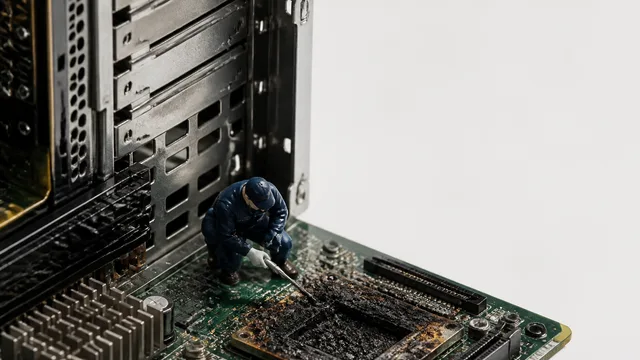
When Your Server Dies and Supply Chains Don't Care
Small business sysadmins face a brutal reality: servers die on their own schedule, not the supply chain's. Here's what DIY looks like in 2025.

The AI Desktop 'Throttling' Story Nobody Got Right
When John Carmack reported power issues with NVIDIA's DGX Spark, headlines screamed 'throttling.' The reality is more interesting—and more fixable.

Nvidia's N1 Laptop Could Keep Your Data Off the Cloud
Nvidia's N1 and N1X laptops promise local AI inference at GB10 superchip power. For privacy-conscious professionals, that's bigger news than the benchmark.

AI Coding's Modular Mirage: Real Pattern or Hype?
A pattern called 'Modular Mirage' is circulating in AI coding circles. The research behind it reveals something more unsettling than any name suggests.

Local AI and Mac Security: Promise Meets Reality
Local AI tools promise to secure your Mac by finding sensitive files before attackers do. The threat landscape says it won't be that simple.