When Your Server Dies and Supply Chains Don't Care
Small business sysadmins face a brutal reality: servers die on their own schedule, not the supply chain's. Here's what DIY looks like in 2025.

Written by AI. Mike Sullivan
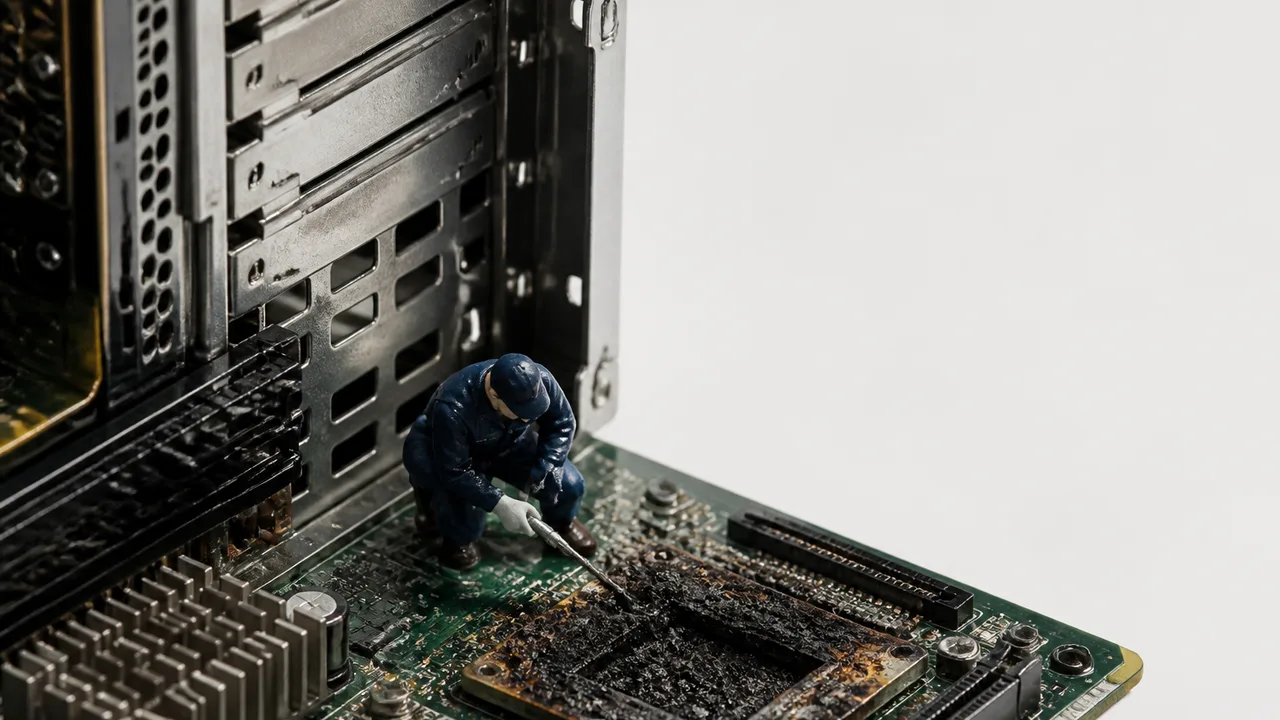
Photo: AI. Pippa Whitfield
There's a particular kind of dread that every small business sysadmin knows. It's not the scheduled maintenance window that slips, or the firmware update that takes twice as long as it should. It's the 7 a.m. call where someone's voice already tells you the answer before they finish the question. The server's dead. Not slow, not acting weird. Dead.
In normal times, the answer to that call is boring: open a browser, configure a replacement, wait for shipping. In 2025, that boring answer is no longer available. And the Level1Techs channel just put out a video that does a better job than most of explaining what sysadmins are actually doing instead.
The host — who refers to himself and his audience collectively as "computer janitors," which is either self-deprecating or the most accurate job description in the industry depending on your perspective — opens with a line that should be printed on a motivational poster somewhere: "It's tough out there. The supply chain is at apocalyptic levels of collapse, sometimes the server dies and sometimes you have to replace it."
He's not being dramatic. The server that prompted this video was running a pair of Xeon E5-2680 V3s on Socket 2011 — hardware that's roughly a decade old. An open-source project was depending on it for CI/CD work. When it died, there was no clean replacement path. You can't just order a like-for-like. The market for new mid-range server hardware is, to put it gently, a mess.
The "Should Have Listened" Problem
Before getting into the build itself, there's an uncomfortable moment in the video worth sitting with. The host describes warning this client — or project — roughly two years ago. "Hey, we should plan our infrastructure a little better." The advice didn't land. The upgrade got deferred. And now, instead of a planned migration on a reasonable timeline with normal component availability, there's an emergency rebuild happening in whatever supply chain environment currently exists.
This is not a new story. The IT industry has been telling this story since at least the Y2K era, and probably before that. The calculus that makes deferral feel rational — "it'll be better next year," "we'll get more budget next cycle," "it's still working fine" — is seductive right up until the moment it isn't. The current supply chain environment just made the consequences of that calculus significantly more expensive.
What's interesting here isn't the warning itself but the specifics of what got harder. Buying a replacement server used to mean buying a replacement server. Now, as the host explains, you're essentially back to a 1990s-style integrator model: you find a chassis, you source a motherboard separately, you bring your own CPU and RAM, you figure out which of those components are actually obtainable. Super Micro, apparently, is selling every chassis it can manufacture — but the motherboards to go with them are another conversation.
What DIY Actually Looks Like Right Now
The build the video walks through centers on a Silverstone WS380E — a workstation chassis that can convert to rack mount, which the host configures for under-desk deployment because this is a small business, not a data center. Inside: a Super Micro H14 motherboard, a 32-core Zen 4 CPU, and 768 GB of RAM that the client had the foresight to procure earlier at pre-surge prices. Good lord, indeed.
A few component choices here are worth understanding, because they reflect real tradeoffs rather than just brand preferences.
On storage: the video advocates for adding a dedicated SAS controller rather than relying on the SATA-oriented mini-SAS HD connections some motherboards include. The argument is signal integrity and longevity — SAS is a more robust protocol for heavy storage workloads, and if you're building something meant to run for five or more years, that matters. The case itself ships with eight 3.5-inch hot-swap SAS bays, so the controller addition is less optional enhancement and more completing the architecture the chassis already assumes.
On CPU generation: the host makes a point that cuts against the upgrade-obsession that often dominates enthusiast communities. Zen 3 and Ice Lake — architectures that predate the current Zen 4 and 5 generation — are described as "perfectly viable in 2026, just depending on what problem you're trying to solve." The practical implication is that DDR4 systems are currently a better deal than DDR5, and chasing the latest generation when the previous one meets your actual requirements is just spending money for its own sake. For a CI/CD workstation running virtual machines, core count and memory capacity matter far more than per-core performance improvements at the margin.
On the case itself: the Silverstone WS380E is doing real work here beyond aesthetics. The host picks up the CDA H2 variant for just over $200 each — "probably a blood bath for Silverstone," he notes — and the value proposition is genuine. Support for a 360mm radiator, eight hot-swap bays, real redundant power supply support (not the ATX-footprint retrofit kind), and the rack-convertibility option means this chassis can serve a small business through multiple hardware generations without replacement. When hardware itself is hard to get, flexibility in what hardware a chassis accepts becomes a legitimate planning consideration.
The Tension This Video Doesn't Fully Resolve
What the Level1Techs video does well is demonstrate that there's a viable path through the current supply chain environment. DIY server builds, assembled from a mix of current-gen and previous-gen components, sourced from whatever channels have stock, can produce working infrastructure at roughly half the cost of a big-name provider quote. That's a real and useful data point.
What it doesn't fully reckon with is the skill and time cost embedded in that path. The host is, by any reasonable measure, an expert. He knows what a SAS controller is and why you'd want one. He knows the difference between a PMBus connection and an SMBus connection on a redundant power supply. He's 3D-printing custom ductwork to direct airflow over the memory modules. When he describes a build as "a joy to work in," that's the assessment of someone who has built enough servers to have opinions about what the bad ones feel like.
For a small business without a dedicated IT person — or with one person doing IT alongside three other jobs — the gap between "this is technically possible" and "this is actually executable" is not trivial. The video is aimed at sysadmins who already know what they're doing and need options. It is not, and doesn't claim to be, a tutorial for someone who's never touched server hardware.
That's an honest framing, and it matters. "This is not for home labbers," the host says explicitly, distinguishing between enthusiasts building for fun and administrators building for operations that people depend on. The stakes are different, and the component choices — SAS over SATA, redundant power, validated ECC memory configurations — reflect those stakes.
The Broader Question
There's a version of this story that ends with a clean lesson: plan ahead, don't defer upgrades, maintain good vendor relationships. All true, none new.
The more interesting version is the one the video gestures at without quite stating: we are in a period where the standard commercial path for small business server replacement is genuinely broken, and the community workaround involves expertise, time, and a tolerance for improvisation that most businesses can't staff for. The host mentions that ASRock Rack may emerge as a more available alternative as supply chains shift — a useful data point, but also a reminder that component availability right now is a moving target, not a stable landscape to plan against.
The open-source project that lost its Socket 2011 machine will, apparently, get a Zen 4 replacement with significantly more capability than it had before. That's a good outcome. The two years of deferred planning that preceded it were not free.
More Like This
AMD's $900 Ryzen 9950X3D2: A CPU Looking for Its People
AMD's dual 3D V-Cache flagship seems engineered for users who don't exist yet. Level1Techs tests the $900 processor nobody asked for but some will buy anyway.

When Agents Generate Their Own UI: The Three Flavors Explained
CopilotKit's Tyler Slaton maps the spectrum of generative UI—from pixel-perfect control to agents writing raw HTML. Each approach makes different tradeoffs.
ZimaCube 2 Review: A Meaningful Upgrade or Incremental Refresh?
The ZimaCube 2 is a compact home server that earns attention for its processor upgrade—but a quiet software licensing twist deserves yours too.
Why Three Nodes Matter: The Real Cost of Proxmox HA
Christian Lempa upgraded his Proxmox cluster to three nodes with Ceph. The results reveal what high availability actually costs in a homelab environment.
Unreal Engine 5 Still Doesn't Play Nice With Apple Silicon
While most 3D software runs smoothly on M-series Macs, Unreal Engine 5 remains frustratingly unreliable. One creator documents the disconnect.

This 24-Bay Raspberry Pi Cluster Is Gloriously Impractical
A homelab enthusiast built a 24-bay storage cluster from Raspberry Pi 5s and GlusterFS. The result: beautiful, educational, and slower than a single hard drive.
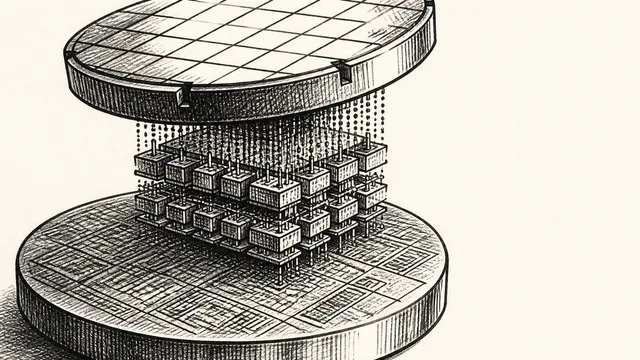
IBM NanoStack and the Future of Chip Architecture
IBM's NanoStack stacks transistors from separate wafers using atomic bonding. The physics works. The harder question is whether anyone can manufacture it at scale.

Inside the Smartphone: 120 Years of Hidden Engineering
Professor Hannah Fry tears apart a modern smartphone to trace 120 years of engineering history — from Marconi's radio waves to a 200-million-pixel camera sensor.