How Dark Fiber Is Becoming a Global Listening Network
Distributed Acoustic Sensing can turn unused fiber optic cables into earthquake detectors, whale trackers, and ship surveillance systems. Here's what that means.

Written by AI. Mike Sullivan
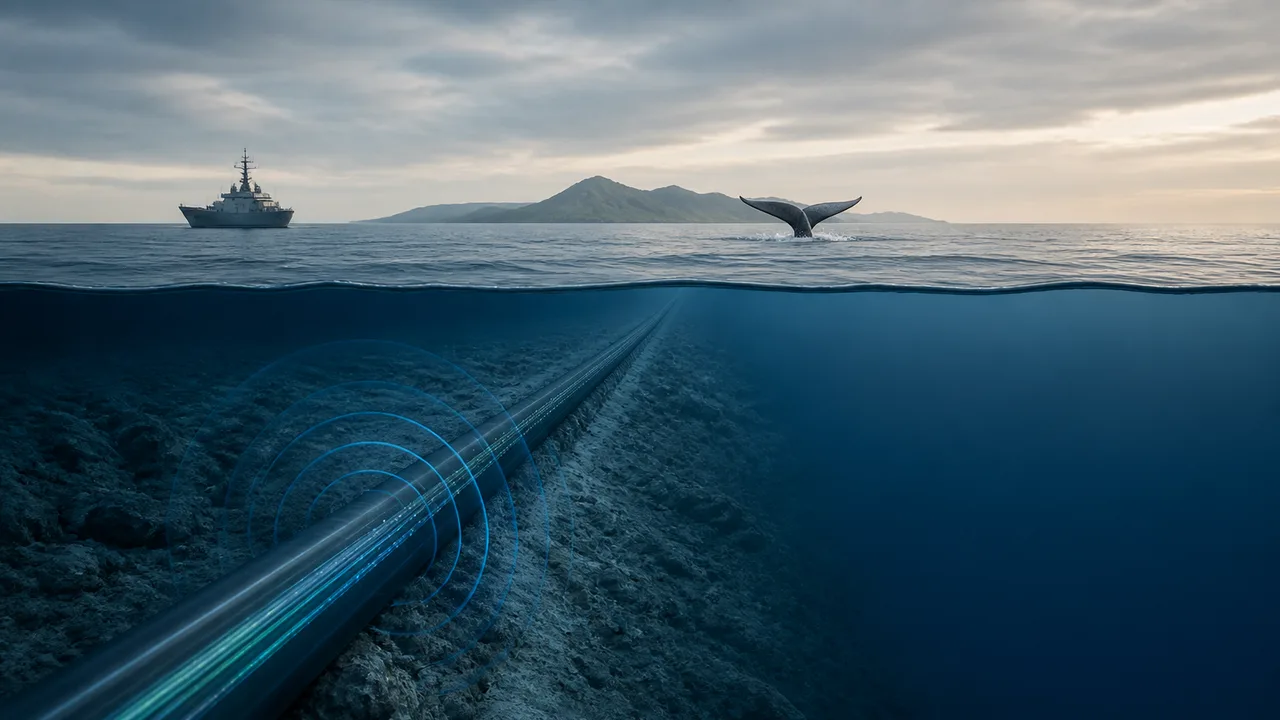
Photo: AI. Hayden Cross
There are roughly 5 million route kilometers of optical fiber in the ground and under the sea worldwide. That number keeps growing — telecoms and tech companies have added over half a million kilometers in the past several years alone. Most people, when they think about this infrastructure at all, think about it the way they think about water pipes: something that carries a thing from one place to another, and is otherwise inert.
It is not inert. And a technology called Distributed Acoustic Sensing — DAS — is the reason that distinction is starting to matter quite a lot.
The Asianometry channel published a video this week walking through exactly how DAS works, where it came from, and what it can now do. It's a good piece of technical journalism, and the core claim is worth sitting with: we may already have the physical infrastructure for the most comprehensive acoustic monitoring network ever built. We just haven't fully switched it on yet.
Glass That Listens
The physics here is not magic, which makes it more impressive. When a laser pulse travels through an optical fiber, it doesn't pass through cleanly. Some of the light scatters backward — a phenomenon called Rayleigh backscattering, caused by tiny, random density variations baked into the glass as it cooled during manufacturing. These variations act, as the video describes, like "little mirrors sprinkled across the fiber, reflecting light backwards."
For decades, engineers used this backscatter only as a diagnostic tool — a way to find breaks or faults along a cable by timing how long the reflected light took to return. But the backscatter profile is also sensitive to physical disturbances along the fiber: vibrations, pressure changes, acoustic waves passing through the surrounding material. Which means the same glass pipe carrying your internet traffic is also, in a very real sense, passively recording what's happening around it.
DAS formalizes that. An interrogation unit fires laser pulses into the cable and analyzes how the returning backscatter changes over time. Changes in that profile correspond to changes in strain along the fiber — which can be caused by sound, seismic activity, or anything else physically disturbing the cable's environment. By measuring when and where those changes occur along the fiber's length, you can reconstruct a picture of what's happening outside the cable, often with spatial resolution as fine as a few meters.
The Oil Patch Proved It Out
The technology didn't emerge from an earthquake lab or a defense contract. Its first commercially viable application, as the Asianometry video explains, was in the oil and gas industry.
The problem oil companies faced was mundane but expensive: they needed to monitor conditions inside well bores — environments with temperatures around 200°C and pressures up to 2,000 bar — without putting sensitive electronics underground where they'd degrade and require costly replacement. Fiber optic cables solved the packaging problem. All the sensitive equipment stays on the surface; only the glass goes into the hole.
That led first to distributed temperature sensing (DTS), using Raman scattering to measure heat along the full length of a fiber. Then, starting in the late 2000s, companies including Shell and BP adopted fiber-based vertical seismic profiling (VSP) — using Rayleigh scattering to listen to acoustic waves bouncing off underground rock formations. The traditional method involved lowering strings of delicate electronic sensors called geophones into the bore hole, doing a survey, pulling them back out, repositioning, and doing it again. Fiber reduced a process that could take up to ten hours to a matter of minutes, with no hardware to reposition and far more coverage.
The oil patch gave DAS its proof-of-concept. Academic researchers noticed, and started asking whether the same technology could work on the massive, mostly unused fiber networks already buried under cities and oceans.
Dark Fiber as Scientific Infrastructure
"Dark fiber" is the telecom industry's term for laid cable that isn't currently carrying traffic — capacity built speculatively, or left over from previous buildouts. Researchers at Berkeley and Stanford began exploring whether this idle infrastructure could be repurposed for earthquake monitoring. The technical challenges were real. Unlike purpose-built oil field fiber, dark fiber isn't anchored to anything — it floats inside a protective tube, loosely coupled to its surroundings. Earthquakes also produce very low-frequency signals that are difficult to pull out of the ambient noise of urban environments — traffic, trains, construction.
Stanford researcher Eileen Martin, speaking about the early skepticism, put it plainly: "People didn't believe this would work. They always assumed that an uncoupled optical fiber would generate too much signal noise to be useful."
They were wrong. Tests on both purpose-built and actual telecom-grade dark fiber networks demonstrated the ability to track hundreds of small earthquakes — some local, others originating well outside the region. Jonathan Ajo Franklin at Berkeley Lab estimated in 2019 that roughly 1 million kilometers of dark fiber existed globally, with more being added continuously by telecoms and tech firms — though the video notes these are rough estimates, since no one actually has precise figures.
A Berkeley team later turned a 20-kilometer stretch of cable in Monterey Bay into a string of 10,000 sensors during a maintenance window, recording a minor earthquake and mapping previously unknown fault zones on the seabed. That's a significant result: fault mapping is exactly the kind of data that informs both long-term seismic risk assessment and, more urgently, tsunami early-warning systems.
Parallel work in Europe has used related laser interferometry techniques — not identical to DAS but operating on similar principles — to detect undersea earthquakes using existing telecommunications fiber, achieving detection of large seismic events across substantial distances using infrastructure that was never designed for the purpose.
Whales, Ships, and the Part That Gets Complicated
Once researchers confirmed the technology could hear earthquakes, the logical next question was: what else can it hear? The answer, it turns out, is quite a lot.
By around 2022, DAS techniques had advanced to the point where researchers could detect and track baleen whale songs through existing seafloor cables. The acoustic environment on the ocean floor is, as the video describes, extraordinarily noisy — internal waves, sediment movement, storm activity — but filtering techniques and algorithms including grid search and Bayesian filters have made it possible to build something close to an automated workflow for whale detection and tracking. That has genuine conservation value: real-time population monitoring for recovering whale populations is something we've never been able to do at meaningful scale.
A French research team published findings in 2021 demonstrating that DAS could track the acoustic signatures of tankers — engine noise, equipment sounds — through fiber cables on the seafloor, with useful results at cable depths of around 85 meters. The study found detection of a tanker's signature from up to 2 kilometers away from the cable.
The Asianometry video doesn't overstate the military implications, but it doesn't ignore them either. Traditional maritime surveillance relies on passive sonar arrays with hydrophone nodes installed on the seafloor — systems that reportedly cost hundreds of millions to billions of dollars at military grade. A DAS-based network, built on infrastructure already in the ground, offers substantially broader coverage at a fraction of that cost. Ships can disable their AIS transponders to evade satellite tracking. They cannot easily mask their acoustic signatures. "Ships can turn off their transponders to evade satellite tracking, but the cables can still hear their acoustic signatures and even make out what they are doing," the video notes.
That's the observation that changes the frame on everything else in this piece. The same capability that lets you track whales also lets you track submarines — or at minimum, large vessels trying not to be found. The same network that provides earthquake early warning also tells you when an anchor is dragging across a seafloor cable, with enough lead time to respond. These are not separate use cases sitting neatly in separate policy buckets. They're the same technology, the same infrastructure, the same data stream.
Infrastructure That Already Exists
The standard narrative around transformative technologies involves a lengthy buildout phase — the period before scale, when the promise is visible but the infrastructure isn't yet there. DAS occupies an unusual position: the infrastructure largely already exists. The question is how quickly the interrogation hardware, algorithms, and institutional frameworks catch up to the physical network.
That convergence is already happening in the scientific domain. It is presumably also happening, less publicly, in others.
A global acoustic sensing network threaded through the ocean floor and buried under cities is not a science-fiction premise. It's a reasonable description of what DAS, applied to existing dark fiber, could become — and in some places, already is. Whether that's primarily a story about better earthquake warning systems, better whale science, or something else entirely depends on who's asking the question, and why.
More Like This
Do You Really Need an $80 HDMI Cable? Maybe Not
Tech reviewer Adam tests a premium HDMI 2.1 cable. We examine what you're actually paying for and whether most users need it.
When Agents Generate Their Own UI: The Three Flavors Explained
CopilotKit's Tyler Slaton maps the spectrum of generative UI—from pixel-perfect control to agents writing raw HTML. Each approach makes different tradeoffs.
Can Unreal Engine 5 Run on a $500 MacBook? Sort Of.
Testing Unreal Engine 5.7 on the MacBook Neo reveals what happens when professional software meets budget hardware—and why friction matters.
Rogue Waves: The Ocean Phenomenon Science Got Wrong
For centuries, scientists dismissed rogue waves as sailor myth. Then one hit a North Sea oil platform and rewrote everything we thought we knew about the ocean.

The Invisible Inventions That Built Modern Life
From flush toilets to undersea fiber cables, the inventions that most shaped modern civilization are the ones we've stopped noticing entirely.
Earthquake Science: What We Know and Cannot Predict
Seismologists can forecast earthquake risk but cannot predict the next big one. Here's what the science actually says — and why that distinction matters.
AI Is Breaking Open Source Supply Chain Security
Ismail Pelaseyed of Superagent explains how AI has compressed attack timelines and why the open source ecosystem may be approaching a structural breaking point.
Local AI vs. Cloud: Why the Holy War Misses the Point
Running AI locally isn't a purity test—it's a systems design problem. Here's what one builder's hardware journey reveals about the real tradeoffs.