Newton and Darwin: Two Delayed Revolutions in Science
A look at Isaac Newton and Charles Darwin—two English geniuses whose world-changing works were published decades after their foundational discoveries were made.

Written by AI. Harold "Harry" Goodman
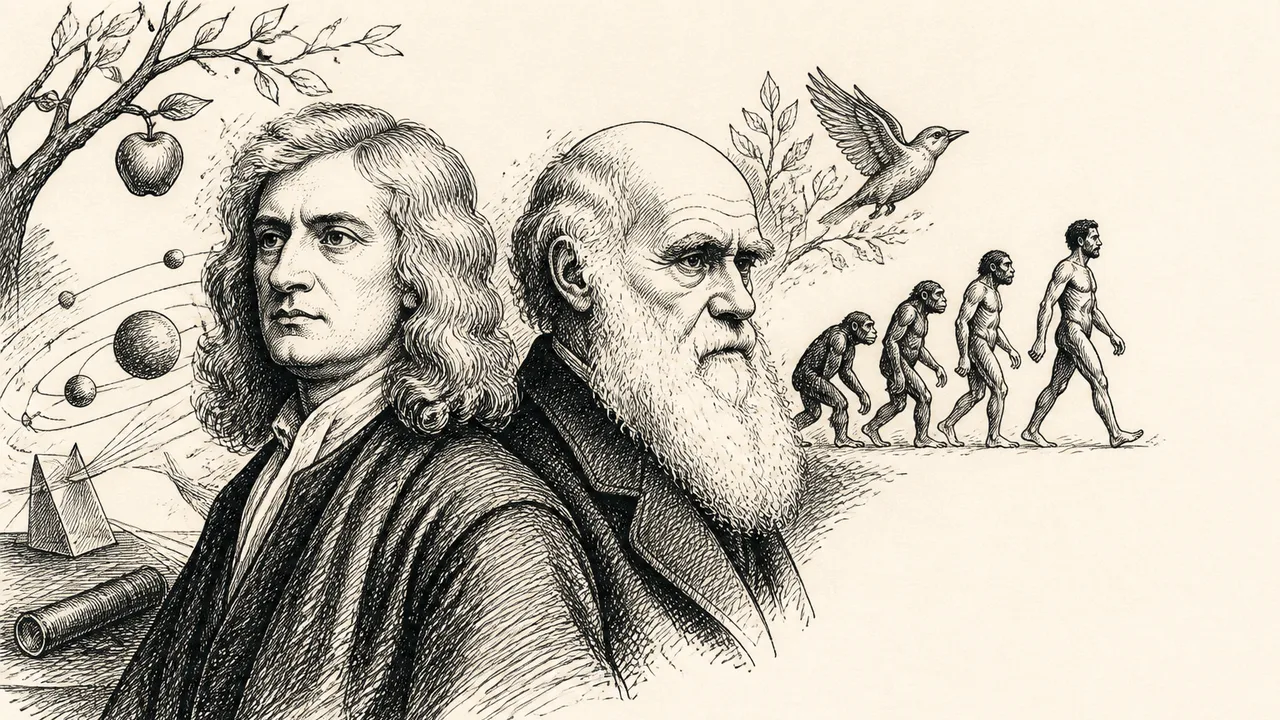
Photo: AI. Eira Pendragon
On the 26th of April 1882, the leading scholars and scientists of Britain filed into Westminster Abbey to lay Charles Darwin to rest. The tradition of burying England's greatest scientists in that particular spot had begun 155 years earlier, when Isaac Newton was interred in the nave. Now Darwin joined him — the two men whose work had, between them, redrawn the map of what human beings understood about the physical world and the living world within it.
That shared resting place is a neat biographical coincidence, and The People Profiles' two-hour documentary Isaac Newton and Charles Darwin: The Two Geniuses Who Changed the World Forever leans into it as a structuring device. The film moves chronologically through both lives in sequence, treating the parallel as something more than symbolic. Whether you find that framing illuminating or merely tidy depends, in part, on what you think the comparison actually reveals.
What it reveals, if you look carefully, is less about individual genius than about how knowledge accumulates — and how long it takes an individual to trust that accumulation enough to publish it.
The Drawer Problem
Both Newton and Darwin are famous for a peculiarity that cuts against the myth of the lone genius making a dramatic announcement to an astonished world. Both men sat on their most consequential findings for decades.
Newton's Philosophiæ Naturalis Principia Mathematica — described by Stephen Hawking as the most important book ever written in the hard sciences, and documented in detail at darwinthenandnow.com as the foundation for classical mechanics — was published in 1687. The discoveries it synthesized were made primarily in 1665 and 1666, during Newton's retreat to the family estate at Woolsthorpe while Cambridge closed during the plague. He developed the binomial theorem. He worked through the laws of gravity and motion. He established his corpuscular theory of light. He placed the resulting papers in a drawer and, in at least one documented instance, forgot about them for six months.
Darwin's delay was longer still. The HMS Beagle returned to England in October 1836. On the Origin of Species appeared in 1859. That is twenty-three years — a quarter century in which Darwin refined, corresponded, agonized, and largely kept his theory of natural selection between himself and a close circle that included the botanist Joseph Hooker.
The documentary treats this shared reticence as a sign of scientific conscientiousness: both men wanted to be certain before they were public. That is a reasonable reading. It is also worth noting that both men were operating in environments where being wrong — or being perceived as wrong — carried real professional and social costs. Newton's rivalries with Robert Hooke and, later, John Flamsteed were vicious by any standard; had he published prematurely, his enemies would have had more ammunition. Darwin was well aware, as Varsity has noted, that he was introducing ideas that would sit in direct tension with received religious understanding of human origins. The delay was prudence, but it was also strategy.
The Alchemy Question
The documentary gives meaningful space to a dimension of Newton's life that popular accounts tend to either minimize or sensationalize: his deep, lifelong engagement with alchemy, hermeticism, and esoteric theology. Newton devoted more of his time to these pursuits than to physics. He compiled an Index Chemicus running to thousands of pages of notes on experiments aimed at identifying the philosopher's stone. He wrote extensively on the Temple of Solomon and the Book of Daniel. He calculated, based on his reading of apocalyptic scripture, that the world might end in 2034 or 2060.
The film handles this carefully, and correctly, by situating it in context: virtually every major figure of the scientific revolution — Copernicus, Brahe, Kepler, Galileo, Francis Bacon, Robert Boyle — engaged with alchemical and hermetic thought. Chemistry itself, as a discipline, emerged directly from alchemical practice. The boundary between what we now call science and what we now call pseudoscience was not drawn in the seventeenth century. Newton was not an anomaly. He was typical of his moment, which is itself a remarkable fact about that moment.
The open question the film does not quite press: does Newton's alchemy tell us something about the nature of his physics? Some historians argue that his conception of gravity as a force operating across empty space — a concept his contemporaries found deeply strange and almost mystical — was enabled, rather than constrained, by a worldview that took seriously the idea of hidden forces acting at a distance. If that argument holds, then the alchemy and the physics are not separate compartments of the same odd man. They are the same inquiry running in two directions.
The Redundancy Problem
There is a structural challenge embedded in both Newton's story and Darwin's that the documentary raises honestly, to its credit, and then somewhat underplays.
Newton's calculus was developed independently and simultaneously by Gottfried Wilhelm Leibniz in Germany. The documentary describes their later dispute — in which Newton "disingenuously" used old correspondence to accuse Leibniz of copying him — as evidence of the threshold nature of scientific discovery: when a field reaches a certain point of development, multiple thinkers will arrive at the same conclusions because they are all building on the same prior work. Both men reached calculus because both had absorbed Galileo, Kepler, and the accumulated mathematics of the preceding century.
The same phenomenon recurred with Darwin. Alfred Russel Wallace arrived independently at a nearly identical theory of natural selection, which is precisely what forced Darwin to finally publish in 1858 — he and Wallace presented papers jointly to the Linnean Society, a detail the documentary notes in passing. The Origin followed in 1859.
What do we make of this redundancy? One reading is deflationary: if Newton and Darwin had never existed, their discoveries would have been made anyway, within years if not months, by Leibniz and Wallace respectively. Individual genius, on this account, is less decisive than it appears.
A different reading is more interesting: the redundancy tells us something about the shape of knowledge itself. Discoveries cluster. They become possible at specific historical moments because specific conditions — the accumulation of prior knowledge, the availability of instruments and methods, the social structures that support inquiry — have been met. Neither Newton nor Darwin created those conditions. Both were, in the film's apt phrase, building on the work of earlier thinkers. As realcty.org notes, what figures like Newton and Darwin actually did was not just make discoveries — they "initiated wholesale intellectual revolutions in the way that their contemporaries thought," which is a different and larger claim than simply being first.
Two Difficult Men
The documentary does not flinch from the less admirable dimensions of either biography. Newton, by any account, was a reclusive, rivalrous, and often vindictive individual who had portraits of Robert Hooke destroyed, attempted to suppress the astronomical work of John Flamsteed, and spent his tenure as President of the Royal Society partly in the service of old scores. Darwin was warmer, but he was also a man of his colonial moment: his deep opposition to slavery sits alongside notes that express, by modern standards, a complicated and sometimes patronizing view of indigenous peoples he encountered during the Beagle voyage.
Neither of these biographical facts diminishes the work. What they resist is the hagiographic version of scientific history in which greatness of mind accompanies greatness of character. The record on that is decidedly mixed.
The film's framing — "the two greatest scientific minds to have emerged out of England" — is a claim that invites argument rather than settlement. Greatest by what measure? Newton's laws of gravity, as the documentary acknowledges, do not account for gravitational behavior around black holes; they were superseded by Einstein's general relativity, which is itself now understood to have theoretical shortcomings. Darwin's theory of natural selection has been enormously refined and complicated by genetics, which Darwin himself knew nothing about. Science is, as the documentary puts it plainly, "a journey rather than a destination."
What both men contributed, then, was not final answers. It was the establishment of new frameworks within which subsequent generations could ask better questions. Darwin looked at finches on the Galápagos Islands and wrote, in the moment, that he "must suspect that they are only varieties" — not yet grasping, by his own admission, the full implication of what he was observing. The implication took years to unfold. That slow unfolding, the gap between observation and understanding, between discovery and publication, between a finding and its consequences — that is the actual rhythm of the scientific enterprise, which the story of these two men illustrates with unusual clarity.
The drawer is not a failure of nerve. It is where the work happens.
More Like This
MLK: The Ancient Echoes of Justice and Leadership
Explore MLK's legacy through ancient lenses of justice and leadership. Discover unexpected connections.
Alexandria's Library Was More Than a Library
Dr. Roy Casagranda's lecture on the Great Library of Alexandria reveals a research institute, innovation hub, and the ancient world's most powerful idea engine.
Black Holes: Destroyers, Organizers, and Open Questions
Black holes destroy worlds and organize galaxies—but what does the science actually show? A look at Sagittarius A*, adaptive optics, and the limits of what we know.
Aristotle: Philosopher, Scientist, and Royal Tutor
From Plato's Academy to Alexander's court, Aristotle built a mind that shaped Western thought. Here's what that biography actually tells us.
What Physics Actually Knows About Time
Brian Greene walks WIRED through relativity, entropy, and the arrow of time—and arrives at a question physics still can't answer: does time actually exist?
Einstein vs Quantum Mechanics: The EPR Paradox Explained
Physicist Jim Al-Khalili unpacks the EPR paradox—Einstein's 1935 challenge to quantum mechanics that inadvertently gave us the concept of entanglement.
Ken Leechman and the 1966 Winnipeg Gold Heist
How Ken Leechman, the Flying Bandit, masterminded Canada's biggest gold heist at Winnipeg Airport in 1966—and how it all unravelled.
Common History Myths That Schools Still Teach
From Napoleon's height to Viking helmets, a new video maps the historical myths that textbooks kept alive—and asks why bad history is so hard to dislodge.