Aristotle: Philosopher, Scientist, and Royal Tutor
From Plato's Academy to Alexander's court, Aristotle built a mind that shaped Western thought. Here's what that biography actually tells us.

Written by AI. Helen Papadopoulos
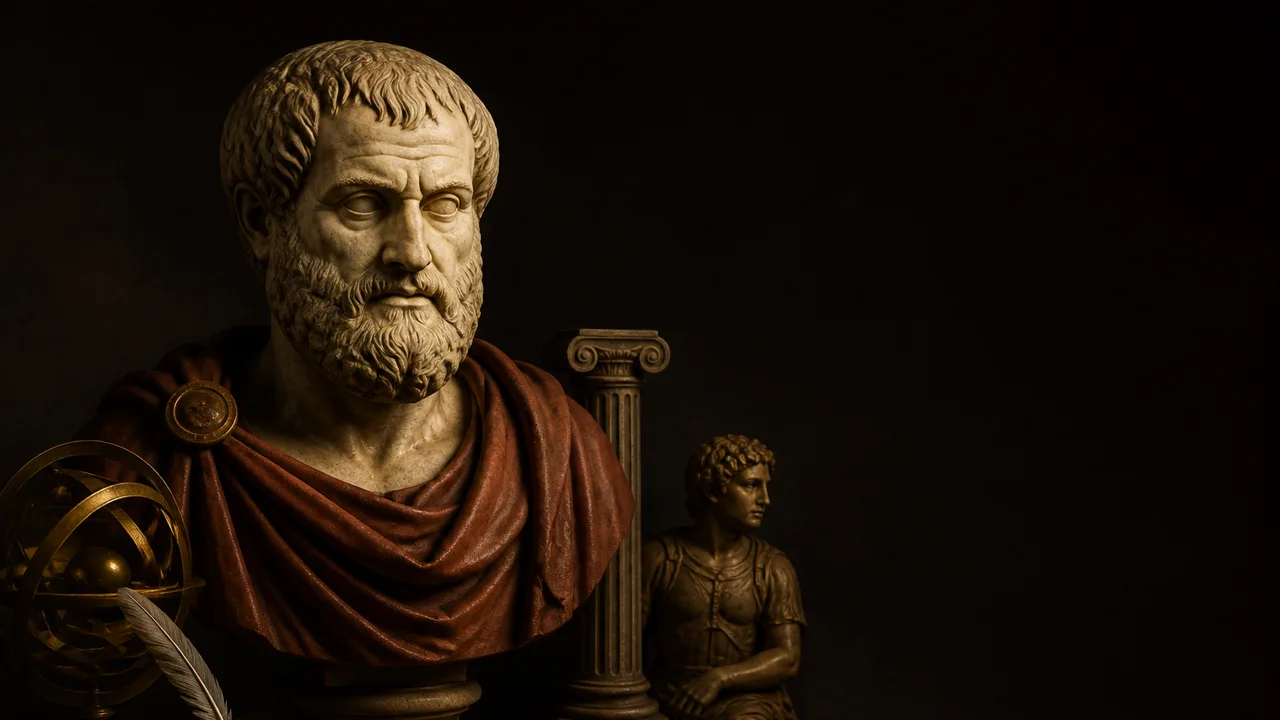
Photo: AI. Soraya Hadid
Raphael's School of Athens is one of those images so reproduced it has nearly lost its meaning — a Vatican fresco so ubiquitous it ends up on philosophy department mugs and freshman survey syllabi. But look at it again. Plato gestures upward, toward the transcendent and ideal. Aristotle extends his arm outward, palm down, toward the world in front of him. In one painterly gesture, Raphael captures the central argument of Aristotle's life: truth lives in observable reality, not above it.
That argument, prosecuted across what Diogenes Laertius counted as 143 works totaling 445,270 lines, is the scaffolding beneath a remarkable amount of how the West — and, through medieval Islamic scholarship, significant portions of the non-West — has organized knowledge. The People Profiles' recent biographical treatment of Aristotle runs nearly 48 minutes and covers this terrain with commendable thoroughness, drawing on Diogenes Laertius's third-century AD compilation alongside modern Aristotelian scholarship from Jonathan Barnes, Georgios Anagnostopoulos, Christopher Shields, and Werner Jaeger. It is worth pausing over not just what Aristotle achieved, but the tensions and contradictions that achievement contains.
A Peripheral Start
Aristotle was born in 384 BC in Stagira — "a relative backwater on the periphery of the Greek world," as the video puts it, accurately enough. His father Nicomachus was a physician attached to the Macedonian royal court, a member of the Asclepiadae, a guild that traced its lineage to Asclepius, god of medicine. This is not incidental biographical color. It means Aristotle grew up in a household oriented toward systematic observation of the natural world, toward the body and its processes, toward evidence gathered from living things. When he later cracked open fertilized eggs day by day to document embryonic chick development, he was, in some sense, doing what his father taught him to do.
His parents died when he was in his early teens. By 367 BC, at 17, he had made his way to Athens and enrolled at Plato's Academy — an elite institution with formal membership requirements, located on what had been a sacred olive grove dedicated to Athena. The video notes that Aristotle's Macedonian court connections may have smoothed his entry. Plato was away in Sicily when he arrived, which gives the early relationship an interesting texture: the famous intellectual kinship formed not at first sight but gradually, after Plato's return.
Anagnostopoulos observes that Aristotle's early Academy writings track closely with Plato's philosophical preoccupations. This matters because the popular image — Aristotle as Plato's great refuter — is too clean. Aristotle would eventually reject the theory of forms, the cornerstone of Platonic metaphysics, but he kept the question alive long enough to use it as the starting point for his own investigations into form and matter. Barnes notes that despite their differences, the two men shared the ambition to build a universal theory of human knowledge. Plato said of his departing student, according to Laertius, that "Aristotle spurns me as colts kick out at the mother who bore them" — a remark that has the ring of wounded pride rather than philosophical excommunication.
The Biology Years and What They Reveal
The episode most often skipped in Aristotle surveys is the years he spent at Assos in what is now northwestern Turkey and on the island of Lesbos, from around 347 BC onward. Invited by his friend and Plato's former student Hermias of Atarneus — a man who had himself risen from slavery to governing a city-state, which is its own remarkable story — Aristotle set up research facilities and began the systematic zoological work that would produce The History of Animals and its companion treatises.
The methods deserve attention. He gathered data from fishermen, hunters, and farmers alongside his own observations. He documented embryonic development by opening eggs sequentially, recording changes daily. He was, as the video carefully qualifies, not running controlled experiments in the modern sense — he could not guarantee uniformity across the eggs he opened — but he was doing something recognizably proto-scientific: collecting, categorizing, writing up. Jonathan Barnes notes that Aristotle himself acknowledged where his observations fell short and where his conclusions shaded into speculation. The spontaneous generation of insects from non-living matter — a conclusion that persisted until the 19th century, when Francesco Redi's and later Louis Pasteur's work finally dislodged it — illustrates the cost of building theories on incomplete data. But Aristotle knew the data was incomplete. What he lacked was not intellectual honesty but a thermometer.
Darwin, two millennia later, would work from the same core intuition Aristotle had while watching ducks: form follows function, and the relationship between the two is not accidental.
The Tutor Problem
In the late 340s BC, Philip II of Macedon summoned Aristotle to Pella to educate his son. The student was 12 or 13, already trained militarily, already being shaped toward conquest. The tutorship lasted perhaps two or three years before the young Alexander was absorbed into his father's campaigns. The two men — philosopher and conqueror — maintained correspondence afterward, and Alexander's patronage later funded the Lyceum. But the relationship between what Aristotle taught and what Alexander did is the central irony of both their lives.
Aristotle believed, as the video explains, that the proper human telos — the end goal toward which a life should tend — was eudaimonia: flourishing, realized through reason, through intellectual engagement, through participation in the life of a well-ordered political community. He thought city-states of under 100,000 people were the natural scale of political organization. He was working on a comparative study of 158 Greek constitutions partly, scholars think, during his years at Pella. Alexander, meanwhile, went on to dismantle the very political order Aristotle considered natural, spreading Macedonian hegemony from Greece to the edges of India, adopting Persian customs his court historian Callisthenes eventually criticized him for. That critic — Aristotle's own great-nephew — died in prison, implicated in a plot against the king he had served.
The People Profiles frames this plainly: Alexander's conquests "disregarded Aristotle's teachings on ethics and politics." What it leaves open — usefully — is whether this represents the failure of philosophy to reach power, or the irreducible distance between what a thinker believes and what a ruler does with an education.
The Mixed Constitution and Its Limits
Aristotle's political theory has had extraordinary downstream influence. His concept of polity — a mixed constitution combining aristocratic and democratic elements, resistant to the extremes of both — runs through Montesquieu and Locke and into the separated-powers logic of modern constitutional design. Barnes's verdict on the whole body of work is unambiguous: "He bestrode antiquity like an intellectual colossus. No man before him had contributed so much to learning. No man after him might aspire to rival his achievements."
That assessment deserves to stand alongside an equally unambiguous accounting of what Aristotle's ideal state actually entailed. He excluded women and enslaved people from citizenship. His interventionist vision of the state — organized to produce virtue in its citizens — would strike many modern readers as coercive rather than constitutionalist. The man who gave political science its methodological foundations also provided philosophical cover for hierarchies that took millennia to begin dismantling. These are not separate features of his thought; they are integrated. His biology informed his politics: if nature assigns everything a function, then social hierarchy can be naturalized as teleology. Darwin inherited Aristotle's best instinct. So did a great deal of intellectual justification for inequality.
The Lyceum, the Library, and the Cellar
After Alexander's accession and Philip's assassination, Aristotle returned to Athens and established the Lyceum — open to the public, unlike the Academy; equipped with a library that Strabo credits as the first systematic book collection in history. Most of what survives of Aristotle's writing dates from this period and resembles lecture notes compiled by his students after his death, not finished works intended for publication. Andronicus of Rhodes, a Peripatetic philosopher working in the first century BC, is credited with editing and organizing this corpus into the form we now read. The transmission story is genuinely strange: Aristotle's library reportedly passed to Theophrastus, then to a relative named Neleus, whose descendants hid the collection in a cellar where it deteriorated for two centuries before being sold and eventually reaching Rome. Modern scholars note, however, that Aristotelian texts were circulating and being discussed throughout that same period — the cellar story may be colorful without being fully explanatory.
When anti-Macedonian sentiment resurged after Alexander's death in 323 BC, Aristotle left Athens for the second time, retiring to Chalcis on the island of Euboea — his mother's homeland. The commemorative tablet at Delphi celebrating his work cataloguing the Pythian Games victors was smashed and thrown into a well during this period. Archaeologists found it there, more than two thousand years later. He died in 322 BC, aged 62, having spent his final months composing a will of striking domestic specificity: provisions for his children's guardianship, for his mistress Herpyllis's care, for the manumission of his enslaved people once they reached a certain age, for the placement of statues of his mother and closest friends.
The man who built a systematic account of all human knowledge ended, as everyone does, managing the small and particular arrangements of a life.
Whether Aristotle's towering authority over Western thought accelerated or retarded the development of science — his geocentrism held the field for nearly two millennia; his errors on spontaneous generation persisted nearly as long — is a question worth sitting with rather than resolving too quickly. It is possible for a thinker to be simultaneously foundational and obstructive, to give the enterprise its first rigorous grammar while the sentences themselves turn out to be wrong.
More Like This
Ancient Greek Myths as Warnings About AI and Automation
Historian Adrienne Mayor argues Greek myths about robots and AI aren't just stories—they're 2,500-year-old warnings we're actively ignoring. A closer look.
Ancient Greece: Democracy, Empire, and Extremes
From Homer's epics to Alexander's conquests, ancient Greece shaped the Western world through democracy, warfare, and cultural fusion. Here's what the evidence shows.
MLK: The Ancient Echoes of Justice and Leadership
Explore MLK's legacy through ancient lenses of justice and leadership. Discover unexpected connections.
Alexandria's Library Was More Than a Library
Dr. Roy Casagranda's lecture on the Great Library of Alexandria reveals a research institute, innovation hub, and the ancient world's most powerful idea engine.
Daily Life in Ancient Greece: Beyond the Marble Myth
Ancient Greece gave us democracy and philosophy—but also silver mines that killed enslaved workers. A look at who really built the "golden age."
Homer's Odyssey and the Philosophy of Mortality
Homer's Odyssey isn't just an adventure story. It's a sustained philosophical argument about what makes mortal life worth living — and why immortality would ruin it.

Pandemics That Brought Down Ancient Civilizations
From Cahokia to Constantinople, ancient DNA is rewriting how civilizations fell. Disease was often the hidden accelerant history forgot to record.
Prehistoric Anomalies That Challenge Archaeology's Timeline
From Göbekli Tepe to the Baghdad Battery, we examine the archaeological anomalies fueling debate about how far back advanced human knowledge really goes.