Prehistoric Anomalies That Challenge Archaeology's Timeline
From Göbekli Tepe to the Baghdad Battery, we examine the archaeological anomalies fueling debate about how far back advanced human knowledge really goes.

Written by AI. Helen Papadopoulos
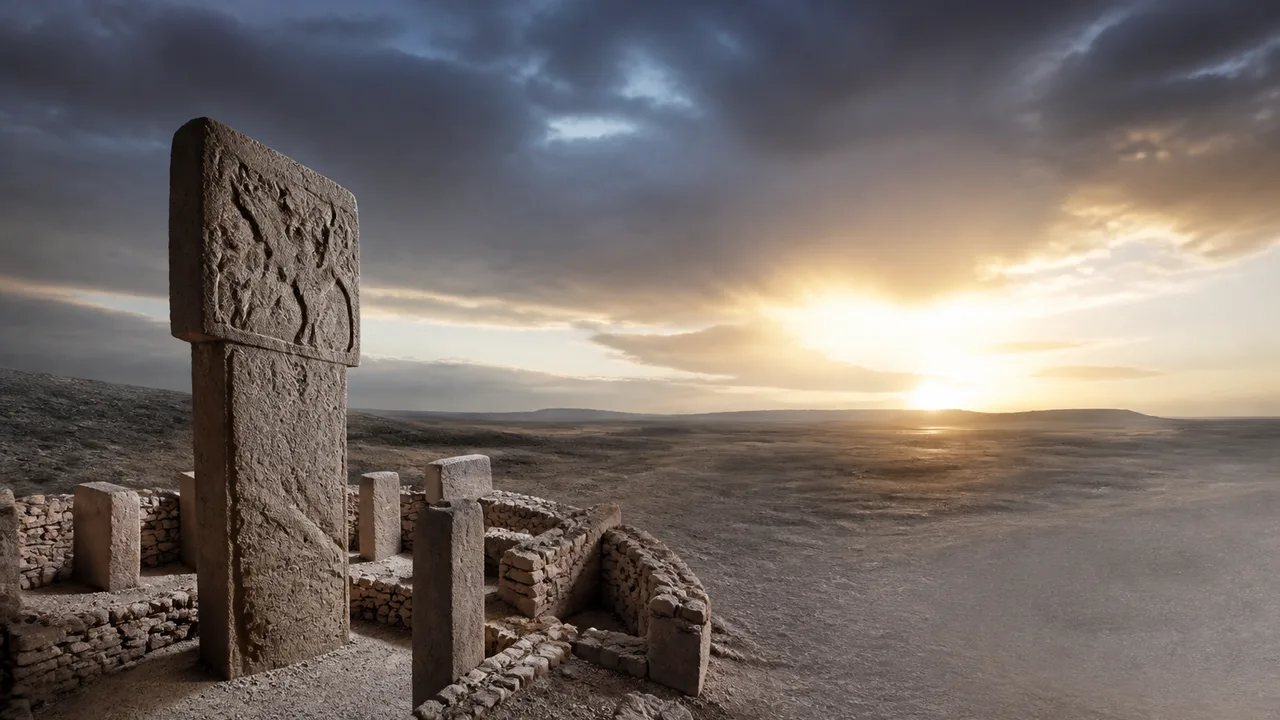
Photo: AI. Hayden Cross
There is a particular genre of ancient-history content that has perfected the art of sounding like a suppressed Ph.D. dissertation while functioning as something closer to a ghost tour. Prehistoric Joe's recent video, 12 Theories About Prehistoric Civilizations That Scientists Can't Publish, runs forty-nine minutes and covers terrain that stretches from the Bolivian Andes to the bottom of the Pacific Ocean. It is, depending on your priors, either a serious catalogue of anomalies the discipline is too hidebound to address, or a skillfully assembled greatest-hits of fringe archaeology. Possibly both. That ambiguity is exactly what makes it worth examining carefully.
Let me be direct about method before anything else. The video operates on a rhetorical structure that archaeology-adjacent YouTube has refined to a gleam: present a genuine puzzle, note that mainstream experts offer an unsatisfying explanation, invoke a suppressed or marginalized alternative theory, then dissolve into a rhetorical question that leaves the audience feeling the weight of unresolved mystery. The structure is not dishonest in itself — genuine puzzles exist, and mainstream explanations are sometimes inadequate. What it does, systematically, is flatten the distinction between we don't fully understand this yet and the academy is hiding something. Those are not the same claim, and conflating them does a disservice to the real questions buried in the material.
With that flag planted, some of what the video covers is genuinely interesting.
What the evidence actually shows
Göbekli Tepe is the strongest card in the deck, and the video plays it well. Dated to approximately 9,600 BCE, the site in southeastern Turkey consists of massive T-shaped limestone pillars — some weighing 20 tons — arranged in circles and carved with foxes, scorpions, and vultures in confident, detailed low relief. The builders, by every other available indicator, were pre-agricultural hunter-gatherers. No pottery. No metal. No writing. No settled villages in the archaeological record for the region.
This is not fringe. The implications of Göbekli Tepe have been mainstream archaeology news since Klaus Schmidt's excavations began in the 1990s, and the discipline has genuinely grappled with them. The currently favored interpretation — that the desire to build ritual sites may have preceded and perhaps driven the invention of agriculture rather than following from it — is not a suppressed idea. It has been argued in peer-reviewed literature by Schmidt himself and developed at length by researchers including Ian Hodder. The video presents this as forbidden knowledge when it is, in fact, one of the more exciting genuine revisions to have occurred in the field in a generation.
The Younger Dryas impact hypothesis sits in a different category: genuinely contested within mainstream science rather than simply dismissed. Researchers Randall Carlson and Graham Hancock, whom the video prominently features, have argued for years that a comet impact approximately 12,800 years ago triggered the Younger Dryas cooling event, wiped out Pleistocene megafauna across multiple continents, and destroyed a sophisticated precursor civilization. The physical evidence the video cites — nano-diamonds, microspherules, and platinum spikes in a stratigraphic layer called the black mat, found at sites across North America — is real, documented, and published in peer-reviewed journals. The impact hypothesis itself was argued in PNAS as early as 2007. The debate over whether those markers indicate a cosmic impact or have alternative explanations remains genuinely live in the scientific literature. This is not suppression; it is how contested hypotheses actually move through science.
The Channeled Scablands of eastern Washington, also invoked here, have their own instructive history. Geologist J Harlen Bretz proposed in the 1920s that the landscape was formed by catastrophic flooding on a scale that his contemporaries found literally unbelievable. He was right. The floods were real. The establishment resisted for decades and then conceded. That story is, counterintuitively, an argument for the way science eventually works, not against it.
Where the argument strains
Other cases in the video require more skepticism about how the evidence is being handled.
The Dogon and Sirius B story — in which French anthropologist Marcel Griaule documented what appeared to be detailed astronomical knowledge of the white dwarf companion of Sirius among Mali's Dogon people in the 1930s — is compelling on its surface. The video acknowledges the main scholarly rebuttal: anthropologist Walter van Beek re-studied the Dogon in the 1990s and found that most community members had no knowledge of the claims Griaule recorded, and that Griaule's methodology suggested he may have inadvertently shaped the responses he received. The video calls this rebuttal "incomplete," which is fair — the debate in the anthropological literature is genuinely unsettled — but it does not engage with the specifics of van Beek's findings, which are substantial.
Piri Reis's 1513 map, which the video claims depicts Antarctica's ice-free subglacial coastline, is a case where the presentation significantly outpaces the evidence. The claim that U.S. Air Force cartographers in 1960 endorsed the match to seismic surveys of Antarctic bedrock derives from a letter by one officer, Charles Hapgood, whose broader thesis about catastrophic pole shifts is not accepted by geologists. Mainstream cartographic analysis holds that the southern coastline on the Piri Reis map is a distorted rendering of South America, a common feature of early modern maps where compilers were reconciling conflicting and incomplete source charts. The "Air Force endorsement" is frequently cited in alternative history literature; it is substantially less dramatic in context than it appears.
The Baghdad Battery — copper cylinders containing iron rods, sealed with asphalt, found near Baghdad and dated to roughly 2,000 years ago — is a genuinely interesting artifact whose function remains debated. The video is on solid ground noting that filled with an acidic liquid, the assembly generates around 1.1 volts. It is less solid in treating electroplating as the probable use, since no electroplated objects have been found in clear association with the jars. The alternative storage-vessel explanation does have the problem the video identifies: no scroll residue was found. The honest answer is that the function of these objects is uncertain.
Sacsayhuamán — the Inca fortress above Cusco with its precisely fitted polygonal stonework — is presented alongside a claim about a Peruvian priest who allegedly isolated a plant-based liquid capable of softening stone. The video acknowledges the story's thinness: "The work was dismissed. The samples lost, the priest forgotten outside fringe circles." This is accurate. The softened-stone theory is unsourced and unverified, and the video essentially admits it while still deploying the atmospheric weight of the claim. Andean archaeologists have documented Inca quarrying and transport methods in considerable detail; the precision of the stonework is extraordinary, but the engineering explanation — patient shaping by skilled masons over long periods, with careful selection and fitting — is not a shrug. It is grounded in experimental archaeology.
The real question underneath
What the video does usefully, even when its individual claims don't hold weight, is point toward a genuine historiographical problem: the archaeological record is substantially biased toward durable materials in accessible locations. A civilization that built primarily in wood, on coastlines that have since been submerged by post-glacial sea level rise of roughly 120 meters, would be almost invisible to us. The video notes the Yonaguni Monument — a submerged stone formation off the coast of Japan with suspicious right angles and flat terraces — in this context. Mainstream geologists maintain it is natural sandstone fracturing; Japanese geologist Masaaki Kimura has argued for decades that it shows evidence of human modification. The debate is unresolved.
"Either the Dogon were taught by someone who already knew," the video argues at one point, "or human history contains a channel of knowledge that runs underneath the official record, quiet and unbroken, carrying answers to questions the rest of us hadn't learned to ask yet."
That framing — the hidden channel of knowledge — is the video's organizing myth, and it is worth examining for what it assumes. It treats the absence of a conventional explanation as evidence for an unconventional one. Archaeology is the science of absence as much as presence; what we don't find tells us something, but not always what the alternative history genre wants it to tell us.
The more durable version of the question is simpler and more verifiable: how much have we missed because we weren't looking in the right places, at the right depths, through the right frameworks? Göbekli Tepe itself was visible from the surface for decades before anyone understood what they were looking at. The first archaeologists to examine its pillars assumed they were medieval.
The discipline has been wrong before about when things began. It will be wrong again. The productive response to that uncertainty is more careful archaeology, not the substitution of mystery for method.
More Like This
WW1 Trench Life: What the Western Front Was Really Like
From Pals' Battalions to the Vickers gun, a new documentary unpacks the grim machinery of survival on the WW1 Western Front in unflinching detail.

Secret Societies: Power, Myth, and Who Gets to Write History
From the Carbonari to Skull and Bones, ten secret societies reveal how influence actually works — and who gets to decide what's real.
Ancient Megastructures That Still Puzzle Engineers
From Göbekli Tepe to the Great Pyramid, these ancient sites raise genuine questions about what early human societies were capable of building—and how.
Asherah: Was She the Wife of the God of Israel?
Inscriptions, figurines, and Ugaritic myth suggest ancient Israelites worshipped a goddess alongside Yahweh. The evidence is real. The debate is very much alive.
What Rocks Know That Scientists Forgot
Earth scientist Anjana Khatwa argues indigenous knowledge and geology tell the same stories. Mei Zhang on why that matters—and who decides which stories count.
Waco Siege: Ancient Echoes in Modern Tragedy
Explore the 1993 Waco siege through the lens of ancient cult dynamics and modern law enforcement challenges.
Bank Cards Are Built From Cold War Spy Tech
From CIA security passes to a Soviet bug hidden in a wooden seal, the technology inside your bank card has a wilder history than you'd expect.
Casa del Desierto: Barstow's Forgotten Harvey House
Barstow's Casa del Desierto is a stunning 1911 Harvey House in the Mojave Desert—and one of America's least-visited Amtrak stations. Here's why it still matters.