Genghis Khan: Rise, Conquest, and Contested Legacy
From orphaned steppe child to ruler of history's largest empire—Genghis Khan's life raises questions about violence, genius, and what conquest actually builds.

Written by AI. James Morrison
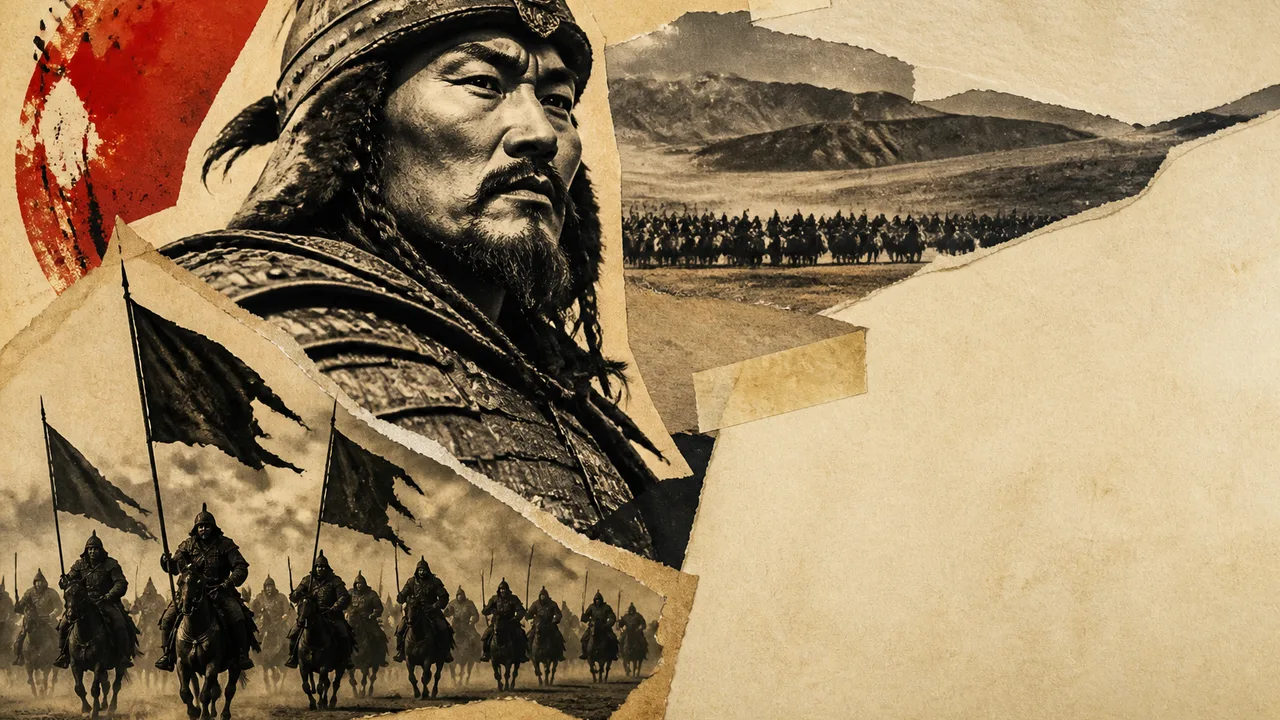
Photo: AI. Wren Sugimoto
Every military commander in history has a founding wound. For Temüjin—the boy who would become Genghis Khan—it came at age nine, when his father was poisoned by Tatars on a road in the Central Asian steppe. The clan promptly abandoned the family. His mother, Hoelun, held the household together through a brutal northern winter with no male protector and no patron clan. That abandonment appears to have done something specific to the boy: it made him allergic to dependency, contemptuous of inherited loyalty, and convinced that security could only be built—by force, by cunning, or by both simultaneously.
The Biographics video on Genghis Khan, hosted by Simon Whistler and written by Steve Theunissen, traces this arc from the steppes to the largest contiguous land empire in human history. It is a useful introduction to the subject, and it raises—without always resolving—the central tension that still animates scholarship on the man: was Genghis Khan primarily a destroyer, or did the destruction produce something that wouldn't otherwise have existed?
The Making of a Commander
The historical record for Genghis Khan's early life rests almost entirely on a single source: The Secret History of the Mongols, written shortly after his death in 1227. That provenance matters. It is a court document, produced by people with reasons to mythologize. The story of a blood clot in his fist at birth—interpreted as a portent of greatness—tells us more about how his followers wanted to remember him than about the delivery room on the steppe. Historians work with it anyway, because it's largely what there is.
What the Secret History describes is a childhood that reads less like mythology and more like a survival manual. As Vedantu's biographical overview notes, Genghis Khan received no formal education—his learning came entirely from tribal life: horsemanship, archery, hunting, and the practical arithmetic of alliance and betrayal. At thirteen, he killed a half-brother who snatched a fish from his hands. At fifteen, he was the dominant figure among his siblings. At sixteen, he turned his wedding gift—a sable coat from his new wife Börte's father—into a political instrument, riding to a neighboring clan chief named Toghrul and presenting the coat as tribute to purchase military alliance.
That coat episode is worth pausing on. It is a nineteen-syllable MBA in steppe politics: identify who holds power, find what they value, give it to them before they ask. Genghis was still a teenager. He had no army, no land, no inherited position. What he had was an unusually clear-eyed read of what other people wanted—and the discipline to subordinate his own immediate interests to longer strategic goals.
The Military Architecture
The army Genghis ultimately built did not emerge from inspiration. It emerged from defeat. When his former blood-brother Jamuka—the relationship severed somewhere around 1185, likely by a combination of personal ambition and the jealousy of Genghis's wife and mother—attacked Genghis's camp with devastating speed, the Mongol chieftains Jamuka captured were tortured and boiled alive. The video's account of Genghis's response to this humiliation is revealing: he did not immediately retaliate. He recognized that his force wasn't ready, and he spent the intervening years building one that was.
The result, according to a military strategy analysis via Edubirdie drawing on Arizona State University scholarship, was an army that could average 70 miles per day on the march and weaponized terror as a deliberate operational tool. "Genghis Khan used terror as a weapon," the analysis notes, "often annihilating entire cities to instill fear in others." The video frames this the same way: attack one enemy with overwhelming brutality so the next enemy surrenders without a fight. In modern military doctrine, this is called shaping the operational environment. In the 12th century steppe, it looked like genocide.
The psychological warfare dimension is perhaps the most tactically sophisticated element of his approach. History is Now Magazine describes his campaigns as "marked by strategic brilliance, adaptability, and psychological warfare that left lasting imprints across continents." The Biographics video puts it plainly: many thousands of his enemies simply surrendered rather than face the carnage that resistance promised. Terror, applied correctly, is economical. It saves the attacker the cost of the battle.
None of this should be read as admiration. Economy of force in service of conquest still produces mass death. The Khorasan campaign—launched after a Shah's forces murdered Genghis's envoys, which he considered an unforgivable violation of diplomatic immunity—unleashed what the video calls "years of savage butchery" on Muslim populations across Central Asia. More than 200,000 men rode west. The toll on civilian populations was catastrophic and, by any measure, constitutes one of the great atrocities of the medieval world.
What Conquest Left Behind
Here is where the historical accounting gets genuinely complicated, and where reasonable people reach different conclusions from the same facts.
The Secret History of the Mongols records the oath sworn to Genghis by his people at the kurultai of 1206, when he was formally proclaimed Great Khan: "We will make you our leader, our Great Khan. We will fling ourselves like lightning upon your foes... if we disobey you, take our flocks and our wives and our children and throw our worthless heads upon the sand." That is the voice of people who have calculated that subordination to one man is preferable to the chaos of perpetual inter-clan war. It is not an endorsement of the methods. It is a desperate pragmatism.
The Biographics video argues—carefully, in its final movement—that Genghis Khan's most durable legacy may be the Pax Mongolica: the period of relative stability across the empire that enabled the first sustained flow of trade and ideas between East and West. The Silk Road, under Mongol protection, carried not just goods but technologies, diseases, and knowledge across a corridor that had previously been too fractured and dangerous for reliable transit. The Smithsonian Magazine's coverage of Genghis Khan's cultural legacy engages precisely this question—the tension between the violence of conquest and the cultural exchange it made possible.
Whether that trade network justifies the methods of its creation is a moral question, not a historical one, and it has no clean answer. The cities that were annihilated in Khorasan did not benefit from the Pax Mongolica. The 70 chieftains boiled alive in Jamuka's camp did not live to see the Silk Road flourish. Consequence and cost do not distribute evenly across populations or across time, and historians who collapse that complexity in either direction—pure monster or accidental modernizer—are doing the record a disservice.
The Texture of the Man
What strikes me most in the Biographics account, and what is easy to lose inside the empire-building machinery, is a handful of small moments that resist the myth-making.
When the mountain clan who had sheltered Jamuka betrayed him to Genghis—handing over their patron to save their own skins—Genghis had them all executed. He was, per the video, "shocked by the lack of loyalty" to his old friend. The man who had built his empire partly through coercion was genuinely offended by coercion's logical product. He then offered Jamuka a pardon. Jamuka refused, asked to be killed, and Genghis granted him a death inside a carpet—a method that avoided the shedding of noble blood. Genghis turned away and could not watch.
That is not the gesture of a man without interior life. It is also not exculpatory. Complicated does not mean redeemable. It means human—which is, ultimately, what military history keeps insisting on, no matter how large the army or how vast the empire: these events were made by people, not forces.
Genghis Khan died in August 1227, having fallen from a horse during a campaign against the Tangut people. He was at the head of 180,000 warriors when it happened. His grandson Kublai Khan would later extend the empire across two continents, making it the largest in recorded history. The blueprint was Genghis's. The question of what to do with that blueprint—how to hold it, how to judge it, how to remember it—remains genuinely open.
More Like This

LIDAR Is Rewriting What We Know of Ancient Cities
Anthropologist Luke Caverns is planning the largest LIDAR scan ever done in the Amazon. What the technology finds may force a rewrite of ancient history.

Unraveling Rome's Dodecahedron Mystery
Exploring the enigmatic Roman dodecahedron, its theories, and historical significance in modern archaeology.
Unveiling the Intricate Engineering of Runways
Explore the hidden complexities of runway design and how these choices impact safety and military operations.
Ancient Greece: Democracy, Empire, and Extremes
From Homer's epics to Alexander's conquests, ancient Greece shaped the Western world through democracy, warfare, and cultural fusion. Here's what the evidence shows.
McClellan's Civil War Failure and the Cost of Hesitation
George McClellan built the finest army America had seen — then refused to use it. What his hesitation cost the Union, and what it still costs us today.
Queen Caroline's Arthurian Gambit and the Politics of Myth
In 1735, Queen Caroline built Merlin's Cave to tie the Hanoverian dynasty to Arthurian legend. The stakes were more than symbolic—they were strategic.
Gettysburg's Command Failures and What They Still Cost Us
Dr. Roy Casagranda's Gettysburg lecture reveals how four command archetypes from 1863 shaped the battle's outcome—and what they still tell us about military leadership today.
The Arab Revolt and the Ottoman Collapse of 1916
How British strategy, Russian pressure, and Sharif Hussein's ambitions combined in 1916 to fracture Ottoman power across the Middle East.