The Arab Revolt and the Ottoman Collapse of 1916
How British strategy, Russian pressure, and Sharif Hussein's ambitions combined in 1916 to fracture Ottoman power across the Middle East.

Written by AI. James Morrison
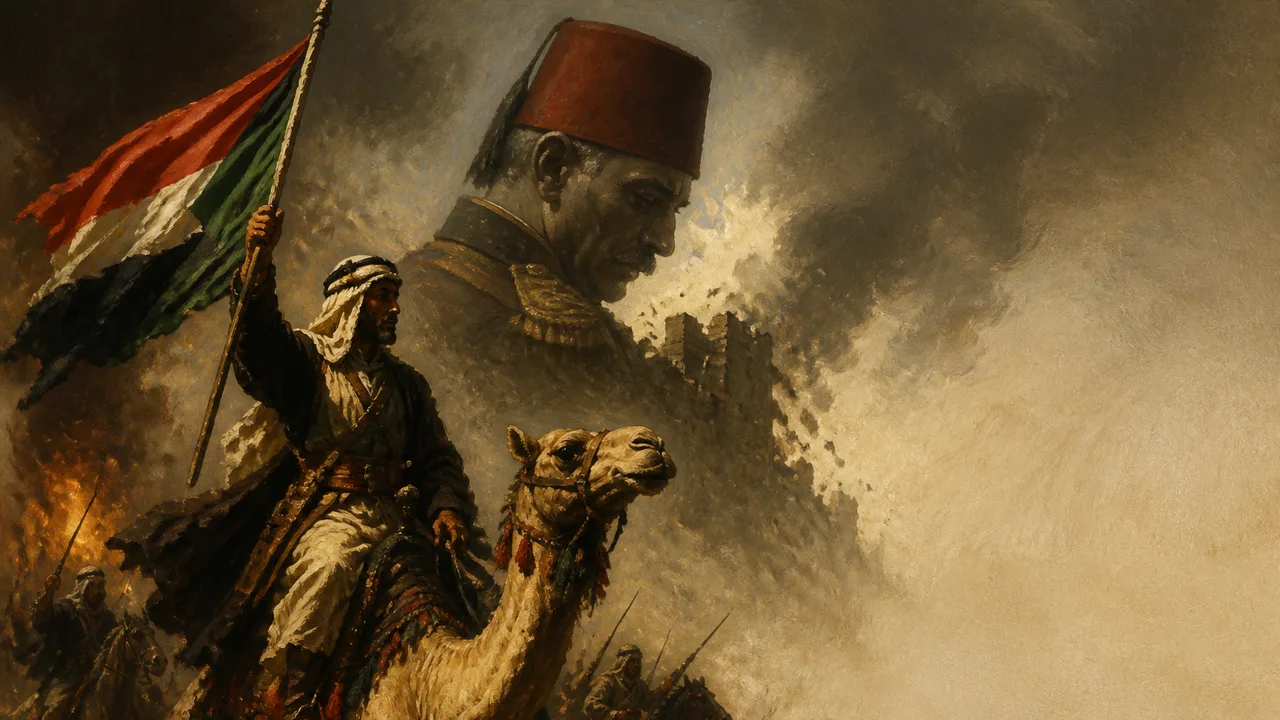
Photo: AI. Henrik Solberg
There is a particular kind of military crisis that doesn't announce itself with a single catastrophic defeat. It arrives as accumulation — front after front going soft, logistics fraying, allies wavering, and the strategic reserve already committed somewhere else. By mid-1916, that was precisely the condition of the Ottoman Empire, and the Kings and Generals documentary series has produced a tightly argued episode tracing how three simultaneous pressures — Russian advances in the Caucasus, British recovery in the Sinai, and the eruption of the Arab Revolt in the Hejaz — converged to crack an empire that was already running on borrowed time.
The framing matters. This was not the story of one decisive battle that "lost" the Middle East. It was the story of an empire being slowly bled from three directions at once, with no strategic depth left to absorb any of them.
The Weight Britain Carried into 1916
The episode is honest about where Britain stood entering 1916. Gallipoli had been a humiliation. The surrender at Kut — where an entire British-Indian force capitulated to Ottoman forces in April 1916 — was the kind of defeat that generates parliamentary inquiries and reshapes careers. As the Kings and Generals script puts it, "both of these defeats cost many lives and justified two official inquiries, prolonging the great war."
What's worth dwelling on here is the institutional psychology that follows such losses. Militaries that have just been embarrassed do one of two things: they become conservative and risk-averse, or they go looking for asymmetric options — ways to bleed the enemy without committing to another frontal catastrophe. Britain did both simultaneously. In the Sinai, General Sir Archibald Murray built a methodical, logistics-first advance anchored by a railway and water pipeline extending at roughly fifteen miles per month. Nothing glamorous. Everything sustainable. In the Hejaz, however, British intelligence went searching for a lever.
That lever was Sharif Hussein bin Ali of Mecca.
Hussein's Calculation
The Arab Revolt is often narrated through Lawrence's eyes, which is a significant distortion of the record. Lawrence arrived in October 1916. The revolt started in June. Hussein had been in negotiation with the British since July 1915 — a ten-letter exchange with High Commissioner Sir Henry McMahon in which the British pledged recognition of Arab self-determination and Hussein pledged 100,000 troops.
What the Kings and Generals account surfaces, without belaboring it, is that Hussein's motivations were not simply anti-Ottoman sentiment. He wanted an independent Arab kingdom. He was worried about Ottoman centralization in the Hejaz. He feared, with some justification, that the Young Turks might simply remove him — or worse. His negotiation with the British was not capitulation to a colonial power; it was a calculated political bet by a regional leader who saw an opportunity in the fog of a world war.
The bet carried real risks. By 1915 the Sharifian army numbered around 50,000 men but held only about 10,000 rifles. Hussein and his sons could not, despite presenting themselves as leaders of a pan-Arab movement, coordinate revolts in Syria or Iraq. The movement was powerful within the Hejaz; beyond it, the reach was limited.
On June 10th, 1916, Hussein fired the first shot of the revolt from his palace window. Within days, around 5,000 Arab fighters pressed the fortresses overlooking Mecca. The symbolism was unmistakable, but the military situation was initially uncertain — one hilltop fortress held out for over four weeks, its guns shelling Mecca, shells striking the canopy over the Kaaba itself. It took British-supplied artillery, operated by Egyptian gunners and dispatched from Sudan, to breach the walls and end Ottoman resistance in Mecca by July 4th.
That detail — British guns, Egyptian crews, Arab cause — is a reasonable summary of the entire enterprise.
The Sinai as a Model
While the Hejaz was politically combustible and logistically primitive, the Sinai front operated on an entirely different logic: engineering as strategy. The Ottoman push toward the Suez Canal culminated at Romani in August 1916, where General Murray's Egyptian Expeditionary Force — ANZAC mounted divisions, the 52nd Lowland Division, backed by an armored train, monitors, and aircraft — absorbed the Ottoman assault and then methodically dismantled it.
The numbers from Romani are worth stating plainly. The two-day engagement inflicted roughly 9,000 casualties on the attacking force, with about 4,000 taken prisoner. British casualties ran to approximately 1,200. Those are not the ratios of a desperate defensive action. They are the ratios of a force that had correctly read the ground, positioned its reserves, and waited.
Following Romani, the British advance into Palestine proceeded at the pace of its railway — slow, steady, and nearly unstoppable. By December, the ANZAC Mounted Division had taken Magdhaba, capturing 1,282 Ottoman troops at a cost of 146 British casualties. "The Romani victories opened space for a British advance into Palestine," the Kings and Generals account notes. That understates it. Romani opened the entire southern approach to the Levant.
Lawrence and What He Actually Did
T.E. Lawrence arrived in the Hejaz on October 16th, 1916, by which point the revolt had already seized Mecca, Jeddah, Taif, Yanbu, and roughly 6,000 Ottoman prisoners. He was a British intelligence officer and a very good one, but he was joining a war already in progress.
His contribution, as the documentary frames it, was strategic rather than operational. Lawrence identified Faisal Hussein as the leader who could hold the revolt together, and he made a conceptual argument that the British found initially uncomfortable: don't try to drive the Ottomans from Medina. Attack the Hejaz Railway instead. Keep the Ottoman garrison at Medina isolated and supplied — a drain on Ottoman resources rather than a force that could be released to fight elsewhere. He also pressed London and Cairo hard on material support: gold, weapons, ammunition, specialists. "Empower the Arabs to fight their war," was the substance of his argument.
That argument was not universally welcomed. There was genuine anxiety in London and Cairo about deploying non-Muslim troops onto what they called "the sacred soil of Hijaz." Britain eventually sent approximately 700 Arab Ottoman prisoners of war to join the revolt, alongside Muslim soldiers from French North Africa. It was a compromise shaped as much by political caution as by military logic.
The test came in December 1916, when Ottoman commander Fakhri Pasha led three brigades from Medina toward Yanbu. The Arab defenders built earthworks. Lawrence secured Royal Navy fire support. Aircraft attacked Ottoman flanks. By December 11th, Fakhri's force reached Yanbu's outskirts — and stopped. Illness, malnutrition, naval bombardment, and guerrilla pressure had spent the column before it could deliver a decisive blow. By January 18th, 1917, the Ottomans had retreated to Medina.
The Caucasus: The Forgotten Pressure
The Hejaz and Sinai operations tend to dominate the English-language historiography of this period, partly because Lawrence wrote about his experiences with considerable literary skill. But the Kings and Generals episode gives substantial weight to what was happening simultaneously in the Caucasus, and the scale is striking.
General Nikolai Yudenich's Russian Caucasus Army had taken Erzurum in February 1916, then Trabzon in April, then ground through a brutal summer of counteroffensive and counter-counteroffensive. The late 1916 operations alone left the Russians with approximately 20,000 casualties — and the Ottomans with up to 60,000. The Ottoman Second Army, which was supposed to deliver a decisive Caucasus offensive, arrived two and a half months late because the Baghdad Railway lacked the capacity to move it faster. That logistical failure, unremarkable in isolation, is representative of a systemic problem the Ottomans could never solve: a vast, multi-front war with infrastructure built for peacetime administration.
As the episode notes, "the only thing that could stop the Russians would be an internal crisis." That internal crisis — the February Revolution — was fourteen months away. Until then, the Ottoman eastern front was slowly collapsing under Russian pressure that no number of Gallipoli veterans could fully reverse.
What 1916 Actually Settled
The Kings and Generals treatment is at its most useful when it shows these three theaters not as separate stories but as a single strategic situation. The Ottoman Empire in 1916 faced simultaneous, sustained pressure from the north, the south, and from within. No single front was individually fatal. Taken together, they constituted a compound fracture.
What the revolt specifically delivered was not the military force to destroy Ottoman power in Arabia — it never had that. What it delivered was disruption, a persistent drain on Ottoman logistics via the Hejaz Railway, and a political signal to the Arab world that Ottoman authority in the Hejaz was no longer secure. "The Arab revolt in Hijaz and the successful defense of Romani had breathed new life into their war effort against the Ottomans," the documentary concludes — and that's accurate, as far as it goes.
The harder question, which the episode gestures toward without fully developing, is what the revolt promised the Arabs in return. The Hussein-McMahon correspondence had pledged British recognition of Arab self-determination. Within two years, the Sykes-Picot Agreement would carve the region into British and French spheres of influence, and the Balfour Declaration would introduce a third complication into the same geography. The men who fired shots at Ottoman garrisons in 1916 were fighting for something specific. Whether they got it is a different story — one that the Middle East has been litigating ever since.
More Like This
Ray Dalio's Framework for Tracking Empire Decline
Ray Dalio argues empires follow measurable, repeating cycles of rise and fall. His framework deserves scrutiny—and raises questions relevant to today's geopolitics.
Medieval England: How Peasants and Guilds Shaped Society
A new documentary traces medieval England's social divide through two real families—one peasant, one guild merchant—and the starkly different worlds they inhabited.
FBI's Struggle Against Omega 7: A Tale of Terrorism and Intrigue
Explore the FBI's complex investigation of Omega 7, a Cuban exile terrorist group, amid community challenges and evolving tactics.
Traveling in Iraq: What American Tourists Find There
Drew Binsky's seven-day Iraq trip with his wife challenges the country's war-zone image—but the full picture is more layered than any single video can capture.
Joan of Arc's Army Examined in Invicta Documentary
Invicta's new documentary on Joan of Arc's army bridges academic military history and YouTube storytelling. Harry Goodman examines what that translation costs and earns.
Belzoni's Tomb: The Strongman Who Found Seti I
Giovanni Belzoni was a circus strongman who became Egypt's greatest explorer. His 1817 discovery of Seti I's tomb rewrote what we knew about the ancient world.
Sun Tzu's Brutal First Lesson and the Real Art of War
A new documentary examines the palace courtyard execution that launched Sun Tzu's career—and asks whether we've been misreading The Art of War for 2,000 years.
Benedict Arnold: Patriot, General, Traitor
Benedict Arnold won the Battle of Saratoga then betrayed his country. A new documentary examines the grievances, ambition, and political failures that made both possible.