Queen Caroline's Arthurian Gambit and the Politics of Myth
In 1735, Queen Caroline built Merlin's Cave to tie the Hanoverian dynasty to Arthurian legend. The stakes were more than symbolic—they were strategic.

Written by AI. James Morrison
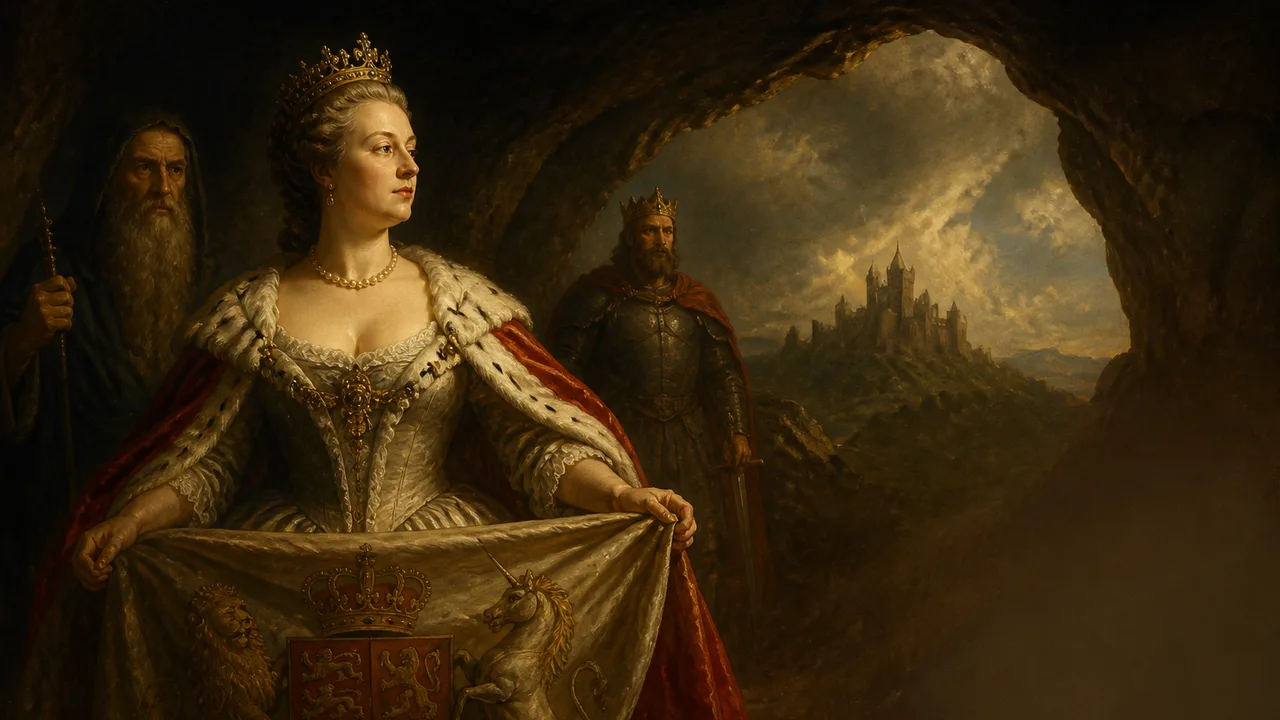
Legitimacy is not a philosophical concept when you are trying to hold an army together. It is operational. An officer corps that quietly doubts the crown's right to issue orders is a fractured instrument before the first shot is fired. A population that views the monarch as a foreign imposition does not conscript eagerly, does not pay taxes willingly, and does not grieve its battlefield dead as sacrifices for the realm. These are not abstractions. They are the load-bearing walls of military power, and in the Britain of the 1730s, those walls had cracks.
The House of Hanover had held the British throne for just over two decades when Caroline of Brandenburg-Ansbach, Queen consort to George II, commissioned a peculiar garden structure on the grounds of Richmond Park in 1735. It was called Merlin's Cave—a thatched, gothic-inflected grotto populated with wax figures, including the wizard Merlin himself alongside figures drawn from Arthurian and British literary tradition. To a modern eye it reads as eccentric royal whimsy. Looked at through the lens of strategic communication, and through the particular anxieties of a dynasty that many Britons still considered illegitimate foreign occupants, it was something considerably more purposeful.
The Problem Caroline Was Actually Solving
The Hanoverian succession of 1714 resolved a constitutional crisis—it did not erase a political one. The Act of Settlement had bypassed dozens of Catholic claimants with stronger genealogical cases in favor of the Protestant Sophia of Hanover and her heirs. When Sophia died weeks before Queen Anne, her son George I inherited the throne. The Jacobite movement—committed to restoring the Stuart line—was not merely a nuisance; it was a sustained military threat. The '15 rebellion had tested the new dynasty's hold on Scotland and the north of England. The '45 would come close enough to genuinely alarm London. Between those two events, Caroline was working.
The question of whether George I could even communicate adequately with his own ministers added texture to the problem. The History of Parliament has examined the received wisdom that George I was linguistically isolated from his English subjects, noting that the reality was more complex—he had functional English, and conducted governmental business in Latin and French with ministers—but the perception of a king who could not speak to his people in their own tongue was itself a political liability that no official clarification could fully neutralize. Perception, in the business of legitimacy, often outweighs record.
Caroline understood this. Born in Brandenburg-Ansbach in 1683 and raised in the Protestant courts of central Europe, she was by any measure a formidable political mind. She had navigated the court of Frederick I of Prussia, turned down a marriage proposal that would have required her to convert to Catholicism—a decision that carried real dynastic risk—and managed the volatile relationship between George II and his chief minister Robert Walpole with enough skill that Walpole reportedly said the king's decisions were often hers. She was not a woman who built garden follies for decoration.
What Caroline faced, in structural terms, was the challenge of making a German royal house feel ancient on British soil—to graft a new dynasty onto an existing root system of national identity. According to Smithsonian Magazine, the answer she reached for was Arthurian legend—specifically the figure of Merlin, whose prophecies in the medieval tradition had long been interpreted as foretelling the rightful rulers of Britain. To place Merlin in a royal garden was to place the dynasty inside Britain's oldest legitimizing narrative.
What the Cave Was Saying
Arthurian mythology had been deployed as political infrastructure before. The Tudors had used it aggressively—Henry VII named his firstborn son Arthur, a gesture so transparent it bordered on parody, and the legend of a returning once-and-future king had been weaponized by various factions across centuries of English political struggle. Caroline was working within a well-established tradition. But the specific context of 1735 gave Merlin's Cave its particular charge.
The Jacobite threat meant that the question of rightful succession was not academic. Every time a pamphleteer argued that the Stuarts were the legitimate heirs and the Hanoverians were usurpers, the argument carried implicit military implications: that soldiers were serving a false king, that oaths of loyalty were misdirected, that rebellion was not treason but restoration. Against that framing, the Arthurian move was shrewd. It did not engage the genealogical argument directly—a fight the Hanoverians could not cleanly win—but instead relocated the question of legitimacy from bloodline to destiny. Merlin's prophecies said Britain's true rulers were those whom history had chosen. Here, implicitly, was the dynasty history had chosen.
As The Conversation notes, the project also demonstrated that Caroline's opponents read the message clearly enough to mock it—the satirical responses to Merlin's Cave indicate that contemporary audiences understood exactly what was being attempted. That the cave attracted parody is not evidence of failure; it is evidence of legibility. Political satire is, in its way, a form of acknowledgment. You do not parody what you find insignificant.
Myth as Strategic Infrastructure
The military stakes here deserve direct statement rather than implication. Between 1715 and 1745, the British state faced two serious armed Jacobite challenges. Military planning in that environment was inherently complicated by political uncertainty—the loyalty of Scottish regiments, the reliability of Protestant northern English militias, the question of whether a push toward London could fracture the government coalition. A dynasty that could not project confident legitimacy was a dynasty that could not project confident military command.
Merlin's Cave was not a barracks or a warship. But it operated in the same system. It was part of the apparatus by which the Hanoverian crown maintained the psychological conditions under which its military authority could function. Image management of this kind is not separate from strategy; it is strategy, operating at the level of public consent rather than at the level of troop deployment. Caroline was, in effect, working on the home front of a long-running legitimacy conflict—one that had kinetic dimensions every time a Jacobite rebellion mustered.
The Jacobite threat was neutralized at Culloden in 1746, nine years after Caroline's death. But the ideological work that figures like Caroline had done in the preceding decades—the steady effort to make the Hanoverian dynasty feel rooted in British soil, British myth, British history—was part of what made Culloden a military operation rather than a political crisis. By 1745, enough of Britain had accepted the Hanoverian claim that the '45 rebellion could be suppressed as a rebellion rather than accommodated as a contested succession. That outcome was not inevitable in 1735. It was built.
The Pattern Doesn't Retire
Origin myth deployed as strategic communication is not a technique that became obsolete with powdered wigs. In contemporary terms, the most instructive parallel is probably Vladimir Putin's sustained effort to position Russian military action in Ukraine within a civilizational narrative—the claim that Ukrainians and Russians are one people, that Kyiv is the cradle of Russian civilization, that NATO expansion violates a sacred sphere of historical influence. The specifics are different. The structure is identical: a leader under legitimacy pressure reaches for the oldest available story about who we are and where we come from, and uses it to reframe present-day military and political choices as destiny rather than policy.
The practical effect is the same one Caroline was after. If your soldiers believe they are restoring something ancient and rightful, they fight differently than if they believe they are executing a policy choice that could have gone the other way. If your population understands the war as an expression of national essence rather than a decision by fallible leaders, the political coalition holds longer under pressure.
Caroline built a thatched cave with wax figures. Putin funds historians and commissions essays. The delivery mechanism varies. The operational logic—use myth to stabilize the legitimacy that military power requires—has not changed since the first king claimed divine right and needed his infantry to believe it.
What changes, across the centuries, is how clearly audiences can see the mechanism working. Caroline's contemporaries could see it well enough to write satire about it. The question for any given era is whether that recognition is enough to blunt the effect—or whether, as often seems to be the case, people can simultaneously understand that they are being addressed through myth and find themselves moved by it anyway.
More Like This

Ray Dalio's Framework for Tracking Empire Decline
Ray Dalio argues empires follow measurable, repeating cycles of rise and fall. His framework deserves scrutiny—and raises questions relevant to today's geopolitics.

Unraveling Rome's Dodecahedron Mystery
Exploring the enigmatic Roman dodecahedron, its theories, and historical significance in modern archaeology.

FBI's Struggle Against Omega 7: A Tale of Terrorism and Intrigue
Explore the FBI's complex investigation of Omega 7, a Cuban exile terrorist group, amid community challenges and evolving tactics.
The Anaconda Plan Was Right. People Paid for It.
Winfield Scott's Anaconda Plan was strategically vindicated — but the years it took to work were paid for in hunger, death, and bondage by ordinary people.
Unexplained Calls: Echoes from the Past
Explore eerie stories of calls from the dead, their impact on military and emergency responses.
The Bayeux Tapestry: Art, Propaganda, and Conquest
The Bayeux Tapestry tells the Norman Conquest through wool and linen — but whose story is it really? A deep look at history's most famous embroidery.
Gettysburg's Command Failures and What They Still Cost Us
Dr. Roy Casagranda's Gettysburg lecture reveals how four command archetypes from 1863 shaped the battle's outcome—and what they still tell us about military leadership today.
The Arab Revolt and the Ottoman Collapse of 1916
How British strategy, Russian pressure, and Sharif Hussein's ambitions combined in 1916 to fracture Ottoman power across the Middle East.