The Bayeux Tapestry: Art, Propaganda, and Conquest
The Bayeux Tapestry tells the Norman Conquest through wool and linen — but whose story is it really? A deep look at history's most famous embroidery.

Written by AI. David Oyelaran
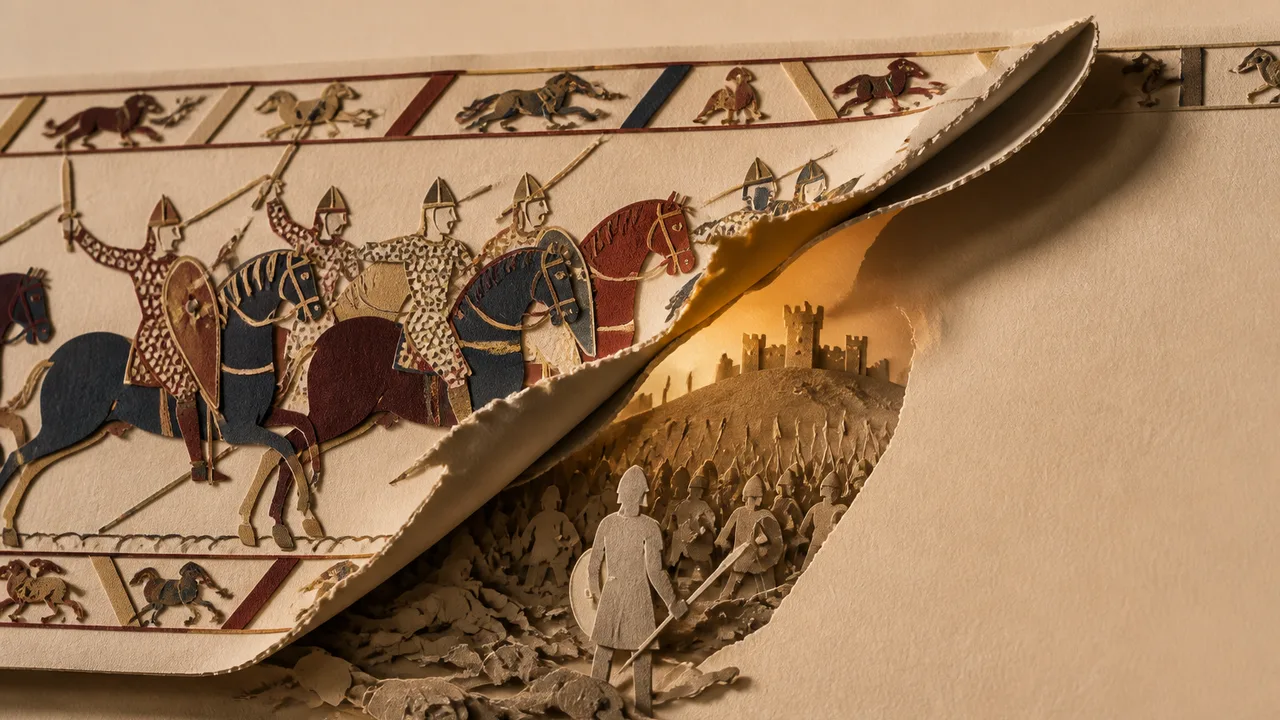
Somewhere in the margins of a medieval manuscript, an anonymous person wrote a lament — grief pressed into borrowed space, small enough to be overlooked, legible only to those who already knew to look. History Today describes it as "a sudden sharp reminder of the time when this manuscript was made, in the troubled aftermath of the Norman Conquest." We cannot know who wrote those words, or what specific event shook them loose. We only know someone felt the need to speak, and found no room of their own to do it in.
That image sits in a particular relationship with the Bayeux Tapestry — which is, in almost every respect, the opposite. It occupies enormous space. It announces itself. It was made by the people who won.
First, the object itself. Despite being universally called a tapestry, it isn't one — technically. As National Geographic notes, what we call the Bayeux Tapestry is actually an embroidery of woolen thread stitched onto linen cloth. The distinction matters less aesthetically than it does historically: embroidery is slower, more deliberate, more personal than woven tapestry. Someone sat with this thing. Many someones, most likely — stitch by careful stitch, for what must have been years.
The result stretches nearly 70 meters, according to the Bayeux Museum, and tells the story of William, Duke of Normandy, who became King of England in 1066 at the end of the Battle of Hastings. History.com describes its scope as spanning nearly the length of a city block, filled with "betrayal, grisly warfare and even a fireball streaking across the sky" — that last detail being Halley's Comet, rendered with remarkable drama for an object whose creators had never heard of comets as anything other than omens.
The narrative arc is not subtle. As Open Culture puts it plainly: the tapestry "commemorates the build-up to and successful execution of the Norman conquest of England in 1066." It begins with Harold, Earl of Wessex, meeting King Edward the Confessor. It tracks his journey to Normandy, where — in the tapestry's framing — he swears an oath of loyalty to William. It ends with Harold's defeat and death at Hastings, and William's triumph. The story is told cleanly, causally, with Harold's oath-breaking as the hinge on which everything turns. William did not conquer England. He retrieved what was promised to him. That is the argument being made in thread.
Who commissioned it? The most durable scholarly proposal points to Odo of Bayeux, William's half-brother and the Bishop of Bayeux. Wikipedia's entry on the tapestry places this within broader scholarly debate, and the question of first display is similarly contested — one widely-held proposal suggests it was shown at the consecration of Bayeux Cathedral, which Wikipedia dates to 1077. These attributions are plausible but not settled.
What's more certain is where the work was likely produced. Most scholars believe the embroidery was made in England — possibly in Canterbury — by Anglo-Saxon craftswomen, working under Norman direction. The irony embedded in that arrangement is considerable: the people whose defeat the tapestry celebrates may well have been the ones who stitched it.
The figures in the margins — animals, fables, scenes that don't quite match the main narrative above — have attracted decades of scrutiny. Some scholars read them as commentary, or even subversion, threaded quietly beneath the official story. Andrew Bridgeford's 2005 book 1066: The Hidden History in the Bayeux Tapestry, referenced in Wikipedia's bibliography, argues for exactly this kind of encoded dissent. Others are less convinced, reading the borders as decorative convention rather than resistance. The record is thin enough that both interpretations remain live.
The tapestry survived the French Revolution — barely, if institutional memory is to be believed. According to the Bayeux Museum's 2022 UNESCO Memory of the World press kit, the tapestry was nearly cut up during the Revolutionary period before someone intervened to preserve it. It spent parts of the 19th century rolled up in storage, studied by antiquarians rather than displayed as a public treasure. Napoleon reportedly borrowed it for propaganda purposes of his own — exhibiting it across France as he prepared his own invasion of England, which never came. The tapestry outlasted him too.
It now lives in a purpose-built museum in Bayeux, Normandy, where it is lit dim and displayed horizontally under glass, and where visitors walk the length of it in a single long room. The experience has a quality that photographs don't capture: the sheer duration of the thing, the way you keep walking and the story keeps going, the way your legs tire before the narrative does.
The questions historians are still sitting with are not small ones. Who are the women in the tapestry — there are a few, named and unnamed — and what do they represent? What happened to the final section? The tapestry ends abruptly; scholars generally believe the last portion was lost, which means we don't have whatever coda the makers intended. Was the ending triumphant? Elegiac? Something in between? We don't know.
And then there's the deeper structural question that National Geographic and History Today both circle: what does it mean that this is the visual record we have? Written sources from the period are fragmentary. The tapestry is coherent, continuous, and compelling — which makes it extraordinarily useful as evidence and extraordinarily dangerous as the primary frame. Its longevity has given its version of events a weight that the absence of competing visual records makes very hard to counterbalance.
The Normans changed not just who ruled England but what language was spoken in its courts, what names its aristocrats carried, how its land was owned and recorded. The tapestry was made in the first generation of that transformation, when the old order was present enough to stitch the cloth and new enough to be told what picture to make.
That anonymous person in the manuscript margins — writing their lament in someone else's book, in a language that would soon lose its official standing — did not get 70 meters of linen. They got a corner. What they wrote has survived anyway, which is either a small miracle or a reminder that survival is not the same as being heard.
The tapestry will outlast most of what we make. But so, tucked quietly beside it in the archive of what remains, will that marginal voice — still asking, in borrowed space, to be counted.
More Like This
Middle Platonism's Hidden Role in Western Esotericism
ESOTERICA's new crowdfunded seminar argues Middle Platonism built the foundations of Hermeticism, Gnosticism, and early Christian theology. Here's what that means.
The Crusades: Two Centuries of Holy War Explained
From Pope Urban II's 1095 call to arms to the fall of Acre in 1291, the Crusades reshaped Christianity, Islam, and the medieval world permanently.
Ancient Maps That Modern Archaeology Proved Accurate
From a Bronze Age rock carving to Ptolemy's coordinates, ten ancient maps have been verified by modern archaeology. What does that tell us about lost knowledge?
Mexico's Radioactive Milk Scandal After Chernobyl
After Chernobyl, Mexico distributed Cesium-contaminated powdered milk to its poorest communities. The families who consumed it left almost no testimony behind.
Mansa Musa: The Emperor Who Crashed Egypt's Economy
Mansa Musa's 1324 pilgrimage to Mecca brought 60,000 people and so much gold it destabilized Egypt's economy. Here's the history most textbooks skipped.
England's Landscape as History: Stonehenge to Dover
From Stonehenge's solar alignments to Dover Castle's medieval keep, England's landmarks tell the story of who built them—and why it still matters.
Cicero and the Fall of the Roman Republic
Marcus Tullius Cicero defended Rome's Republic with words alone—and paid with his life. A look at history's most consequential orator and his impossible political moment.

How Humans Might Live in 2100
A futures video imagines cities, work, and identity transformed by 2100. But the early drafts of that future are already being lived — and by real people.