Gettysburg's Command Failures and What They Still Cost Us
Dr. Roy Casagranda's Gettysburg lecture reveals how four command archetypes from 1863 shaped the battle's outcome—and what they still tell us about military leadership today.

Written by AI. James Morrison
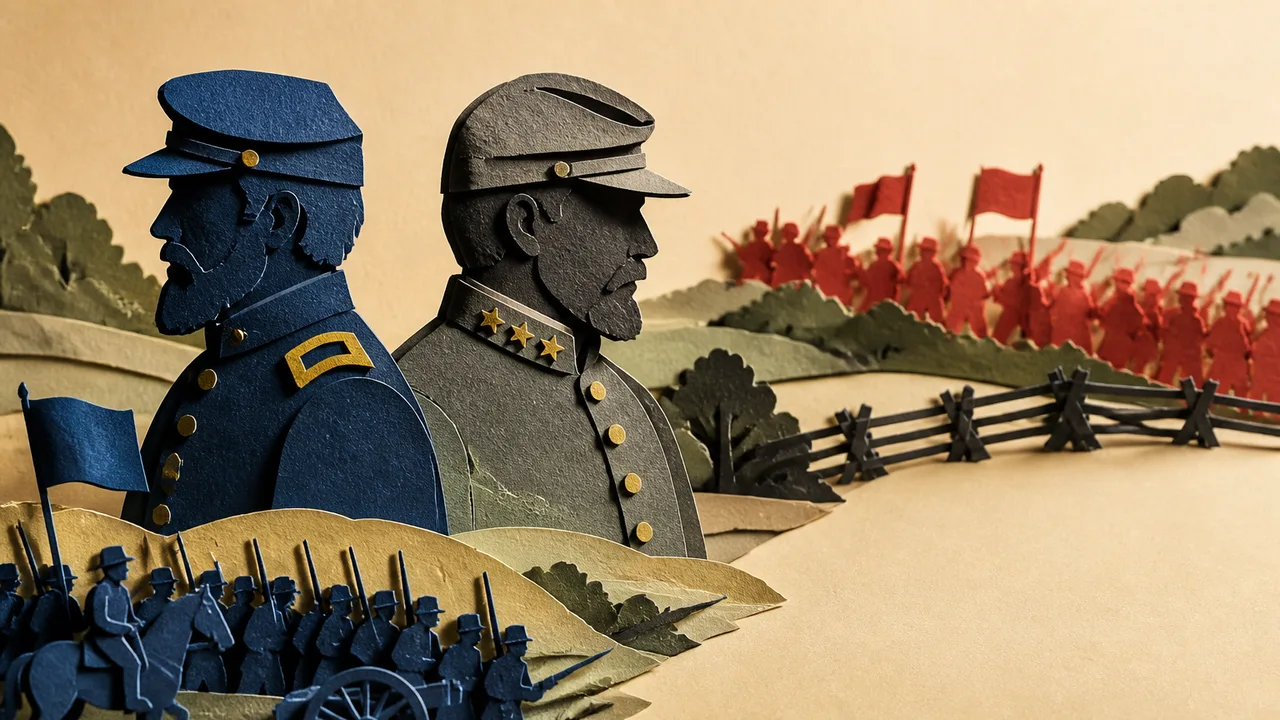
Photo: AI. Lila Bencher
The most useful thing about Dr. Roy Casagranda's lecture on Gettysburg — pulled from his American Civil War course and available as a free preview — is that he doesn't treat it as a story about tactics. He treats it as a story about decisions, and specifically about the kinds of minds that make them under pressure. That distinction matters more than it might seem.
Casagranda walks through all three days of the battle with the comfortable authority of someone who has taught this material long enough to know where the bodies are buried, figuratively and otherwise. He admits his mistakes in real time, corrects himself on which battlefield features belong to which engagement (the cornfield is Antietam; the wheat field is Gettysburg — easy to scramble), and lets the lecture breathe with the kind of digression that makes military history feel like human history rather than a staff ride briefing. The result is something closer to a conversation than a lecture, and it's a better vehicle for the argument he's actually making.
That argument, distilled: Gettysburg was decided less by Lee's audacity or Meade's positioning than by a sequence of individual command decisions — some brilliant, some catastrophically passive — made in a compressed window of roughly 48 hours. The terrain mattered. The numbers mattered. But what sealed it was the gap between commanders who could read a situation and act on that reading immediately, and those who couldn't.
Buford Saw It Coming
The lecture opens its analytical engine on Brig. Gen. John Buford, the Union cavalry commander who arrived at Gettysburg on July 1, 1863 with roughly 2,500 troopers and an appreciation of ground that Casagranda calls nothing short of clairvoyant.
Buford understood, before the battle formally existed, exactly how it would unfold if nobody intervened. Meade — newly appointed, unknown quantity — would hesitate, as every eastern theater Union commander before him had hesitated. Lee would seize the high ground flanking the town. Then Lincoln, who in Casagranda's reading was psychologically incapable of ordering a siege when a charge was available, would drive the Army of the Potomac straight up those hills into Confederate fire, and Lee would bleed them white on ground of his own choosing.
"There are these moments in history," Casagranda says in the lecture, "where one person understands the situation so clearly that they are going to change the course of history because of that understanding."
Buford's response was to dismount his cavalry — dramatically outnumbered, facing Confederate forces he estimated at around 20,000 — and conduct a holding action specifically designed to buy Meade time to occupy those hills first. It worked. Not elegantly, not without cost, and not without Reynolds arriving with infantry reinforcements before being shot dead almost immediately upon engagement. But it worked. By day's end on July 1, Meade held Cemetery Hill and Culp's Hill, and the Union had the high ground.
Ewell Watched It Happen
The same evening, Confederate Lt. Gen. Richard Ewell stood within reach of Culp's Hill — still unoccupied, still there for the taking — and did nothing. Casagranda is precise about how little was required: Ewell didn't need to commit fully. A single unit sent up the slope would have been enough to contest Union control and undo everything Buford had spent the day achieving. Instead, Ewell watched.
"Ewell clearly was a Confederate general," Casagranda observes, "but he behaved like a Yankee."
The line gets a laugh in the lecture, but the point beneath it is serious. Gen. Isaac Trimble, furious at Ewell's inaction, famously threw down his sword and demanded reassignment. Lee refused and then transferred him anyway — which tells you something about how clearly the problem was visible to those around Ewell, and how slowly the institution moved to address it. Ewell wasn't a new failure. He had a pattern.
Sickles Was Right for the Wrong Reasons
Day two produces what is, to my eye, the most instructive command episode of the entire battle. Maj. Gen. Daniel Sickles, commanding the Union III Corps on the left flank, disobeyed direct orders. He was supposed to hold Cemetery Ridge. He pulled his corps off the ridge and moved them down into the wheat field, the orchard, and Devil's Den — difficult terrain, a protruding W-shaped front rather than the clean fishhook line Meade had established, and nowhere near enough men to cover the ground he'd committed to.
Meade rode down personally, discovered what Sickles had done, ordered him to move back. Sickles told him to court-martial him after the battle. He didn't move.
Casagranda's verdict on Sickles is complicated, and he's right to complicate it. The disobedience was tactically dangerous — Meade had to pull 20,000 men from other positions to shore up a line that should never have been where it was. And yet Longstreet's assault, which drove into that protruding line all afternoon in some of the most savage close-quarters fighting of the war, failed to crack Cemetery Ridge. The terrain Sickles chose made the Confederate attack a nightmare to prosecute. The III Corps was effectively destroyed in the process, but the ridge held.
The question Casagranda leaves open — and it's a genuine open question — is whether Sickles' insubordination helped win the day or whether the position Meade had ordered would have held anyway, with less carnage. There is no clean answer. What's clear is that Sickles violated orders, got his corps wrecked, held the flank, lost a leg to artillery, and later became U.S. Ambassador to Spain. Whether the day belonged to him or in spite of him is still debated. Casagranda doesn't pretend otherwise.
Lee, Longstreet, and the Arithmetic of Pickett's Charge
By the morning of July 3, Lee had two days of evidence that the Union position was not coming apart. Longstreet had that evidence too, and he told Lee plainly: to attack the center, he needed 30,000 men. He had 13,000. Lee gave him 2,000 more and told him to proceed.
"You're going to succeed," Casagranda summarizes Lee's instruction. "You're going to get up on that ridge."
Longstreet's assault on the Union center — remembered as Pickett's Charge because Maj. Gen. George Pickett's division was part of the attacking force — crossed roughly three-quarters of a mile of open ground under fire that Casagranda describes with appropriate grimness. Lewis Armistead was killed at the wall the Confederates briefly overran before being driven back. John Bell Hood's arm was destroyed. Longstreet watched his corps disintegrate in an attack he had argued against from the beginning.
The Confederate army withdrew that evening. On July 4, Vicksburg fell to Grant. One day apart, the two engagements that effectively ended Confederate strategic initiative concluded in Union victories.
What Four Archetypes Add Up To
Here is what I take from the pattern Casagranda has laid out, and it's not a comforting conclusion for anyone who thinks military institutions have solved this problem.
Buford represents a kind of tactical intelligence that almost certainly cannot be taught systematically. He read a battle that hadn't happened yet and imposed conditions on it through will and at significant personal cost. The Army produced him, but it didn't produce him on purpose — it produced him alongside the entire roster of eastern theater commanders who couldn't win a battle on their best day.
Ewell represents something different and, in some ways, more troubling: a commander whose limitations were visible to his subordinates and superiors alike, who was retained and repositioned rather than removed. The cost of that institutional slowness was the high ground on the evening of July 1. The modern U.S. military has invested heavily in evaluation systems, up-or-out promotion frameworks, and relief-for-cause doctrine precisely because of failures like Ewell's. The question worth asking is not whether those systems exist — they do — but whether they move fast enough when a Culp's Hill equivalent is sitting there unoccupied at dusk.
The problem isn't identifying Ewells after the fact. Every after-action review finds them. The problem is that armies are bureaucracies, and bureaucracies have a structural preference for waiting to see whether someone will figure it out over the next assignment, the next deployment, the next level of command. Three days at Gettysburg suggest that preference has a measurable price. The Ewells don't usually announce themselves until the moment the hill needs to be taken, and by then the sun is setting.
More Like This
Douglas MacArthur and the People He Left Behind
MacArthur is remembered as a military legend. But what about the veterans he gassed, the soldiers he abandoned, and the Japanese citizens who built a new democracy?
Ray Dalio's Framework for Tracking Empire Decline
Ray Dalio argues empires follow measurable, repeating cycles of rise and fall. His framework deserves scrutiny—and raises questions relevant to today's geopolitics.
Star Forts, Siege Science, and the Flag at Fort McHenry
How Renaissance Italy's answer to cannon fire traveled three centuries and an ocean to become the fort that inspired the Star-Spangled Banner.
Unraveling Rome's Dodecahedron Mystery
Exploring the enigmatic Roman dodecahedron, its theories, and historical significance in modern archaeology.
FBI's Struggle Against Omega 7: A Tale of Terrorism and Intrigue
Explore the FBI's complex investigation of Omega 7, a Cuban exile terrorist group, amid community challenges and evolving tactics.
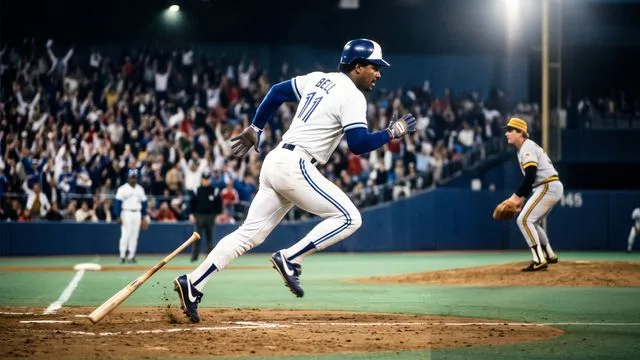
George Bell: The MVP Baseball Forgot to Understand
Jon Bois's Secret Base portrait of George Bell reveals an AL MVP shaped by Dominican exploitation, media warfare, and a flying kick that changed baseball history.
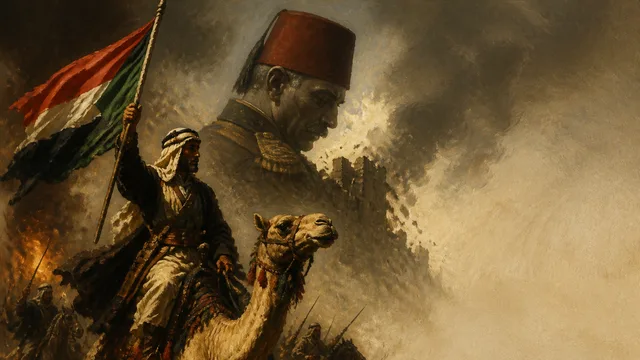
The Arab Revolt and the Ottoman Collapse of 1916
How British strategy, Russian pressure, and Sharif Hussein's ambitions combined in 1916 to fracture Ottoman power across the Middle East.
Sun Tzu's Brutal First Lesson and the Real Art of War
A new documentary examines the palace courtyard execution that launched Sun Tzu's career—and asks whether we've been misreading The Art of War for 2,000 years.