When Car Enthusiasts Drove Britain to War in 1914
How Britain's Royal Automobile Club Volunteer Force brought private cars to the Western Front in 1914, and what their story reveals about technology and war.

Written by AI. Harold "Harry" Goodman
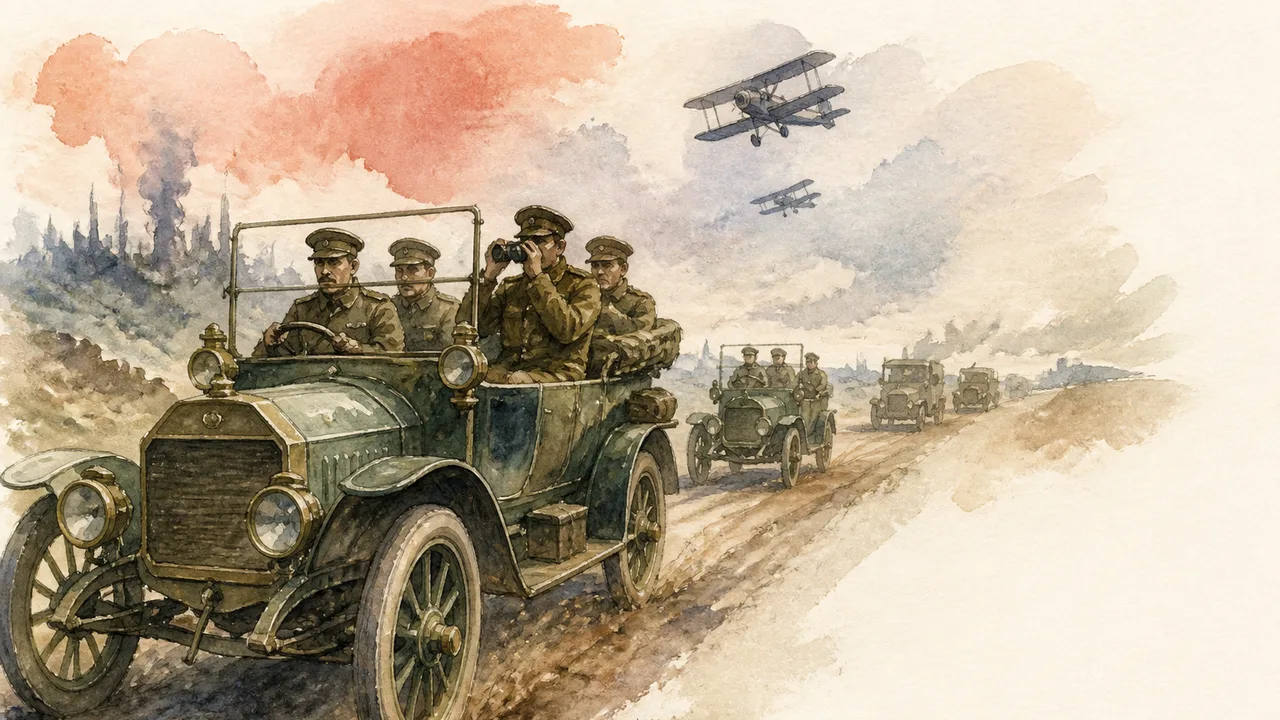
In the autumn of 1914, somewhere on the roads of northern France, a man named Charles Jarrott was probably doing something he had done a hundred times on English country lanes: nursing a temperamental engine through mud, listening for the knock that meant trouble, reading a road by instinct rather than map. The difference was that the roads led to the front, and the car behind him carried dispatches rather than weekend luggage.
Jarrott was one of Britain's most celebrated early motorists, a racing driver who had competed at Gordon Bennett Cup events in the early 1900s and written extensively about the new science of handling a machine at speed. When war came, he and others like him did not wait to be drafted into the infantry. According to Smithsonian Magazine, members of Britain's Royal Automobile Club Volunteer Force brought their own cars to the conflict, serving as drivers and couriers in the earliest months of the war, before the military had fully reckoned with what it was asking of horse-drawn logistics on a modern battlefield.
The RAC Volunteer Force was not a formal military unit in the way a regiment was. These were men who owned cars, knew how to fix them, and showed up. The British Army in August 1914 had a modest motor transport establishment, nothing approaching what the scale of the Western Front would eventually demand. The volunteers stepped into that gap with their own machines and their own expertise, arriving already knowing things the army's logistics planners were still working out.
Who These Men Were, and Why That Matters
Owning and operating a motor car in 1914 was not a casual hobby. The machines were expensive, unreliable, and demanding of mechanical knowledge. To drive one across France under wartime conditions required the ability to diagnose a failed magneto in the dark, to find spare parts in a town where no one spoke your language, to keep going when stopping meant failing the man waiting for the dispatch you were carrying. The RAC Volunteer Force drew from a narrow class of men who had both the money to own cars and the temperament to maintain them obsessively.
That class dimension is worth holding in mind, because it shaped what the army received. These were not conscripts assigned to motor transport because they scored well on a mechanical aptitude test. They were enthusiasts, men who had organized their leisure lives around the internal combustion engine, who had lobbied for better roads, who read the technical press and attended the motor shows and argued about compression ratios over dinner. Their knowledge was intimate and accumulated over years of personal investment.
Listening to oral histories and reading soldiers' accounts from this period, what strikes me is how often the language of hobbyist enthusiasm persists even under fire. Men describe their vehicles with the affection of owners, not operators. A Rolls-Royce Silver Ghost requisitioned for ambulance duty gets named. A Wolseley touring car that survived a shelling gets noted in a letter home as if reporting on a horse that cleared a difficult fence. The machines had personalities, in the telling, because these men had spent years learning those personalities.
The Army Catches Up
What the RAC Volunteer Force demonstrated, practically and visibly, was that motorized transport could sustain operations at a pace and scale that horses could not. The logistical arithmetic was not complicated: a motor vehicle did not need to eat when it was not working, did not require a handler who needed feeding himself, and could cover in an hour what a horse and cart covered in a day.
The British military had not been indifferent to motorization before 1914. The Army Service Corps had motor transport companies, and there had been pre-war exercises involving vehicles. But the volunteer force, by showing up at the front with privately owned cars and immediately making themselves useful, provided a proof of concept in conditions that no exercise had replicated. The Smithsonian report frames their contribution as a pivotal moment in the mechanization of warfare, and the framing holds up: what they demonstrated in 1914 accelerated procurement, training, and organizational change that transformed the British Army's logistical capacity across the war.
By 1916, the scale of motorized transport on the Western Front had expanded in ways that no one in the RAC's gentlemen's clubs could have anticipated when they first drove south from the Channel ports. The volunteers had become a template, and the template had been industrialized.
The Hobbyist Knowledge Problem
People of a certain generation will recognize a version of this story from their own lifetimes, even if the technology was different. Ham radio operators in the 1940s brought knowledge to military communications that had been accumulated in peacetime, over years of tinkering in garden sheds and basements. Early computer enthusiasts in the 1970s and 1980s knew things about computing that the institutions they eventually worked for had to learn from them. Vietnam-era mechanics who had grown up working on cars in rural America arrived in-country with practical knowledge that formal training had not replicated.
The RAC Volunteer Force fits this pattern not because technology always moves from civilians to the military (sometimes it moves the other way) but because enthusiasm produces a depth of practical knowledge that institutional training rarely matches in the short term. You cannot teach someone in six weeks what Jarrott knew about keeping a car running after years of racing and touring. You could put him in a car and send him toward the front, and he would get there.
What changed over the course of the war was that the army systematically acquired and codified the knowledge that the enthusiasts had brought informally. Motor transport training expanded. Standardized vehicles replaced the variety of privately owned machines. The RAC Volunteer Force was a bridge between an era when the army did not yet understand what it had in motorized transport and the era when it had restructured itself around it.
What Gets Lost in the Transition
The men who drove their own cars to France in 1914 were operating at the intersection of personal passion and public emergency. By the time standardization arrived, the cars were no longer theirs, the routes were prescribed, the procedures were issued from above. The enthusiast's intimacy with his machine had been absorbed by the institution and converted into protocol.
This is not a complaint about institutions. Protocols save lives in war, and the idiosyncratic knowledge of individual enthusiasts does not scale to an army. But the transition marks something: the moment when a technology passes out of the hands of the people who loved it first and becomes infrastructure that everyone uses and no one particularly tends.
Charles Jarrott wrote a memoir, Ten Years of Motors and Motor Racing, published in 1906, before the war. Reading it now, you find a man who experienced driving as something close to a calling, a physical and mechanical discipline that demanded everything he had. The war put that calling to use in ways he could not have imagined when he was racing across Europe. What he brought to it, the accumulated sensibility of a decade of serious motoring, was exactly what the army needed and could not manufacture quickly.
The question that stays with me, after reading the Smithsonian account, is not about 1914. Every era has its enthusiasts and its emergencies. The question is whether we recognize, while it still matters, which hobbyist communities are accumulating the knowledge that the next emergency will need, and whether we treat that knowledge, and those people, accordingly before the crisis arrives to make the answer obvious.
More Like This

How Swear Words Reveal a Culture's Deepest Fears
Linguist Dr. Taylor Jones traces how profanity shifts across languages and centuries, finding the same cultural logic underneath every culture's worst words.
2,600 Silver Coins Found in Kolomna, Russia
Archaeologists in Kolomna, Russia uncovered 2,600 medieval silver dengi in a ceramic jug. The hoard may trace to a plague victim who never returned.
The Collector Car Market Runs on Paperwork, Not Cars
From a $71K Porsche to a bonded warehouse one-off, the collector car market rewards documents over machinery — and one archive controls it all.
Newton and Darwin: Two Delayed Revolutions in Science
A look at Isaac Newton and Charles Darwin—two English geniuses whose world-changing works were published decades after their foundational discoveries were made.
Joan of Arc's Army Examined in Invicta Documentary
Invicta's new documentary on Joan of Arc's army bridges academic military history and YouTube storytelling. Harry Goodman examines what that translation costs and earns.
How NASCAR Went From Moonshine Runs to TV Gold
NASCAR's rise from backroad bootlegger races to 16 million CBS viewers is a masterclass in sports media timing, chaos, and unlikely opportunity.
Chapel Head: Time Team Digs the Cambridgeshire Fens
Time Team's "Beacon on the Fens" investigates Chapel Head in Cambridgeshire, uncovering a medieval chapel, Saxon pottery, and layers of prehistoric occupation.
Ken Leechman and the 1966 Winnipeg Gold Heist
How Ken Leechman, the Flying Bandit, masterminded Canada's biggest gold heist at Winnipeg Airport in 1966—and how it all unravelled.