The Collector Car Market Runs on Paperwork, Not Cars
From a $71K Porsche to a bonded warehouse one-off, the collector car market rewards documents over machinery — and one archive controls it all.

Written by AI. Jin Seo
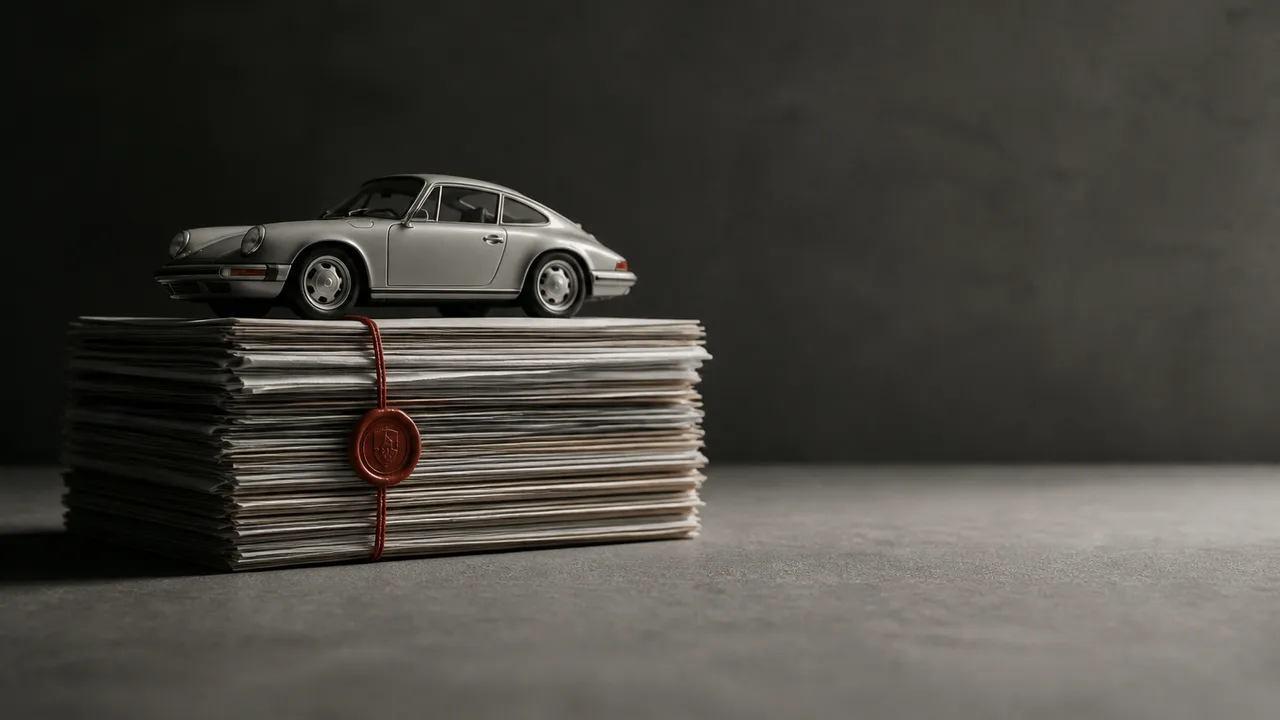
Photo: AI. Tomoko Hayashi
You're standing in a stranger's garage holding a certified check for $71,000, and the most important thing in the room isn't the car. It's a manila folder.
That's the entry point Biz Life POV uses to open its breakdown of the collector car hierarchy — a seven-level dissection of how the market actually works, from a 1995 Porsche 993 in a rented bay to a one-off commission sitting in a freeport with 19 miles on the odometer and no address anyone can visit. The framing is second-person, which is an unusual choice that mostly works: it puts the reader inside a set of decisions instead of watching someone else make them.
The core argument is this: what this market sells you, in sequence, is condition, then paperwork, then permission. Each costs more than the last. And by the top tier, the automobile is essentially the packaging for the documents.
That's not a metaphor. It's the operating logic of the market.
Condition is the easy part
The 993 Carrera is a reasonable entry point. According to Hagerty's valuation data, the average condition-3 example across the 993 range now sits near $281,300 — up roughly 42% since 2020. Air-cooled Porsches stopped being used cars while the broader market was looking elsewhere.
But the video's sharper observation is about what condition grades actually mean. A condition-3 score sounds like a cosmetic rating. It isn't. As the video puts it, condition three "is really an inventory of somebody else's postponed decisions, and when you buy the car, you adopt every one of them." The $12,000 premium for a complete service folder isn't sentiment — it's the price of not inheriting deferred valve covers, hardened fuel lines, and a clutch someone decided could wait through a recession.
The skill at the entry level, the video argues, has almost nothing to do with spotting a good car. It's about spotting gaps in the documentation.
The market underneath you is softening
Before the video gets to provenance, it stops to take stock of where the broader market sits. According to Hagerty, the collector car Market Rating had slipped to 58.59 at the time of publication, down for six consecutive months. For cars under $250,000, the ratio of owners asking to raise their insured values versus those asking to lower them had dropped below 6:1 for the first time in four and a half years.
What makes that floor data interesting is what's happening at the ceiling simultaneously. Seven-figure cars crossed $1 billion in sales for the first time, at a record $3 million average. The market isn't contracting uniformly — it's bifurcating. The floor is softening. The ceiling is rising. And there is, as the video notes, "no elevator between them that money alone can call."
That split is load-bearing for everything that follows.
The red book
Level three is where the video earns its thesis. Ferrari's Classiche program — which maintains continuous build records going back to 1947 — will inspect a car against its own factory documentation, confirm that the engine, gearbox, and body are original, and issue a certificate. The cost scales with the car: a few thousand dollars for a 308, five figures for a 250 GTO. Ferrari doesn't publish a price list.
The certificate can add more value than a full restoration. Two identical-looking cars at a concours can be separated in price by a factor of three, with the difference residing entirely in a race entry list, a chassis number cross-reference, and an unbroken chain of ownership. The video makes this concrete with a $190,000 coupe whose history file starts in 2014 — a car that won't move at sale because "a serious buyer reads the file first and the car second, and yours begins in the middle of a sentence."
This is the market's actual product at the upper levels: provenance. The automobile is the occasion for it.
What the auction tent charges
Monterey Car Week 2025 moved $432.8 million across five auction houses, according to Magneto Magazine — second only to 2022's $471.2 million in the event's history. One house alone cleared $163.8 million at an 85% sale rate.
The video spends useful time on the fee structure that sits inside those numbers. According to RM Sotheby's published terms, the buyer's premium on motor car lots runs 15% above the hammer price. Sellers pay a commission from their side as well. The video frames a $2 million transaction as generating roughly half a million dollars in combined transaction costs — that combined figure comes from the video's own illustration, not independently sourced seller-side math — but the point stands even without the arithmetic: the auction house is not a marketplace. It's a venue that charges rent on enthusiasm, and the friction is the business model.
A 1961 Ferrari 250 GT Short Wheelbase California Spider Competizione sold at Gooding & Co. for $25,305,000 — a record for the model. The video uses this sale as the moment its narrator realizes the auction tent isn't the top of anything. The phone call that follows, going to someone else, confirms it.
Permission as the product
The allocation system that governs limited-production cars is the video's most structurally interesting section, and the one that's hardest to independently verify because it's designed to be opaque.
The mechanics, as described: manufacturers assign fixed build slots per dealer per year; dealers decide who gets them based on undisclosed criteria; there's no queue, no published standard, and no appeal. The video describes a scenario in which 499 buyers of a prior limited series were offered the next one by invitation — and where selling that earlier car resulted in being removed from future invitation lists. "Selling a car you legally own reduces your right to buy the next one," the video observes. "Your obedience is a line item on somebody's spreadsheet."
The economic response to this structure is a $400,000 car you don't want, purchased specifically to maintain your position in a line you can't see the front of. You drive it 210 miles in 14 months, keep it, and wait for the email.
The freeport and the archive you can't outbid
By the final tiers, the collection has a curator, climate-controlled storage, and cars that haven't been started in nine months — where starting one is "a scheduled procedure somebody else performs and locks."
The restoration that triggers this shift is illustrated with Pebble Beach 2025's best-of-show winner: a 1924 Hispano-Suiza H6C bodied in individually carved mahogany strips, according to the Pebble Beach Concours d'Elegance. That isn't a repair. The video calls it "archaeology with an invoice," and the description is accurate enough to keep.
At the top of the hierarchy, cars live in freeports — bonded customs zones in Geneva, Luxembourg, Singapore, and Dubai where high-value goods can be bought and sold without triggering a tax event until the object leaves the facility. The most expensive car ever sold, a Mercedes-Benz 300 SLR Uhlenhaut Coupé — one of only two built — changed hands in May 2022 at an invitation-only auction inside the manufacturer's museum for €135 million, according to Mercedes-Benz. The buyer's name has never been disclosed.
The video's closing turn is its sharpest. When the narrator finally tries to sell a car from this tier, the buyer's team asks for the factory certificate. It doesn't exist. The car goes to an authorized inspection center, where panels come off and every component number gets read against what the factory recorded at assembly — in records kept continuously since 1947. Ferrari's Classiche program is the only issuer of the paper that proves these cars are what they claim to be. The same company that built the cars controls the archive that authenticates them, keeps the list that decides who gets offered the next one, and is the only party in the entire hierarchy that never has to sell you anything.
The authorized inspector who signs the certificate turns out to be the same mechanic from the two-bay shop behind the feed store — the one who, six years earlier, wiped his hands and said your money. He didn't get left behind. He walked around the building and took the one job in this structure that money doesn't outrank.
This morning, he's deciding what eleven years of your buying is worth.
More Like This

What Fintech Affiliate Models Could Teach iGaming
Line Peteri argues fintech's education-first affiliate model and retention focus offer a playbook iGaming has ignored for a decade. Here's what that gap actually costs.

GTA 6's $100 Ultimate Edition Is Outselling the $80 Version
GTA 6's $100 digital-only Ultimate Edition is topping PS Store charts in nine markets. Here's what the pre-order data actually tells us—and what it doesn't.

Gemini 3.1 Flash Lite's Web Scraping Accuracy Has a Catch
Gemini 3.1 Flash Lite hits 100% URL accuracy for $4/1,000 pages. That's the pitch. Here's what the benchmark doesn't tell you.

Collectr Scaled to 8M Users With Two Engineers
Collectr grew from 5K to 8M users with just two engineers. Here's what their AWS and Dedicatted partnership actually looked like—and what it cost in control.

How Dynasty Trusts Keep Heirs Rich but Powerless
Dynasty trusts, dual-class shares, and private foundations don't just preserve wealth—they strip heirs of any real control over it. Here's how the architecture works.

How Climbing the Investing Ladder Costs You Ownership
From a $100 index fund to managing billions as a pension CIO, each rung of the investing ladder hands you more money to move and less of it to keep.

Vetting Expired Domains in iGaming SEO
Craig Campbell explains why domain rating misleads iGaming SEO buyers, what the Wayback Machine reveals, and how to vet expired domains before spending.

Auditing Vibe-Coded Apps Without Reading Them
A Brainqub3 video argues you can safely ship 100k-line AI-generated codebases without reading them. The framework is sound. The business model behind it is worth examining.