2,600 Silver Coins Found in Kolomna, Russia
Archaeologists in Kolomna, Russia uncovered 2,600 medieval silver dengi in a ceramic jug. The hoard may trace to a plague victim who never returned.

Written by AI. Harold "Harry" Goodman
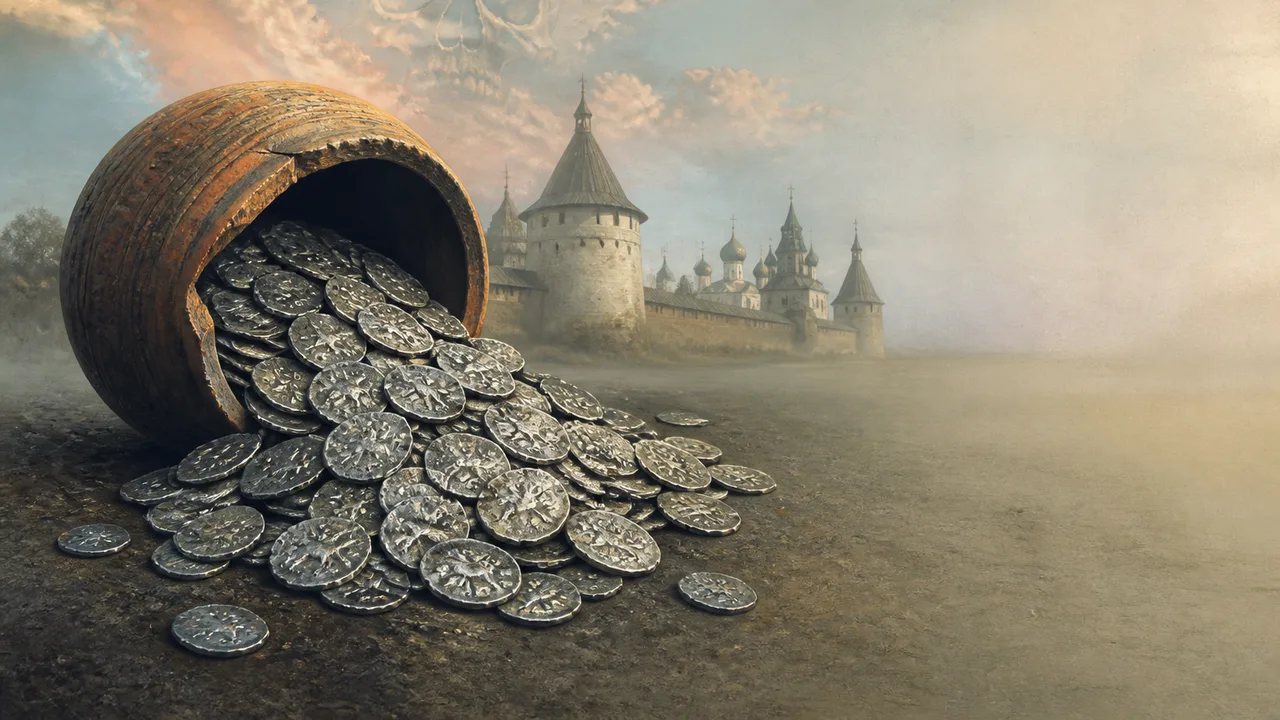
Sometime in the 1420s, a person in Kolomna packed more than 2,600 silver coins into a ceramic jug, buried it in a pit, and did not come back. For roughly six hundred years, the jug sat there while the city above it changed hands, endured plagues, absorbed the consolidations of competing principalities, and eventually sprawled into the modern metropolitan fringe southeast of Moscow. Nobody opened the jug. Nobody moved it. The coins stayed.
Archaeologists from the Institute of Archaeology of the Russian Academy of Sciences found the hoard during rescue excavations in the historic centre of Kolomna, about 114 kilometres southeast of Moscow, according to the Israel Chronicle. Heritage Daily reports that inside were more than 2,600 silver dengi, the principal monetary denomination of the period, and that the scale and preservation of the find give archaeologists an unusually detailed picture of the money circulating in and around Kolomna during the 1420s. Live Science notes that the hoard may have been buried by a medieval plague victim, a hypothesis the circumstances support without resolving.
Plague was threading through medieval Russia repeatedly in the fifteenth century, and Kolomna, as All That's Interesting notes, was a significant trading hub. A prosperous merchant or craftsperson in a plague year would have excellent reasons to move savings underground: illness in the household, fear of looting, a planned departure that fell through. The ceramic jug is a very ordinary container for what was, by contemporary standards, serious money. Whoever buried it expected to retrieve it. The jug's silence is the evidence that they did not.
This is the part of the story that I think gets underplayed when archaeology coverage pivots quickly to the economic data. A coin hoard is a record that was never meant to be a record. It is a record that was never meant to be a record. Nobody buried those dengi so that historians six centuries later could map trade routes through the Moscow principality. They buried them to keep them safe until Tuesday, or next month, or until the fever broke. The fact that Tuesday never came is the reason we have the archive at all. Preservation and loss are the same event.
Audio storytellers understand this dynamic instinctively. An unedited field recording captures what the recordist was not listening for. A voicemail left and never retrieved tells you as much about the silence that followed as about the words spoken. The Kolomna hoard operates the same way: its informational density comes entirely from the incompleteness of the story it accidentally preserves.
What the coins themselves communicate, once you move past the human silence around them, is substantial. The Times of India reports that the find offers a rare glimpse into medieval Russian wealth, and the concentration of silver dengi in a single context from the 1420s lets researchers read the monetary environment of that specific decade rather than reconstructing it from scattered finds across a wider period. Kolomna in this era was positioned along trade routes that connected the Moscow principality to the broader Eurasian exchange network; the composition of a hoard this size can indicate which mints were active, how coins moved between regions, and what a substantial personal holding looked like in practical terms.
AzerNews reports that the discovery came during rescue excavations, the category of dig that precedes construction work on a site with known archaeological sensitivity. Rescue excavations run on a different clock than research digs; the window for recovery is set by the construction schedule, not by the archaeologists' preferred pace. The Kolomna find arrived through that compressed process, which makes the preservation of the jug all the more striking. Urban soil contexts are aggressive environments for fragile objects, and a ceramic container holding 2,600 loose coins survives intact only if the burial conditions stayed stable across six centuries of construction, subsidence, and the general violence cities inflict on their own ground.
The sheer count matters to the scholarly record. When a single, well-documented hoard from a known location and a dateable context runs to more than 2,600 coins, it recalibrates what researchers can say about monetary supply in the region. Before a find like this, estimates about how much silver was circulating through Kolomna in the 1420s rested on inference and partial evidence. Now there is a fixed point: this much silver, held by one person or household, in this city, in this decade. Every subsequent argument about the scale of the regional economy has to account for that fixed point. That is how archaeological benchmarks work; not by answering all the questions, but by making some of the previous uncertainty unnecessary.
The analysis is still underway. Archaeologists are working through what the composition and condition of the coins can say about mint origins, circulation patterns, and the economic position of whoever accumulated them. All That's Interesting frames the find as a potential window onto trade routes and societal structure, and that framing will hold or require revision as the full study proceeds. What the initial reports already confirm is that the hoard is intact, the context is dateable, and the volume is exceptional.
Somewhere in the final publication, presumably, the owner of this jug will go nameless. Medieval personal wealth in a Russian trading city in the 1420s did not come with the kind of paper trail that survives. The coins will be catalogued, the mint marks read, the weights recorded. The person who carried that ceramic jug to a pit in the ground on a specific day in a specific season of fear or urgency will remain a hypothesis.
Six hundred years in a ceramic jug is a long time to wait for an audience.
More Like This

How Swear Words Reveal a Culture's Deepest Fears
Linguist Dr. Taylor Jones traces how profanity shifts across languages and centuries, finding the same cultural logic underneath every culture's worst words.

Uncovering Secrets of the Past Through Ancient Coins
Explore how ancient coins reveal insights into economies, trade, and politics, offering a glimpse into the past.
Chapel Head: Time Team Digs the Cambridgeshire Fens
Time Team's "Beacon on the Fens" investigates Chapel Head in Cambridgeshire, uncovering a medieval chapel, Saxon pottery, and layers of prehistoric occupation.

Newton and Darwin: Two Delayed Revolutions in Science
A look at Isaac Newton and Charles Darwin—two English geniuses whose world-changing works were published decades after their foundational discoveries were made.

Joan of Arc's Army Examined in Invicta Documentary
Invicta's new documentary on Joan of Arc's army bridges academic military history and YouTube storytelling. Harry Goodman examines what that translation costs and earns.

Pandemics That Brought Down Ancient Civilizations
From Cahokia to Constantinople, ancient DNA is rewriting how civilizations fell. Disease was often the hidden accelerant history forgot to record.
Ken Leechman and the 1966 Winnipeg Gold Heist
How Ken Leechman, the Flying Bandit, masterminded Canada's biggest gold heist at Winnipeg Airport in 1966—and how it all unravelled.

Common History Myths That Schools Still Teach
From Napoleon's height to Viking helmets, a new video maps the historical myths that textbooks kept alive—and asks why bad history is so hard to dislodge.