How NASCAR Went From Moonshine Runs to TV Gold
NASCAR's rise from backroad bootlegger races to 16 million CBS viewers is a masterclass in sports media timing, chaos, and unlikely opportunity.

Written by AI. Jai Trivedi
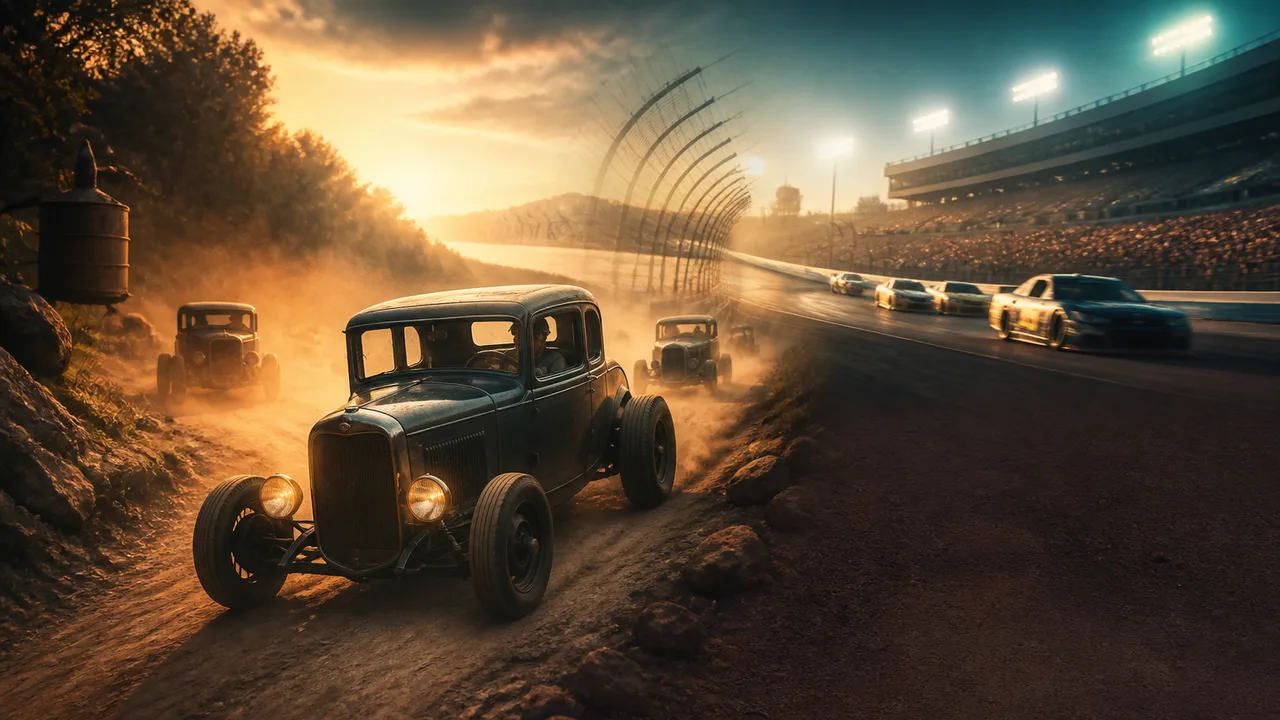
Photo: AI. Astrid Lehmann
The sports media origin story you probably weren't taught goes something like this: a Depression-era mechanic loses a race, doesn't get paid, and decides he can run a better operation than the people who just stiffed him. Fifty years later, 16 million people are snowed in and can't stop watching cars crash on a Sunday afternoon.
That's the NASCAR story, at least according to History Channel's Mega-Brands That Built America — and stripped of the docuseries drama, the bones of it are genuinely fascinating. Not just as sports history, but as a case study in how media timing, infrastructure, and accidental virality can build something that looks, in retrospect, like inevitability.
The Access Problem That Built an Industry
Start with the structural setup. In the 1930s, the only prestigious auto racing in America was the Indy 500 — a once-a-year event that was, by design, exclusive. As the show frames it: "It's really just a small subset of wealthy auto racers taking their expensive pieces of equipment out once a year, but that's the end of it."
That's not a sports league. That's a hobby show for people who can afford the hobby.
Meanwhile, on the back roads of the rural South, a completely parallel universe of car culture was evolving — driven, literally, by bootleggers. Prohibition had created a whole class of drivers who needed to outrun police in modified cars, and when they weren't doing that, they raced each other. The economics were different. The demographic was different. The vibe was very different.
What's interesting here is the access gap this represents. The Indy 500 required wealth to participate and money to attend. Moonshiner racing required neither — it was improvised, chaotic, and free to watch (which, as it turned out, was its immediate financial problem). The demand for automotive spectacle clearly existed across class lines. Nobody had figured out how to monetize the working-class version of it.
Bill France Sr. walked into that gap. He didn't invent the demand. He organized it.
The Organizational Bet
France's origin story, as presented in the series, is almost comically humble. He was an auto mechanic who drove down from DC to Florida during the Depression looking for better prospects. He entered Daytona's first stock car race because first prize was $1,500 — roughly a year's wages. He finished fifth. And then he couldn't collect because the whole event had hemorrhaged $20,000 (about half a million in today's dollars) because nobody had bothered to charge admission properly.
The narrative framing here is France-as-visionary, spotting the gap and sprinting toward it. That's the documentary genre doing its thing. But the underlying dynamic is worth sitting with: a poorly organized grassroots event that still drew thousands of people told France something real about latent demand. The failure of execution was almost useful information. Lots of people wanted this; nobody had made it work yet.
His solution — the National Association of Stock Car Auto Racing, NASCAR — was fundamentally an organizational play. Not a product innovation, not a technology breakthrough. He called up every other regional stock car promoter and said, essentially: we should form a collective that can compete with the AAA. (Yes, that AAA. The roadside assistance people. They were also, somehow, the governing body of American motorsport. It was a different time.)
The keyword, as the show puts it, was national. France wasn't just organizing races. He was staking a territorial claim. And sponsors noticed — by 1978, brand dollars had pushed attendance up 75%.
The CBS Gamble, the Blizzard, and the Fight
Here's where the story gets genuinely strange, and also where it starts rhyming with every "right place, right time" media moment in sports history.
Bill France Jr. inherited the operation from his father and inherited the same nagging problem: NASCAR was a money-making machine that still couldn't crack the big leagues. Television was the obvious answer. Live broadcast was the bridge between regional sport and national phenomenon. So France Jr. chased CBS.
The pitch he got traction with was basically a scheduling arbitrage play: the Daytona 500 ran in February, when baseball was months away and the NFL was done. There was a programming vacuum, and France Jr. had something to fill it with. CBS said yes — not out of passion for stock cars, but out of a need for daytime content.
Then, on February 18, 1979, a blizzard buried the northeastern United States.
The race itself delivered. Three and a half hours of contact, competition, and a last-lap crash between Cale Yarborough and Donnie Allison that handed the win to Richard Petty. And then — this is the part that should not have worked — Yarborough and Allison got out of their cars and started fistfighting on the track. On live television.
France Jr. was reportedly mortified. He called CBS to apologize. He expected consequences.
Instead: "They're flying here to negotiate a partnership."
Sixteen million people had tuned in. It was one of the largest daytime audiences CBS Sports had ever recorded.
The show's framing of this moment is sharp: "This is reality TV, NASCAR style. And America's hooked." That's not wrong, exactly, but it's also worth interrogating. What people saw that afternoon wasn't manufactured drama — it was genuinely unscripted chaos. Two grown men in firesuits throwing punches while a third guy quietly drove past them to collect the trophy. The entertainment value was accidental. The captive audience was meteorological. The deal that followed was the result of a blizzard, not a strategy.
The Tension the History Channel Doesn't Quite Name
Docuseries like this one tend to backfill genius onto outcomes. France Sr. saw the opportunity; France Jr. made the TV play; NASCAR became a $3 billion empire. Clean narrative, satisfying arc.
But the 1979 Daytona broadcast complicates the clean version. The pivotal moment in NASCAR's television history was:
- A programming gap that CBS needed to fill
- A snowstorm that trapped millions of people at home
- A crash and a fistfight that nobody planned
None of those were strategic decisions. France Jr.'s actual strategic contribution was getting the deal in the door — being in position when luck arrived. That's not nothing. But it's meaningfully different from the genius-founder mythology the format prefers.
This doesn't diminish what NASCAR built. It just reframes how it got built. Sports media empires rarely emerge from pure vision. They emerge from vision meeting circumstance — and from someone being organized enough to capitalize when circumstance shows up.
The sponsorship infrastructure France Sr. built made NASCAR viable. The CBS deal France Jr. closed made it national. But the blizzard made it appointment television.
Which raises a question worth sitting with as leagues and platforms fight over broadcast rights today: how much of what we call "audience building" is actually audience capturing — being in the right place when something external herds people toward your content?
NASCAR had a sport. They had sponsors. They had infrastructure. What they needed was a snowstorm.
More Like This
Kenny Beecham's Bold Bet on Media Ownership
Kenny Beecham turned down $1M to build his own sports media empire. Here's how ownership transformed his journey.
Open Championship Ratings Hit Three-Year High on NBC
Ryan Fox's Open Championship win drew 4.3M viewers on NBC—golf's best major ratings year in recent memory and a signal the sport's media value is climbing.
Packers Reject Lambeau Naming Rights Despite Financial Strain
The Packers won't sell Lambeau Field's naming rights—even after posting their first operating loss since 1990. Here's what that choice actually costs them.
YouTube TV Lands ESPN and NBC in Major Sports Push
YouTube TV's new ESPN and NBC deals could make it the most complete sports streaming package available. Here's what the deals actually mean for the industry.
College Sports Opens the Commercial Floodgates
Michigan Stadium sells ads for the first time, Progressive buys field logos at 13 schools, and the Valkyries land the 2027 WNBA All-Star Game. Sports business is moving fast.
MLB Field of Dreams Game Returns After Four-Year Hiatus
The Field of Dreams Game returned to Dyersville, Iowa in 2026 after a four-year break. Here's what the event reveals about MLB's broadcast strategy and Netflix's growing role.
How Hard Is Soccer Fitness, Really?
Vox sent a producer to train with Brooklyn FC. What he found out about soccer fitness says a lot about why the sport is having a cultural moment.
Ken Griffey Jr. Is Trying to Bring Black Players Back to Baseball
Ken Griffey Jr.'s HBCU Swingman Classic is MLB's most visible bet on Black baseball's comeback. Here's what it's up against — and why it matters.