Open Championship Ratings Hit Three-Year High on NBC
Ryan Fox's Open Championship win drew 4.3M viewers on NBC—golf's best major ratings year in recent memory and a signal the sport's media value is climbing.
Written by AI. Jai Trivedi

Ryan Fox wasn't supposed to win the Open Championship. He wasn't the story anyone had scripted. And yet there he was at Royal Birkdale, hoisting the Claret Jug—and 4.3 million Americans watched him do it.
That number, confirmed by NBC Sports in an official press release, represents the most-watched final round of the Open Championship since 2022. It's a 6% bump over last year's final, when Scottie Scheffler claimed the title—held, per Wikipedia's record of the 2024 Open Championship, at Royal Troon, not Royal Portrush as some outlets incorrectly noted (Royal Portrush hosted back in 2019). The audience peaked at 6.1 million viewers at some point during Sunday's coverage window, according to Golf Business News.
For context: 4.3 million people watching a Sunday morning golf broadcast—NBC and Peacock ran coverage from 9:02 a.m. to 2:06 p.m. ET—on a summer weekend is not a small thing. This isn't prime time. This isn't the Super Bowl lead-in slot. This is competing against brunch.
The Summer Context Actually Matters Here
The weekend Ryan Fox won, American sports media was still processing the hangover from one of the most-watched soccer matches in U.S. television history. The World Cup final averaged over 66 million viewers combined across Fox and Telemundo, per Front Office Sports, and peaked at 51.7 million viewers, according to The Athletic. Those are completely different orders of magnitude—comparing golf to the World Cup final is a category error, the sports media equivalent of comparing a critically acclaimed limited series to the most-watched TV event of the year.
But that context cuts both ways. The Open didn't collapse under the weight of a sports-saturated summer calendar. It grew. That's actually the more interesting data point.
Golf's audience for its marquee events has proven stickier than critics of the sport's fragmented, LIV-vs.-PGA-Tour era would have predicted. The 154th Open Championship—as listed on the official Open Championship website—closed out a year in which, according to Front Office Sports, all four men's major championships saw TV ratings rise. That's a sweep. All four. In a media environment where linear TV ratings for almost everything trend one direction—down—golf's majors went the other way.
Golf's pitch to the marketplace just got a clean set of evidence.
The Number Inside the Number
The 4.3 million average is the headline, but the 6.1 million peak is the figure I'd want if I were selling advertising inventory. Peak viewership captures the drama moment—the final holes, the deciding putt, the trophy lift. Advertisers buying into golf aren't just buying a demographic (though the affluent-older-male demo is obviously part of the pitch); they're buying into a specific emotional window. The gap between 4.3 million average and 6.1 million peak tells you people tuned in for something, not just left the TV on.
Awful Announcing frames this correctly: NBC earned its best Open Championship audience in three years. That framing is accurate and useful, but it also understates something. The 2022 Open—Cameron Smith's Claret Jug at St Andrews, the Home of Golf—was a different kind of draw. St Andrews carries gravity that most venues don't. Royal Birkdale is a classic links, beloved by golf traditionalists, but it's not the same cultural touchstone. Matching that era's numbers from a different venue suggests the upward pressure here isn't just course-dependent.
The Yahoo Sports report on the numbers notes the year-over-year comparison clearly: 4.3 million this year versus 4.1 million for Scheffler's 2024 victory at Royal Troon. That's clean growth. Not explosive, but consistent—which is actually more valuable for a rights negotiation than a one-year spike.
What NBC and Peacock Are Actually Selling
There's a structural story embedded in this ratings report that's easy to miss if you're just tracking the headline number.
NBC's Open Championship coverage runs jointly across NBC and Peacock—the linear network and the streaming platform sharing the same window. The 4.3 million figure is a combined average across both platforms, per the NBC Sports press release. The industry doesn't always separate those streams publicly, which makes it difficult to know how much of that audience is cord-cutters watching on Peacock versus traditional linear viewers. That distinction matters enormously for where the money actually flows.
Peacock has been aggressively accumulating live sports rights—it's one of the few streaming plays that seems to have a coherent theory about why sports belong on its platform rather than just hoping the audience shows up. Golf fits neatly: the viewing window (weekend mornings) is naturally streaming-friendly, the demographic skews toward people who actually pay for subscriptions, and the event length doesn't require the same kind of appointment viewing commitment that an NFL game demands. You can dip in and out of five hours of Open Championship coverage in a way you can't really do with a playoff basketball game.
That flexibility might be part of why the numbers held. The measurement is combined, which means every Peacock viewer who tuned in on a laptop while half-paying attention still counts. Whether that's a strength or a caveat depends on how the ad buy is structured.
The Rights Value Question
Here's the part that actually has money behind it: consistent major championship ratings growth is direct input to whatever golf's next broadcast rights conversation looks like.
The PGA Tour's current deals have NBC/Peacock as a key partner, and the R&A controls the Open Championship rights separately. A year in which all four majors grew their TV audiences—in a declining linear environment, against a World Cup summer—is exactly the data package you want walking into a renewal or an expansion negotiation. GolfMagic called this Ryan Fox's "dramatic" victory, and drama is, not incidentally, what justifies premium ad rates and rights fees.
The LIV question hovers over all of this without being answerable from the ratings data alone. Golf's audience fragmentation risk—fans spread across PGA Tour events, LIV broadcasts, majors, and whatever Netflix golf content exists—hasn't materialized in the majors numbers. Majors, it turns out, function as a kind of common ground. Everyone watches the majors. The 154 other weeks of competitive golf are where the audience fractures.
That distinction is actually golf's most important media asset right now: the majors operate like cultural events, not like regular-season games. Four times a year, golf forces a consolidated audience. The rest of the time, it's a fragmented niche. If you're a rights holder or a network, you want to own those four weeks. Everything else is negotiable.
Ryan Fox wasn't the story anyone scripted—but the 4.3 million people who watched him win might be the most useful number golf's media partners have seen all year.
More Like This

College Sports' $20.5M Spending Cap Is Already Broken
Power 4 schools are blowing past the $20.5M rev-share cap through NIL stacking and frontloaded deals. Here's how the workarounds work—and what comes next.
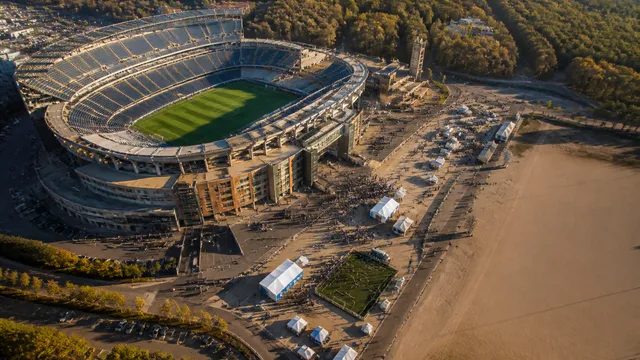
Boston's 2026 World Cup: Great Games, Real Costs
Boston's World Cup run at Gillette Stadium produced tournament classics and a fan zone shutdown. Here's what the city's rocky hosting run actually reveals.

MLBPA's 2026 CBA Push: Rosters, Pay, and Data Power
The MLBPA's latest CBA proposal isn't just about roster sizes — it's about who controls player data, movement, and earning power in MLB's next era.

MLS Ticket Sales Surge, But TV Ratings Stay Flat
MLS is riding a World Cup attendance wave, but TV ratings haven't followed. What that gap means for media rights, and MLS player salaries.

Marathon Running's Rise as a Commercial Powerhouse
From shoe sales to title sponsorships, marathon running has become a serious commercial enterprise. Here's who's profiting—and what the growth costs.
England Ends Norway's World Cup Run, Haaland Silenced
England beat Norway 2-1 in extra time to reach the 2026 World Cup semifinals. Bellingham scored the winner. Here's what the money story actually looks like.

Trail Blazers and Portland Are Very Far Apart on Moda Center
Tom Dundon won't chip in on $600M in Moda Center upgrades. Portland won't write a blank check. Here's what's actually at stake for both sides.

FIFA's TikTok Deal Is Rewriting Sports Media Rights
FIFA's TikTok partnership for the 2026 World Cup pulled 465 million streams. The real story is what that means for every rights deal negotiated after this.