Marathon Running's Rise as a Commercial Powerhouse
From shoe sales to title sponsorships, marathon running has become a serious commercial enterprise. Here's who's profiting—and what the growth costs.

Written by AI. Elena Vasquez-Moreno
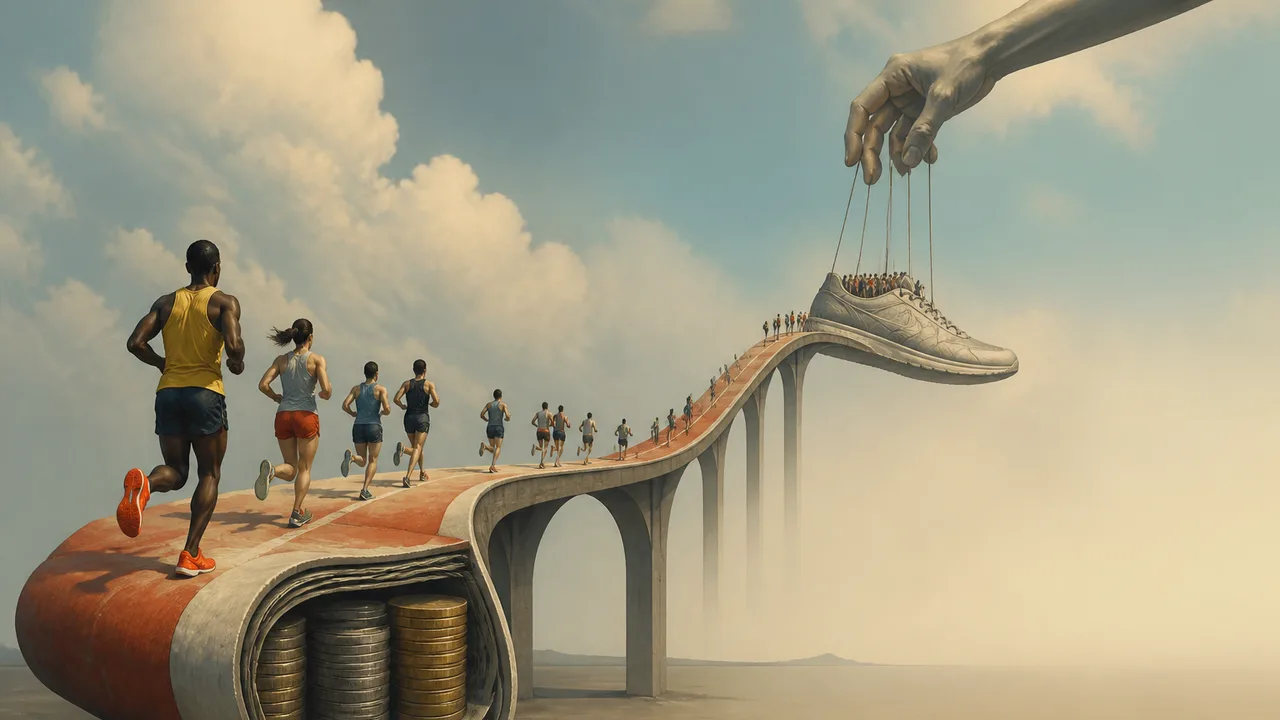
Consider what it takes to run a modern marathon before you even lace up. You need the shoes—according to Empower, the average pair goes for $121.10, and most marathon runners buy two or three pairs in training. You need a race entry, which at the major events can require years on a lottery waitlist or a guaranteed spot through a charity that comes attached to significant fundraising commitments routinely running to several thousand dollars. Then there's the GPS watch, the compression gear, the nutrition plan, the 16-week training program—perhaps the one "powered by Lululemon," as Business Insider described, in which New Yorkers spend months preparing for "the absurdity of running 26.2 miles."
The absurdity is now a multi-billion-dollar industry. Marathon running, which for most of its competitive history was a niche pursuit of lean-bodied obsessives who woke up at 5 a.m. by choice, has transformed into one of sport's more quietly spectacular commercial expansions. Understanding how that happened—and who holds the receipts—requires looking at the whole architecture, not just the finish-line tape.
The Abbott Effect and the Geography of Prestige
The clearest signal of marathon's commercial maturation is the expansion of the Abbott World Marathon Majors. The six-race circuit—Boston, Tokyo, London, Berlin, Chicago, New York—built its brand on scarcity and prestige, the velvet rope of endurance sports. Now, according to SportsPro, the TCS Sydney Marathon officially joins the Majors circuit beginning with its 2025 edition, and the Sanlam Cape Town Marathon follows in 2027. That's geographic diversification with a purpose: Sydney and Cape Town open Pacific and African markets to a brand architecture that had been overwhelmingly concentrated in the Northern Hemisphere's wealthiest cities.
The Majors model is worth understanding structurally, because it's the commercial engine that the rest of the industry orbits. A World Marathon Major is not just a race—it's a title sponsorship platform, a tourism multiplier, a media property, and a participant-experience product all simultaneously. Hans-Peter Zurbruegg of sports marketing agency Infront has pointed to the broad demographic appeal of marathon running and the economic activity it generates in host cities as core drivers of the boom, per SportsPro. That framing—marathon as economic development tool—is exactly how host cities justify the infrastructure investment, and how event organizers justify the sponsorship rates they charge.
The naming-rights market tells the story plainly. "TCS Sydney Marathon." "Sanlam Cape Town Marathon." The title sponsor gets their name embedded into every training log, every race recap, every Instagram finish-line photo for a year. That's not traditional sports sponsorship, where you buy a patch on a jersey that a camera might or might not catch. That's the brand woven into the participant's identity at the moment of peak emotional investment.
The Shoe as Commercial Pivot Point
The single biggest commercial shift of the past decade, as European Business Magazine identifies it, is who marathon brands are actually selling to. Nike's Vaporfly and Alphafly lines were originally engineered for Eliud Kipchoge's sub-two-hour project—elite performance technology developed at extraordinary cost to shave seconds off world-record pace. What happened next is the recurring story of performance gear in aspirational sports: the technology filtered down, the price point stayed high, and the mass market bought in anyway.
The carbon-plated shoe is now standard equipment for recreational runners chasing four-hour finish times. The performance gap between a $250 racing flat and a $100 training shoe is meaningful for a 2:05 marathoner; it is largely psychological for a 4:30 marathoner. The industry understands this and prices accordingly. The result is a consumer who is both rationally justified in the purchase (the technology is real) and emotionally primed for it (the technology was built for a world-record attempt). That's an unusually clean marketing brief.
Empower's data on the two-to-three pairs per training cycle starts to make more sense in this context. Marathon runners aren't just buying footwear—they're participating in a gear culture with its own logic of upgrades, limited releases, and performance signaling. The shoe has become the most visible artifact of a commercial ecosystem that runs from wearables to nutrition supplements to race-day photography packages.
The Demographic the Industry Is Underreading
Here is where the commercial story gets genuinely interesting, and where the industry's self-congratulation starts to strain against its own data.
Vogue's reporting includes a pointed observation from Stylus analyst Baron: the surge in marathon participation is largely being driven by women—a trend she describes as "still under-acknowledged, and at brands' peril." That framing deserves to sit with you for a moment. The people most responsible for growing marathon's participant base are the demographic that the commercial apparatus has been slowest to fully build around.
This isn't a subtle oversight. "Women in wellness" has been a brand talking point for the better part of a decade—you'll find it in every sponsorship deck and brand partnership announcement in the space. But talking points and product architecture are different things. The evidence that female runners are driving participation growth has been available long enough that its continued "under-acknowledgment" by the industry isn't an information problem—it's a structural one. The people building the sponsorship packages and designing the product lines aren't necessarily the people running the races. The gear has historically been engineered for male physiology and then scaled down; the race-day experience has been designed around cohorts that skew older and male; the aspirational marketing has leaned on elite male athletes as its primary symbols of the sport's identity. Kipchoge breaking two hours is a genuinely extraordinary story. It is also not the story of who actually fills the start corrals at Sydney, Cape Town, or New York.
The brands that close this gap first won't be doing women a favor. They'll be correcting a misread that has left real commercial value on the table while the actual growth market has been running past them for years.
The Sustainability Question Nobody Has Fully Answered
SportsPro's framing of the current moment centers on the right question: how does this boom sustain itself? Every commercial cycle in endurance sports eventually confronts the participation ceiling—the point at which the aspirational market saturates and growth requires either finding new geographies (Sydney, Cape Town) or deepening revenue extraction from the existing base.
The Majors expansion is one answer to the geography problem. But deepening extraction from existing participants has a natural limit defined by accessibility. Marathon's commercial appeal is inseparable from its democratic mythology—the idea that an ordinary person can enter the same race as the elites, on the same course, on the same day. The moment that mythology becomes visibly hollow—because entry costs, gear requirements, and training program subscriptions effectively price out the recreational runner—is the moment the sport's aspirational marketing proposition weakens.
New York Road Runners' CEO has noted growing brand interest amid the running boom, which is true enough. Brand interest tracks participation and cultural cachet, and both are currently high. The design of the New York City Marathon finish medal—the course wound into "about 10 1/4 inches," per the same report, reducing 26.2 miles of terrain to "tiny fractions"—is an apt metaphor for the commercial challenge: compressing an enormous, messy, expensive human endeavor into something clean, wearable, and sellable. The compression works. The question is whether the thing being compressed can hold its shape indefinitely.
The circuit is expanding, the shoe technology keeps advancing, and the sponsorship categories keep multiplying. Whether the sport's growth engine—the everyday runner who decided, for reasons that a marketing team couldn't have scripted, that 26.2 miles sounded like a reasonable thing to attempt—continues to supply the demand side of this economy depends on something no sponsorship deck can guarantee: that running a marathon still feels worth it.
More Like This

The Enhanced Games' Real Business Isn't Sports
The Enhanced Games look like a doping Olympics. The actual business model is a $1.2B pharmaceutical marketing engine. Here's how it works.
The Giants' Walk Rate Is Historically Bad in 2026
The SF Giants have a 5.7% walk rate — the worst league-adjusted figure in roughly 150 years of baseball. Here's what the numbers actually mean.

How True Sea Moss Scaled From $20M to $140M
How True Sea Moss's CMO Luka Kvaratskhelia used Meta discipline, cohort data, and category education to build a $140M bootstrapped DTC brand.

Como 1907: Building Football's Most Ambitious Brand
The Hartono brothers didn't just buy a football club—they bought a canvas. How Como 1907's tourism-meets-football model could rewrite sports business.

How iRunFar Grew Traffic 249% While Affiliate Sites Collapsed
Bryon Powell's trail running site iRunFar defied Google's affiliate site purge. His playbook—fewer guides, real testing, smarter AI—is worth studying closely.
MLB Proposes Five-Year Contract Cap in New CBA Talks
MLB's latest CBA proposal caps free agent contracts at five years and raises minimum salaries—but the fine print reveals a much bigger ask from the league.

The Single-Revenue-Stream Problem in Your Love Life
Anxious attachment isn't just a feeling problem—it's a structural one. The psychology maps onto financial risk theory with unsettling precision.
Exploring Baseball's Complex Steroid Era
A deep dive into baseball's Steroid Era, its cultural impact, and MLB's growth amid controversy.