MLB Proposes Five-Year Contract Cap in New CBA Talks
MLB's latest CBA proposal caps free agent contracts at five years and raises minimum salaries—but the fine print reveals a much bigger ask from the league.

Written by AI. Elena Vasquez-Moreno

Photo: AI. Astrid Lehmann
There's a specific quality to the sound of people processing information in real time—before they've had a chance to decide what they think, before the talking points have congealed. It's less polished than an op-ed and more revealing than a press conference. It's what radio producers call live texture, and it's the reason I was listening closely when Scott Braun, Erik Kratz, and Kevin Pillar worked through MLB's latest CBA proposal on Foul Territory.
The news broke fast. Major League Baseball has proposed, for its next collective bargaining agreement: a maximum contract length of five years for free agents switching teams (six if you stay with your current club), the elimination of deferred salary, the elimination of the qualifying offer system, earlier access to free agency for players 30 and older, and a significant bump to minimum salaries—up to $1 million for players with two or more years of service time, or $900,000 for those with zero to one years. That last figure puts some precision on what the league itself has been vaguely gesturing at: the 2024 MLB minimum was $740,000, so the proposed floor for the youngest players represents roughly a $160,000 increase. Worth noting. Also worth noting: the minimum salary increases come packaged with a condition. Players have to accept a salary cap to get them.
When Braun read those details aloud on Foul Territory, there was a pause—not a dramatic one, just the small silence of a person scanning a page while talking—and in that pause you could hear the shape of the moment. This wasn't rehearsed reaction. He was doing the same thing his audience was doing: reading and processing simultaneously, finding out what he thought by saying it out loud.
That texture matters, because what this proposal is designed to do is not the same as what it says it does.
Braun put it clearly: "This is right now where you're a little kid and you say, 'Hey, write what you want from Santa.' And you're like, 'I want a million dollars. I want the world's biggest house. I want all the best chefs in the world.' You just write whatever you want."
He's describing a ritual, not a negotiation—the opening moves of a CBA cycle, where maximalist demands are the convention and neither side expects the other to take the list literally. The real conversation happens later, probably around February, when the positions compress and the actual priorities become legible. Understanding this doesn't make the proposals meaningless; it makes them diagnostic. You learn something about what each side actually wants by watching what they're willing to inflate.
And what MLB appears to want, above everything else, is a salary cap. That's the key buried in the fine print that Pillar flagged on the broadcast. The headline-friendly items—eliminating the qualifying offer, raising the minimum salary, scrapping deferred contracts—are the bold print. The salary cap is what's written small. But the minimum salary increases are explicitly contingent on players accepting one. The qualifying offer elimination, which the league's representative credited as a concession to the MLBPA, is something owners were already largely comfortable losing. "Owners are like, 'Hey, we're totally fine with that,'" Kratz observed, with the flat delivery of someone who spent enough years in clubhouses to read a negotiating room.
That delivery—Kratz doing labor math in an almost offhand register, the voice of a guy who has literally been inside these conversations—is the kind of thing a press release cannot replicate. When he noted that roughly 12 players received qualifying offers last year and only around three accepted (figures relayed from the broadcast and unverified against MLBPA records, so treat them as directional), his point wasn't to cite a statistic. It was to frame the absurdity: a system that annually affects a tiny fraction of the league's roughly 1,200 players requires the entire union to collectively accept or reject it. The owners offering to eliminate something that barely costs them anything isn't a concession. It's a gesture.
The minimum salary play is where the proposal gets genuinely complicated, and where the Foul Territory conversation surfaced the most interesting tension.
The league is dangling real money at the players least likely to have leverage—the young ones, the guys early in service time, the ones whose average MLB career will last somewhere around three years. An extra $100,000–$160,000 per year is not nothing for that population. It's the kind of improvement that feels significant in the moment, which is exactly the point. If the union is 1,200 people and most of them earn near the minimum, and you offer the majority of them a meaningful raise contingent on accepting a structural change they may not fully understand, you're not negotiating with the union's leadership. You're negotiating around it.
Braun raised this directly: "This is the whole dichotomy of trying to crack a group that has a thousand people versus a group that has 30." The salary cap, if accepted, would primarily constrain the earning potential of the players who haven't arrived yet—the future stars who would, under the current uncapped system, be able to sign the kinds of nine- and ten-figure free agent deals that have defined baseball's recent winters. Shohei Ohtani's Dodgers deal, for instance, is a 10-year contract at $70M annually, with $68M of that deferred each year—payments beginning after the contract concludes in 2033. Under the proposed maximum, a deal like that simply doesn't exist in its current form. Juan Soto's 15-year, $765M deal with the Mets, signed in December 2024, would likewise be ineligible: no switching-team contract could run longer than five years.
Whether those mega-deals represent baseball at its most creative or most distorted is genuinely debatable, but what isn't debatable is who benefits from capping them. It isn't the players.
The proposal does include some ideas that sit outside the clean owner/player binary. The "cornerstone player provision," modeled loosely on the NBA's Bird rights, would let teams exceed normal limits to retain their own stars. It's the kind of rule that sounds fan-friendly—your city doesn't lose its beloved player to a richer market—but also happens to benefit ownership by reducing the free agent pool's most valuable names. Whether it's good for the game depends heavily on whether you think competitive markets for player movement are a feature or a bug.
What I kept hearing underneath all of it, threading through the Foul Territory conversation like a low-frequency hum, was something Pillar said near the end: "I feel like the owners would never say it about the player side. If they came up with some good ideas, they would never agree to those ideas being good." He was being careful—I'm really trying to process all this new information, he said—but the care itself was telling. There's a difference between the measured tone of someone who doesn't want to overstate something and the measured tone of someone choosing their words because they know they'll be listened to. Pillar sounded like the latter. Former players, even in casual broadcast settings, don't entirely forget that they're talking to an audience that includes people still in the game.
That's the thing about hearing labor negotiations discussed out loud, in real time, by people who lived on one side of them: the subtext leaks. The Santa Claus analogy, the knowing aside about what owners are "totally fine" conceding, the careful hedge from Pillar—none of that makes it into a league press release. Glenn Kaplan, identified in the Foul Territory broadcast as a special assistant for baseball operations and the lead MLB voice on the proposal, described the league's package as "the largest ever increase in minimum salary earned by over half of MLB players." That's a real sentence, carefully constructed to foreground what sounds generous. But it's also a sentence that only works if you don't notice the salary cap attached to it like a price tag hidden on the back.
The real negotiations won't look like this. They'll be compressed, behind closed doors, stripped of the Santa list. What gets agreed on will be the residue of what both sides couldn't afford to lose. What I heard today in Braun's voice reading bullet points he was still absorbing, in Kratz counting qualifying offer acceptances on his fingers, in Pillar choosing his words—was two former players and a broadcaster encountering the formal opening of a fight they've been waiting for. Not alarm, exactly. More like recognition. They knew this shape. They'd seen it before. And underneath the jokes about debut uniforms and clubhouse dues was something that sounded a lot like bracing.
More Like This
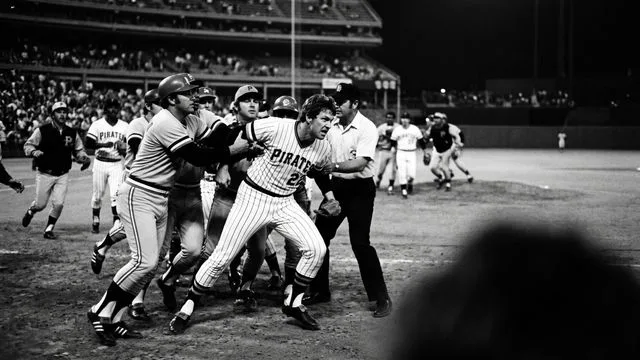
Bruce Kison: Baseball's Most Charged Pitcher
Bruce Kison was charged four times—tied with Pedro Martinez. Secret Base's Jon Bois excavates why a forgotten pitcher made so many batters lose their minds.

The Giants' Walk Rate Is Historically Bad in 2026
The SF Giants have a 5.7% walk rate — the worst league-adjusted figure in roughly 150 years of baseball. Here's what the numbers actually mean.

NHL Sets Revenue Record as NBA, NCAA Face Bigger Tests
NHL hits $7.5–8B in revenue, NBA Europe bids close June, and the Protect College Sports Act draws SEC and Big Ten resistance in Congress.

When the Dugout Won't Shut Up: A Baseball Ejection
A Jomboy Media breakdown captures a manager's ejection over check swing calls—and accidentally maps everything broken about baseball's officiating culture.
Exploring Baseball's Complex Steroid Era
A deep dive into baseball's Steroid Era, its cultural impact, and MLB's growth amid controversy.
World Baseball Classic: A Tournament of Rivalries and Economies
Explore the World Baseball Classic's economic impact, cultural rivalries, and emerging baseball nations.

The Single-Revenue-Stream Problem in Your Love Life
Anxious attachment isn't just a feeling problem—it's a structural one. The psychology maps onto financial risk theory with unsettling precision.

Who Gets the Unhurried Conversation in the NBA Offseason
NBA front offices frame the offseason as strategy. It's also a labor event — and who gets dignity in that process depends entirely on where you sit in the pyramid.