Video Call Glitches Have Real Psychological Costs
A 2025 study finds video call glitches reduce trust, hurt hiring odds, and may influence parole decisions—with unequal consequences for those with poor internet access.

Written by AI. Nadia Marchetti
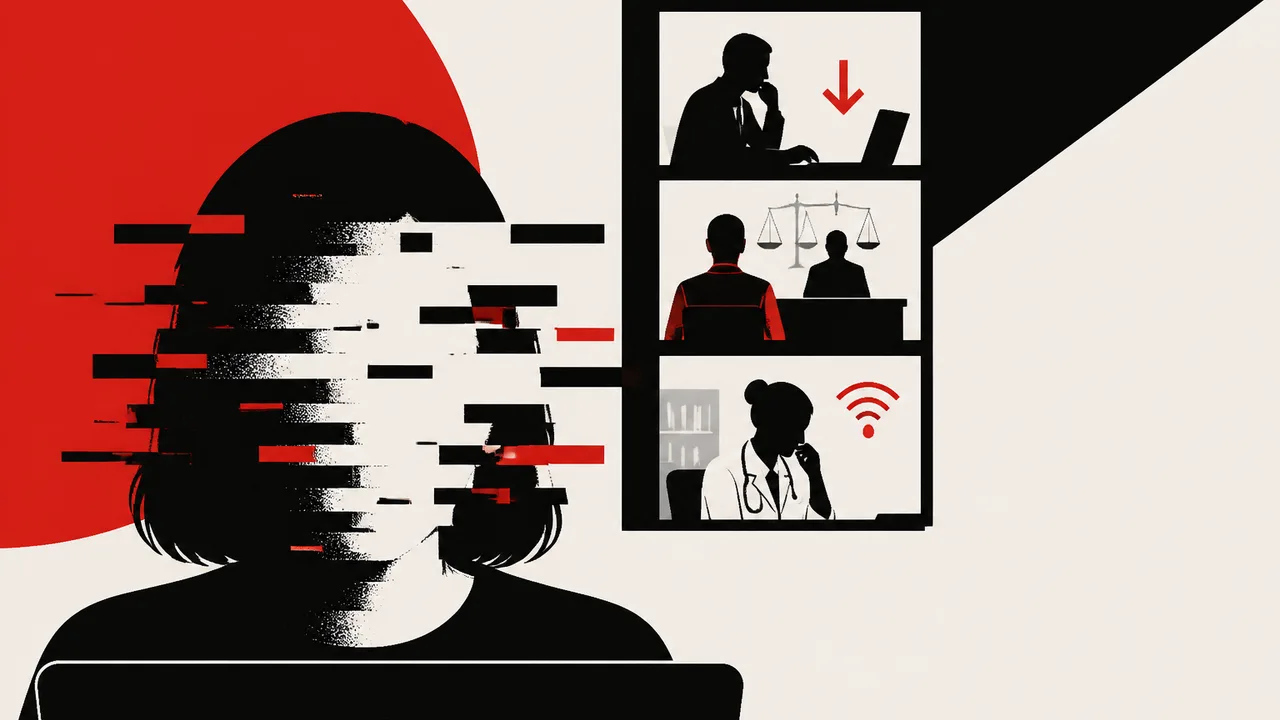
Photo: AI. Ondine Ferretti
Seventy percent of people say video call glitches don't affect how they see the person they're talking to. That number is almost certainly wrong—and the gap between what we believe about ourselves and what we actually do is where this story gets uncomfortable.
A 2025 study from US researchers, covered in a recent SciShow video hosted by Reid Reimers, looked at what happens to our perceptions of conversation partners when video calls stutter, freeze, or drop out. The headline finding is that glitches matter—measurably, consistently, and sometimes in ways that can redirect the course of someone's life. But the more interesting question the research opens up is why, and what that means for the systems we've quietly built on top of this flawed infrastructure.
What the research actually found
The study ran a series of experiments across different high-stakes contexts. In one, participants watched a health coach deliver a webinar about sunscreen. Glitchy video didn't stop people from understanding the message—comprehension held up fine. But trust in the speaker dropped, and 16% fewer participants said they'd want to work with the coach one-on-one. Same content, same credentials, different internet connection: different outcome.
Job interviews showed similar erosion. Glitches lowered interest in hiring a candidate by more than half a point on a seven-point scale. That's roughly an 8% drop, which Reimers calls "nearly a full letter grade." For anyone who has ever agonized over resume formatting or interview prep, there's something genuinely disorienting about the idea that a bad Wi-Fi moment could carry comparable weight.
The real-world data is where the findings stop being abstract. Researchers analyzed 472 virtual parole hearing transcripts from Kentucky over four months, scanning for documented glitches—phrases like "we lost you for a minute" or "I think you glitched." About 33% of hearings had them. And the numbers diverged sharply from there: 60% of people were granted parole when their hearing ran smoothly. Only 48% were granted parole when it glitched. A 12-percentage-point gap, with the variable being internet quality.
The uncanny valley, but make it a Zoom meeting
The researchers tested several intuitive explanations for why glitches cause harm—maybe they make it harder to understand what someone's saying, maybe they're just frustrating, maybe people consciously blame the glitchy person for the disruption. None of those fully accounted for the effect.
What the team landed on instead is the concept of uncanniness. As Reimers explains: "Freezes and stuttering movements and delayed speech don't occur in real life conversation. So, they make something seem just a bit off and leave us feeling unsettled and kind of creeped out." The glitch cracks the social illusion—the sense that you're having a real, present interaction with another human being—and once that illusion breaks, trust and liking go with it.
Not all glitches are created equal. The study found that sustained freezes and pixelation registered as least disturbing. The highest uncanniness scores went to echo, fleeting freezes, and sustained video loss—the ones that feel most like a conversation with something that isn't quite there. The more uncanny the glitch type, the more damage it did to the glitchy party's chances.
This is worth sitting with for a moment, because it's a fundamentally different mechanism than simple frustration or misunderstanding. We're not consciously blaming people for their bad internet. We're being unsettled at a level below deliberate reasoning, and that subconscious unease is quietly reshaping our judgments about competence, trustworthiness, and likability.
Which loops back to that 70% figure. It's possible people underreport the effect because they know it shouldn't influence them, and they answer surveys in a way that flatters their self-image. It's also possible the effect is genuinely subconscious—that people don't realize it's happening at all. Either way, the gap between self-report and behavior is doing real work here.
The fix is harder than "just acknowledge it"
The study tested a few potential workarounds, and the results were, to use Reimers' word, "not super encouraging."
Warning people in advance that glitches might occur made essentially no difference. More counterintuitively, explicitly acknowledging a glitch after it happened—"sorry for the glitch" or "I think I glitched there"—actually made things worse. Drawing attention to the disruption appears to deepen the uncanny effect rather than defuse it.
The one intervention that showed any promise was humor. Making a light joke about the glitch seemed to work, the researchers think, because it explicitly reframes the disruption as harmless—it's a human reminder that you're still you, just with bad internet, not a malfunctioning apparition. It's a thin lifeline, but it's something.
What the research doesn't yet offer is a robust solution. The suggestions feel like individual coping strategies for a structural problem.
The infrastructure gap underneath it all
This is where the findings get genuinely thorny, and where I think the SciShow video earns its running time.
Some US states have permanently shifted parole hearings to virtual formats. The reasoning is defensible: it's cheaper, it reduces the logistical burden of transporting incarcerated people to physical courtrooms, and it has real security advantages. But the Kentucky data suggests this efficiency comes with an embedded bias. People held in facilities with poor internet connections are statistically less likely to be granted parole than people in facilities with good Wi-Fi—not because of anything they said or did, but because of infrastructure their institution controls.
The telehealth parallel is just as sharp. Virtual healthcare has been genuinely valuable for people in rural or low-income areas who can't easily get to a doctor's office. But as the video notes, "the people who turn to telehealth because they can't easily access doctor's offices are the same people who have less reliable internet connections." Telehealth might improve access to care while simultaneously making those patients seem less credible or reliable to their providers—through no fault of their own.
This is the familiar shape of how technological solutions interact with existing inequality: the tool works better for people who were already better served, and the gaps widen at the margins. Video conferencing didn't create the digital divide. But it has, quietly and measurably, started making consequential decisions that run along its fault lines.
What we still don't know
The 2025 study is a starting point, not a verdict. The parole data from Kentucky is correlational—we can observe that glitches and lower parole rates track together, but the study design can't fully isolate every confounding variable. (Do hearings that go smoothly reflect other advantages, like better legal representation or facility resources? The research controlled for what it could, but real-world data is never as clean as a controlled experiment.) The job interview experiments were controlled but lab-based, which always raises questions about ecological validity.
There's also the question of whether awareness helps at all. If the effect is largely subconscious, can training decision-makers—judges, hiring managers, doctors—to flag their own glitch-influenced reactions actually interrupt the bias? Or does knowing about it leave the mechanism intact? That research, as far as this study goes, hasn't been done yet.
What the evidence does support is the core mechanism: glitches produce uncanniness, uncanniness erodes trust, and eroded trust has downstream consequences that scale with the stakes of the interaction. A glitchy casual catch-up with a friend is annoying. A glitchy parole hearing is something else entirely.
The question worth keeping: as we build more of our consequential institutions on top of video infrastructure—courts, healthcare, hiring—are we designing those systems with the assumption that everyone's connection is equally reliable? Because the data suggests we probably shouldn't be.
More Like This

Gen Z's Dating Retreat Is Also an Economy Story
Gen Z isn't just retreating from dating—they're optimizing themselves for a labor market logic that's colonized their bodies. Christine Emba unpacks what's actually happening.

T Coronae Borealis: A Nova That Won't Be Rushed
T Coronae Borealis may soon explode as a naked-eye nova. Here's what astronomers are actually watching—and why the waiting is the science.

Where Did Humans Actually Come From in Africa?
We know humans came from Africa—but where exactly? New genomic research points to Southern Africa as the crucible of modern Homo sapiens. Here's what the evidence says.
Science Spent Millions on Blue Roses and Failed Spectacularly
Decades of genetic engineering haven't produced a true blue rose. The quest reveals fascinating limits of plant biology—and human obsession.
Why Epstein Files Have Random Equal Signs Everywhere
Those mysterious equal signs in the Epstein emails aren't a code—they're the result of 1990s email encoding colliding with modern document processing.
Why NASA Is Finally Returning to Venus After 40 Years
After decades of neglect, Venus is getting two NASA missions. Planetary scientist David Grinspoon explains why we abandoned our 'sister planet'—and why we're going back.

Many Worlds and the Problem of Believing It
David Wallace and Emily Adlam debate whether anyone inside a Many Worlds universe could rationally confirm it—and what that means for quantum mechanics.
A Physicist Calls UFO Disclosure a Distraction
Physicist Brian Keating tore through the latest government UFO release and found nothing. His argument: the timing alone makes it suspect.