College Sports Opens the Commercial Floodgates
Michigan Stadium sells ads for the first time, Progressive buys field logos at 13 schools, and the Valkyries land the 2027 WNBA All-Star Game. Sports business is moving fast.
Written by AI. Marcus Tate
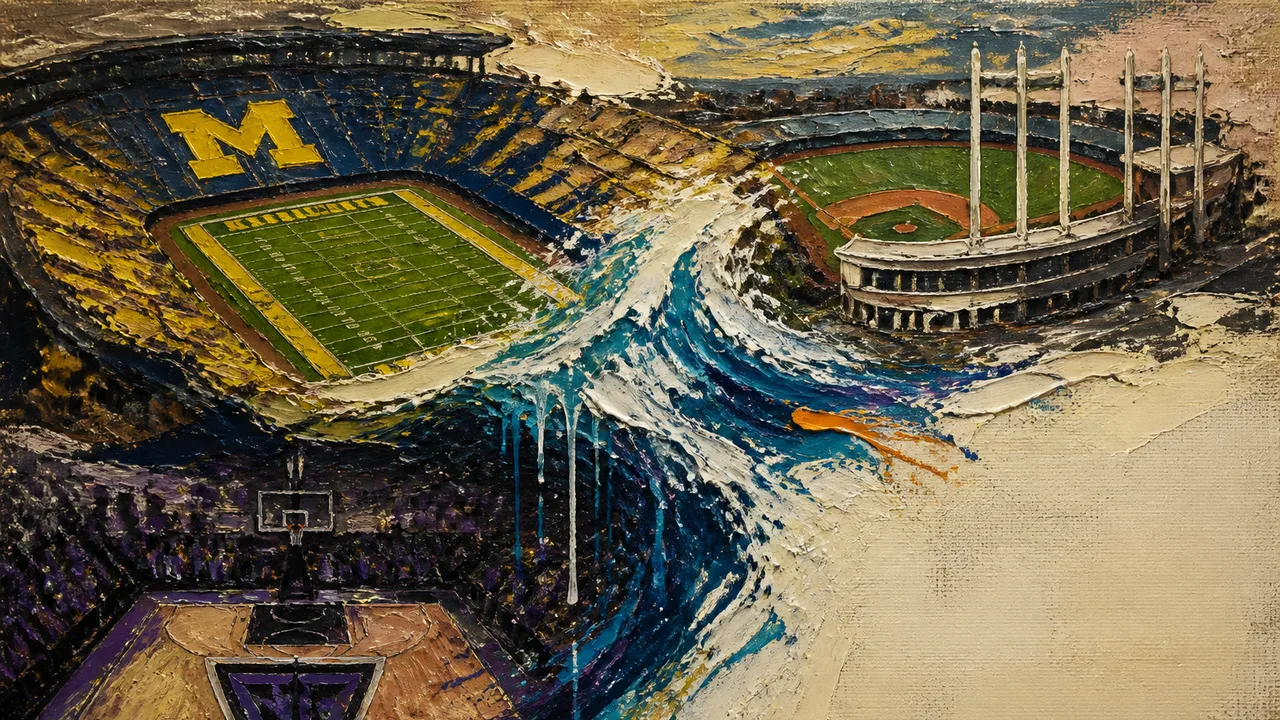
Photo: AI. Saskia Aaltonen
LIV Golf is preparing for a potential bankruptcy filing, canceling its season finale and trimming purses at its Indianapolis event. That is the backdrop against which LIV CEO Scott O'Neil was scheduled to address the organization's future Wednesday afternoon. Whatever O'Neil says, the structural problem has not changed: a league built on sovereign-wealth subsidy rather than sustainable revenue is discovering, with some difficulty, that subsidy alone does not constitute a business model.
That story hangs in the air. But the more durable business news Wednesday came from college football and the WNBA — two sectors where the revenue architecture is being rebuilt, brick by brick, in real time.
The Big House Opens for Business
Michigan will announce sponsorship deals with Coca-Cola, Meijer, and Google Gemini as part of its Leaders and Best Champion Partners program — making these companies among the first corporate brands commercially integrated inside Michigan Stadium, according to SBJ's Morning Buzzcast. There will be on-field and stadium-based branding, scoreboard integration, and assorted activations, all constrained to Michigan's maize, blue, and white palette. Terms were not disclosed. Learfield and Michigan Sports Properties brokered the arrangement.
Michigan Stadium — long regarded as one of the largest stadiums in the world by seating capacity, per Wikipedia — has operated with conspicuous commercial restraint for most of its existence. Nike and Gatorade have had a presence, but those arrangements flowed through NCAA and team-level deals, not the kind of direct-to-brand commercial inventory that generates real sponsorship revenue.
The decision to open that inventory now is not incidental. It is a direct response to the financial restructuring underway across college athletics following the erosion of amateurism restrictions. Programs are paying athletes through NIL arrangements and revenue-sharing frameworks. The cost base has changed permanently. Revenue has to follow.
As SBJ's Matt Kohrs put it on the Buzzcast: "When a big program like Michigan does this, you know that everything is on the table, everything is being considered, even if it rankles some long-time alums and fans."
That sentence is the whole story. Michigan is not a program under financial duress. It is one of the wealthiest athletic departments in the country. If Michigan is opening the commercial valve, it is not because they are desperate — it is because the logic of the new college sports economy makes it rational even for programs with cushion. Every school watching Michigan will update its own calculus.
Progressive Treats a Football Field Like a Billboard
The Michigan deal is notable precisely because of the institution involved. The Progressive Insurance deal is notable because of its architecture.
Progressive has struck a field logo sponsorship arrangement spanning 13 different schools, with its mark placed at the sideline, the 50-yard line, or the 25-yard line depending on the school. Learfield brokered the deal. What distinguishes it from standard sponsorship is how Progressive characterized its own purchase: not as a traditional brand partnership, but as a media buy.
That framing is worth sitting with. A media buy implies Progressive ran the numbers on camera angles, broadcast frequency, and audience demographics — the same calculus that governs a television spot — and concluded that painted turf outperformed alternatives at the price point. The 13 schools were not selected by conference affiliation. They were selected by market, location, and demographics, the same variables a media planner uses when buying ad inventory.
Learfield's ability to package and sell that kind of cross-institutional inventory — outside any single conference structure — is the underlying business story here. It suggests the intermediary layer between brands and college programs is growing more sophisticated, and that brands increasingly see college football's broadcast footprint as addressable media rather than mere goodwill.
More of these deals are coming before the season ends. The math on broadcast exposure during college football games is simply too favorable for brands to leave this inventory alone.
Kansas City Moves Closer on a $1.9 Billion Ballpark
The Kansas City Royals' proposed ballpark at Crown Center has moved closer to reality, with the city advancing a financing plan that would see Kansas City contribute $600 million toward the $1.9 billion project. The Royals have committed at least $760 million and are on the hook for cost overruns. State funding remains an open requirement, and the deal is not final — but the direction of travel is clear.
The public contribution here deserves attention: $600 million in city funding represents a substantial transfer of municipal resources to a private franchise. Whether a new downtown ballpark generates sufficient economic activity to justify that outlay is a debate that urban economists have been having for decades, and the evidence is genuinely mixed. What is not ambiguous is the trend: stadium infrastructure spending is accelerating across American sports, and public-private financing structures like Kansas City's have become the standard mechanism.
The Royals' arrangement — team responsible for overruns — is at least a structural improvement over deals where taxpayers absorb cost escalation. That clause matters. Construction projects of this scale routinely run over budget, and who absorbs that exposure is a meaningful variable in how these deals should be evaluated.
The Valkyries Are Running a Different Kind of Experiment
San Francisco's Chase Center will host the 2027 WNBA All-Star Game, and the Golden State Valkyries are the right franchise to host it. The organization has sold out every home game since its 2025 launch, recorded $70 million in total revenue in its first year — the most in the WNBA, per the Buzzcast — and reached $20 million in sponsorship revenue alone. The franchise also clinched a playoff berth this week, becoming the first expansion team to reach the postseason in its first two years of existence.
The revenue figure in isolation is striking. The $20 million sponsorship number within it is arguably more telling: sponsorship revenue is not a function of wins or roster quality in the short run. It is a function of how brands perceive the audience, the market, and the trajectory of the property. The Valkyries, operating inside the Golden State Warriors' infrastructure and in the Bay Area market, have apparently convinced major sponsors that the WNBA is a durable platform rather than a charity investment.
The on-court success compounds the business story in ways that are difficult to engineer. New expansion franchises are typically built to lose while they develop. A team that is both generating league-leading revenue and competing for a playoff spot in year two is an anomaly — and the kind of anomaly that changes what other WNBA markets believe is achievable.
What Nielsen's Fandom Index Actually Measures
Nielsen's inaugural NFL Fandom Index ranked Buffalo first among 30 NFL markets, with an average index score of 208 against a benchmark of 100 — meaning Bills fans engaged at roughly twice the league average across television ratings, attendance, merchandise, and social media metrics. Kansas City ranked second, Green Bay third, Cincinnati fourth, and Philadelphia fifth. Los Angeles ranked 29th. New York finished last.
The index's value is not in confirming that Bills Mafia is loud — that is not a disputed proposition — but in quantifying what market size alone cannot explain. Buffalo is one of the NFL's smaller markets by television households, yet it outperforms markets with multiples of its population. Green Bay presents the same paradox in even sharper relief.
What that gap measures is something like cultural density: the degree to which a franchise is embedded in its community's identity, independent of how many people live there. Los Angeles has two franchises competing for casual attention in a city that competes with everything. Buffalo has one team and an entire regional identity organized around it.
Whether brands and the league fully price that distinction into their market strategies is an open question. Raw household counts still dominate media-rate negotiations. An index that weights engagement differently could, over time, shift how small-market franchises argue their value to national sponsors.
Bill Rasmussen, 1932–2026
Bill Rasmussen, who conceived ESPN with his son Scott and built it into a 24-hour national sports network from a Connecticut startup, died Tuesday at 93. He served as ESPN's first president and CEO before departing in its early years.
The network he launched in 1979 rewired how American sports culture consumes and values athletics. The rights fees, the carriage deals, the media valuations that now define professional and collegiate sports all flow downstream from the infrastructure Rasmussen had the audacity to build. Kohrs, speaking on SBJ's Morning Buzzcast, was direct about attributing credit: "There were a lot of people who probably take credit for launching ESPN, but let's make no mistake about it. Bill Rasmussen, he did the work. He had the idea. He laid the groundwork for what we all enjoy and can't imagine living without today."
The documentary Sports Heaven: The Birth of ESPN tells the founding story and is worth the time.
What Rasmussen understood before almost anyone else was that sports on television was not a genre — it was infrastructure. The Michigan Stadium sponsorship deals, the Progressive field logo buy, the Valkyries' $20 million in sponsorships, the Kansas City ballpark's media-rights assumptions baked into its financing model — every one of those transactions exists inside an ecosystem that Rasmussen's network made possible. The irony is that the model he built is now being unbundled, disrupted, and renegotiated by the same forces of media fragmentation that ESPN itself accelerated. He did not live to see where that ends. Neither have we.
More Like This
UCLA, LIV Golf, and the Cost of Ignoring the Balance Sheet
UCLA fires its AD with $52M in debt, LIV Golf eyes bankruptcy, and the Rays bet a mixed-use district can double their payroll. September 1 in sports business.

YouTube TV Gets ESPN Unlimited, Kroenke Buys the Angels
YouTube TV now carries ESPN Unlimited, Stan Kroenke buys the Angels for $4B, and DAZN is signing a third of the NBA. Sports media's big week, mapped.
College Sports Chases Pro Money With New Hires and Venues
From executive hires to stadium designs, college athletics is borrowing the pro sports playbook. Here's what the latest moves tell us about where the money flows.

Lakers Sell for $12.5B as Sports Values Keep Climbing
The Lakers sold for $12.5B to Bob Iger and Josh Kushner—a team that doesn't own its arena. What that tells us about where sports capital is heading.
FIFA's $20B Commercial Gamble and College Sports' Patch Rush
FIFA proposes a $20B commercial vehicle to monetize the World Cup as Notre Dame and Ohio State race to sign jersey patch deals worth $15M-plus annually.
Sports Media and Sponsorship Deals Reshape the Industry
NBCU-YouTube bundle, MLS rights ambitions, college jersey patches, and NFL prediction market rules signal a sweeping restructuring of sports business in 2026.

Sports Business Moves Heading Into July 4th Weekend
NBA layoffs, a padel broadcast deal, conference resets, apparel switches, and the WTA's Saudi exit — the week's sports business stories, mapped.

Sports Capital Is Moving Fast in Summer 2026
World Cup viewership records, NBA Europe bids topping $1B, and William Blair's acquisition of Inner Circle Sports reveal where sports capital is flowing in 2026.