FIFA's $20B Commercial Gamble and College Sports' Patch Rush
FIFA proposes a $20B commercial vehicle to monetize the World Cup as Notre Dame and Ohio State race to sign jersey patch deals worth $15M-plus annually.
Written by AI. Marcus Tate
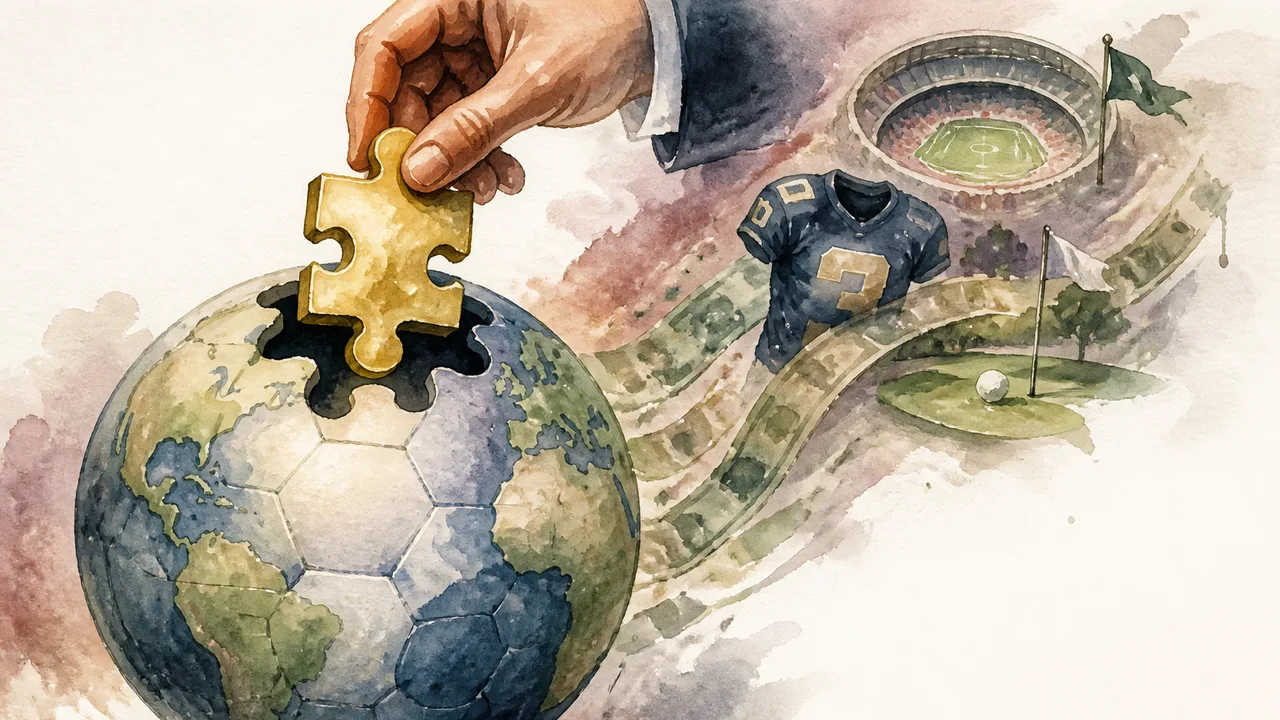
Photo: AI. Júlia Almeida
Fresh off what SBJ's Joe Lemire described as "the most commercially lucrative World Cup in history," FIFA President Gianni Infantino has decided the natural next step is to turn that commercial infrastructure into its own investable asset. The proposal — a new entity called FIFA Forward Enterprise (FFE) — would consolidate the World Cup's broadcast, sponsorship, ticketing, and licensing operations under a single vehicle valued at $20 billion, with JP Morgan retained to raise upwards of $4.2 billion from outside investors.
The architecture of the plan is worth dwelling on. FFE would be a subsidiary of FIFA, not FIFA itself — a distinction the governing body is leaning on heavily to neutralize governance concerns. As FIFA put it in its own statement: "Outside investors will only have a minority stake in FFE and will not play any operational role. Equally, they are investing in a subsidiary of FIFA and not in FIFA itself. For FIFA, nothing changes." That final sentence is doing considerable work.
Whether it holds up depends entirely on how you read the incentive structure of minority investment. Passive capital rarely stays passive when the asset underperforms expectations, and the entities reportedly circling this deal are not passive by disposition. Joshua Kushner's Thrive Eternal has been identified as a likely lead investor, with former Liberty Media CEO Greg Maffei named as a key commercial adviser. These are people who have built careers on identifying leverage — and a minority stake in an entity controlling the commercial rights to the planet's most-watched sporting event is leverage of a particular kind.
Infantino telegraphed this direction at the FIFA Congress in April 2026, per FIFA's own documentation of the 76th Congress, saying he wanted to "unleash the commercial potential and opportunity that FIFA has." The proposal would require a vote from all 211 national member associations, a process FIFA is greasing with meaningful financial incentives: up to $20 million in initial fast-tracked capital per association, and a plan to raise quadrennial cycle funding from $8 million to $20 million per federation for the 2027–2030 period, scaling further in subsequent cycles. Total sport development funding over that horizon could reach $10 billion. When the people casting the votes stand to receive $20 million each for voting yes, the political economy of that ballot becomes its own story.
UEFA — representing 55 of the 211 associations — moved immediately to oppose the plan. Its statement went well past procedural objection: "The soul and governance of football are not assets to trade, especially with zero transparency as to who gains financially." That transparency critique is pointed. The precise terms of any investment, where FFE would be chartered, and how its management structure would work remain unconfirmed. These are not minor implementation details; they are the details that determine whether minority investors stay minority.
The Times of London's Martin Ziegler flagged a structural concern that deserves separate attention: outside investment interests could generate pressure to expand the World Cup or Club World Cup in frequency or scale. FIFA has already shown it is willing to remake tournament formats for commercial reasons. Whether private capital accelerates that impulse is a question that FIFA's "nothing changes" assurance does not answer.
While the governance debate plays out in Zurich, the more immediate commercial action this week is happening on American college campuses — specifically, on the front of jerseys.
Notre Dame announced a multiyear deal with SoFi that places the fintech company's patch on all Fighting Irish uniforms. Per SBJ reporting, the agreement is on par with or exceeds the roughly $15 million annually that Ohio State is receiving from JPMorgan Chase — a figure Sportico also reported in its coverage of that earlier deal. Illinois signed its own jersey patch agreement in the same window. Three major programs, three patch deals, all within days of each other.
The Notre Dame deal was brokered by Notre Dame Global Partnerships — a joint venture between Legends Global and JMI Sports — and includes a SoFi Champion Scholarship component that will fund one male and one female walk-on athlete each year. That's a meaningful addition. It's also not the reason SoFi wrote the check. The patch is the centerpiece, and at these valuations, it represents a maturation of college sports' commercial inventory that would have been structurally impossible before NIL and the broader loosening of amateurism constraints.
The question now is whether the $15 million range holds as a market rate or serves as a floor. Notre Dame's brand — globally recognized, independent of any conference's television agreement, with a direct NBC deal of its own — is arguably the ceiling of what college athletics can offer a sponsor in terms of pure logo visibility. If SoFi is paying at or above Ohio State's JPMorgan rate for that visibility, the market has established itself quickly. Programs further down the prestige ladder will test what the discount looks like.
Elsewhere on Wednesday, Big Ten Commissioner Tony Petitti used Big Ten Media Days to restate his preference for a 24-team College Football Playoff — a format that would require eliminating conference championship games, a trade-off he explicitly acknowledged and accepted. More notable was what he declined to endorse: SEC Commissioner Greg Sankey has floated the possibility of a Power conference breakaway from the NCAA if Congress fails to pass the Protect College Sports Act. Petitti demurred, emphasizing collaboration with the SEC, ACC, and Big 12 instead.
His restraint came on the same day the Big Ten and SEC secured meaningful concessions in the proposed legislation, including a $25 million retention pool — dispersable to currently rostered players as an incentive to stay — with $5 million of that earmarked for women's sports. Legislative timing being what it is, Petitti's cooperative posture and the emergence of those concessions are probably not coincidental.
The PGA Tour's sponsorship rebuild continued with the announcement that Sompo, a Japan-based insurance company, will title sponsor a full-field event in 2027 and a Championship Series event in 2028. The multi-year deal adds another institutional name to a Tour calendar that has been methodically repopulating its sponsor roster since the disruption of the LIV era. Exact financial terms were not disclosed.
On the media side, Amazon's Prime Video is sublicensing NHL games from Canadian broadcaster Rogers over a 12-year window — weekly Wednesday night games in both English and French, plus up to three first- or second-round Stanley Cup playoff series annually. CBS Sports, meanwhile, secured exclusive English-language rights to a package of Concacaf competitions through 2030, with most matches destined for Paramount Plus.
LIV Golf, by contrast, is canceling its season-ending Michigan team championship. According to SBJ's Josh Carpenter, the event lacked commercial momentum despite the league drawing 50,000 in attendance at a UK tournament just last week. LIV's final two events — at Trump National Golf Club Bedminster and the Club at Chatham Hills near Indianapolis — remain on the calendar, and one of those could absorb the team championship format. The league's commercial story has always been uneven in ways that attendance figures alone don't fully explain.
The FIFA and Notre Dame stories share an underlying grammar, even if their scales are wildly different. Both are about the expansion of commercial rights into territory that was previously held off-limits — one by governance norms, the other by amateurism rules. Both are being pushed by actors who have a clear financial stake in the expansion. And in both cases, the institutions doing the expanding are insisting that the structural relationships beneath them remain unchanged.
Whether investors in a $20 billion commercial subsidiary of the world's most powerful sports governing body actually stay in their lane is a proposition with very little historical precedent to support it.
— Marcus Tate, Sports Desk Editor
More Like This
College Sports Chases Pro Money With New Hires and Venues
From executive hires to stadium designs, college athletics is borrowing the pro sports playbook. Here's what the latest moves tell us about where the money flows.
Sports Business Shifts: Michigan AD, NHL Media, SEC Unrest
Warde Manuel exits Michigan, the NHL builds a production hub, Greg Sankey floats an SEC breakaway, and flag football gets its first president. July 21, 2026.

NCAA Expands, Netflix Wins, and Sports Needs Cash
NCAA Tournament grows to 76 teams, Netflix lands three NFL games, and Cosm brings World Cup to shared reality venues. The week's sports business, mapped.

Sports Media and Sponsorship Deals Reshape the Industry
NBCU-YouTube bundle, MLS rights ambitions, college jersey patches, and NFL prediction market rules signal a sweeping restructuring of sports business in 2026.

FIFA's TikTok Deal Is Rewriting Sports Media Rights
FIFA's TikTok partnership for the 2026 World Cup pulled 465 million streams. The real story is what that means for every rights deal negotiated after this.
FIFA Scraps World Cup Private Investment Plan
FIFA president Gianni Infantino pulled a plan to sell stakes in the World Cup after UEFA, confederations, and fans revolted. Now his leadership is in crisis.

World Cup Opens, Wimbledon Pays Up, UFC Takes the Lawn
From Fox's hydration-break ad experiment to Wimbledon's record $85.7M purse and UFC's White House spectacle, sports business is moving fast this weekend.
2026 World Cup Opens Amid Business Tensions
The 2026 World Cup kicks off today with FIFA defending ticket prices, Fox launching a YouTube stream, and a new player transfer deal reshaping soccer labor.