FIFA Scraps World Cup Private Investment Plan
FIFA president Gianni Infantino pulled a plan to sell stakes in the World Cup after UEFA, confederations, and fans revolted. Now his leadership is in crisis.

Written by AI. Elena Vasquez-Moreno
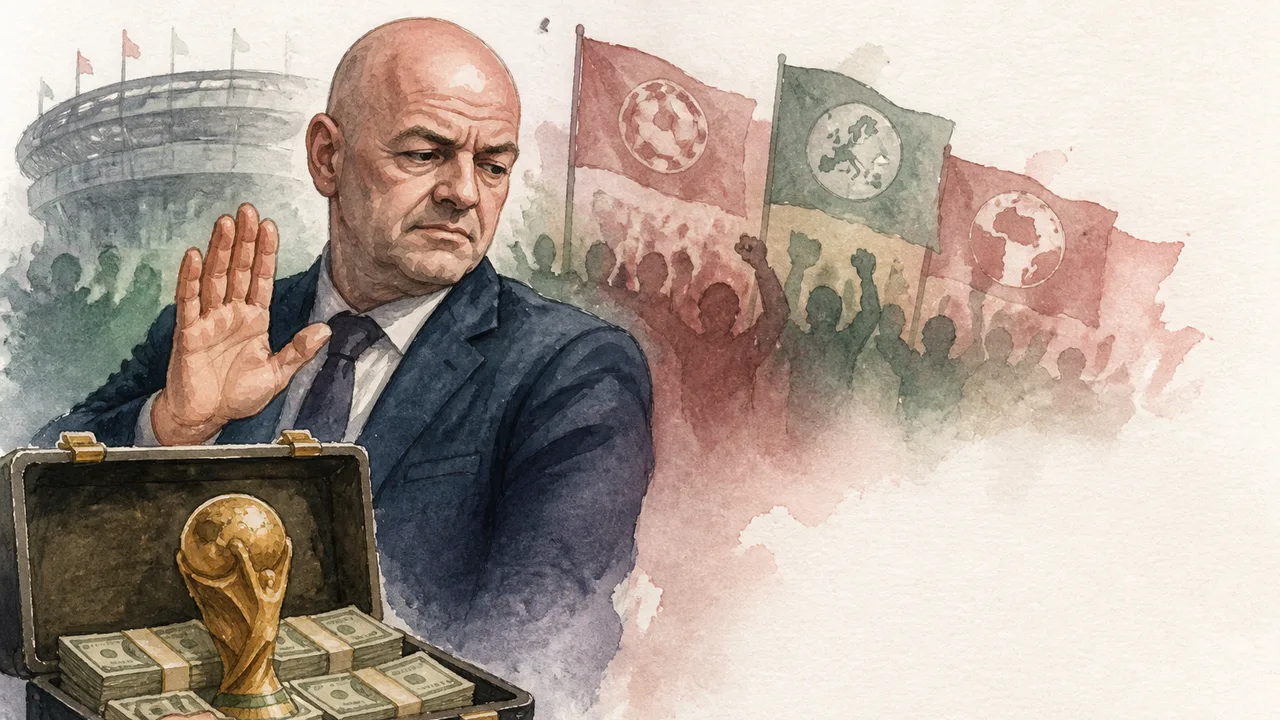
Photo: AI. Júlia Almeida
Gianni Infantino has presided over FIFA long enough to know that the organization's 211 member associations can be managed, cajoled, and—when necessary—offered cash to make problems go away. The cash, in this case, was $40 million per association: the sweetener attached to a proposal for private investment in FIFA's major tournaments, including the men's and women's World Cups. It did not work. By the time Infantino released his statement scrapping the plan, UEFA had threatened to pull its clubs from the 2030 World Cup, the Asian Football Confederation and CONCACAF had piled on, and according to ESPN, at least one senior FIFA executive had publicly stated that Infantino had deceived staff about the proposal—a claim that followed reports of a separate FIFA executive resigning in protest. What was supposed to be a bold revenue play had become, in the span of days, a case study in how quickly institutional authority can dissolve.
The statement Infantino released was the kind of carefully worded retreat that says everything without admitting anything: "Having listened carefully to all the views, it's become clear that the project has created divisions of a nature that regardless of the level of support are no longer in the interest of the objective set out in the first place. Our purpose has always been and will always be to unite and improve. As a result, this proposal will not proceed."
Translation: the vote count was not there, the optics were catastrophic, and the investors had already walked.
The architecture of the collapse
James Fray, who broke the story and spoke to BBC News, framed the collapse in characteristically blunt terms: "This was a question of politics really killing this deal. The numbers simply didn't add up."
That framing is worth sitting with, because it contains a tension worth unpacking. The numbers — or at least FIFA's version of them — were actually the easy part of the pitch. Private capital flowing into FIFA's commercial structure could, in theory, expand revenue streams for smaller federations that currently subsist on thin distributions from the World Cup cycle. The $40 million per-association offer was, by the standards of most national football budgets, real money. And the underlying premise — that the World Cup is a massively undermonetized asset relative to, say, a Premier League rights deal or a Champions League sponsorship package — is not obviously wrong.
But Infantino made a critical error that has nothing to do with the math and everything to do with governance: he announced the plan without building the coalitions first. Brian Sheretta, writing for American Soccer Now and Soccer America, put it plainly when speaking to BBC News: "There was no consensus building before this plan was announced. It was essentially forced on people from day one... Usually when you want to make a bold decision, you gather everyone around, you talk about it in the back rooms and you try to come to a consensus before the plan is put in place. And in this case, that was not done."
That process failure transformed what might have been a negotiable proposal into a trust referendum — and Infantino lost.
The UEFA variable
Of all the dominoes, UEFA's was the one that mattered. When European football's governing body announced it would not send its clubs to the 2030 World Cup — which is set to be hosted across Spain, Portugal, and Morocco — the practical implications were immediate and undeniable. Jude Bellingham, Kylian Mbappé, and most of the sport's marketable stars play in European club competitions. A World Cup without them is not a product any private investor would want a stake in. Fray, speaking to BBC News, made the sequencing clear: "As soon as UEFA came out with that statement, this plan was already on the rocks."
What UEFA's move also did was surface the real power map of global football. FIFA nominally governs the sport. But European club football generates the revenue that makes players, agents, broadcasters, and sponsors care about the World Cup in the first place. When UEFA decided to call that bluff, Infantino discovered the limits of his authority with unusual speed.
Sheretta's read on the aftermath is that UEFA now feels emboldened — and that assessment seems reasonable. "He's certainly a weaker leader now of FIFA than he ever has been," Sheretta told BBC News. "I think UEFA probably feels emboldened right now in terms of the fact of the power that it has over global football when it was able to really essentially get Infantino to back down."
That power dynamic is worth watching. UEFA versus FIFA tensions are not new — the European Super League fiasco of 2021 was, in some ways, a preview of what happens when European club interests feel threatened by a governing body they view as overreaching. The difference now is that it was FIFA doing the overreaching, and UEFA that played the role of populist defender.
The process problem, and whether the idea itself was sound
Here is where the analysis gets genuinely complicated, and where easy narratives about fan power should be held at arm's length.
FIFA's stated rationale for the proposal — finding new revenue channels to benefit smaller, developing football nations — is not inherently cynical. The global distribution of football wealth is deeply uneven. The Premier League's commercial machine dwarfs the entire operating budgets of most national federations. If private capital could be structured to flow downward rather than simply extract upward, there would be a coherent case for it.
The problem is that FIFA never made that case transparently, never submitted its assumptions to independent scrutiny, and never explained why the revenue from a recently concluded World Cup — which generated substantial commercial returns — was insufficient to meet those objectives. As Sheretta noted: "We're just coming off a World Cup right now where lots of revenue came in. Tons of revenue came in. So why wasn't that enough to meet FIFA's objectives?"
The absence of answers to that question is not a reason to assume the proposal was purely extractive. It is a reason to wish the proposal had been subjected to the kind of public analysis that might have either vindicated or condemned it on its actual merits. Instead, the optics of the political connections involved, the speed of the announcement, and the revelation per ESPN that FIFA's own senior staff felt deceived all ensured the proposal would be read in the worst possible light before anyone had interrogated the financial mechanics.
That is a governance failure, and it belongs to Infantino.
What comes next for Infantino
Fray described the situation as "probably the darkest period in FIFA's [121-year] history" — FIFA was founded in 1904, per Wikipedia, making the figure cited by Fray off by a year — but the hyperbole, if it is hyperbole, contains something real. Infantino faces reelection in early 2026 and has been running effectively unopposed. That calculus may shift.
Sheretta was candid about his uncertainty: "It's going to be very close and wouldn't surprise me if the answer is no... This is a very public humiliation for him. It's very tough to survive these kinds of things."
The historical comparison that Sheretta reached for was the 2021 European Super League, when fan protests in England and across the continent forced founding clubs to withdraw within days of the announcement. The analogy has real limits — the Super League was a breakaway attempt by club owners, while this was a FIFA-initiated commercial restructuring — but the underlying dynamic is similar: a governing body or ownership class miscalculates how far it can push structural change without consent, and the backlash forces a retreat.
What neither episode answers is whether the retreats address the underlying tensions or simply delay them. The financial pressures that made private investment look attractive to FIFA this week have not gone away. The next person who holds Infantino's job — whether that is Infantino himself after a humbling reelection campaign, or someone new — will eventually have to answer the same questions about how to grow FIFA's revenue base without ceding the institutional independence that gives the World Cup its identity as a public good.
The plan is dead. The question it was trying to answer is not.
By Elena Vasquez-Moreno
More Like This
Jeff Bezos Eyes a $1.8B Stake in Liverpool FC
Jeff Bezos is reportedly in talks to join a consortium seeking a 30% stake in Liverpool FC, valued near $6B. Here's what the deal structure reveals.
FIFA's $20B Commercial Gamble and College Sports' Patch Rush
FIFA proposes a $20B commercial vehicle to monetize the World Cup as Notre Dame and Ohio State race to sign jersey patch deals worth $15M-plus annually.
World Cup Streaming Scams Fuel a $220M Black Market
Cybercriminals are exploiting World Cup fever with stolen streaming accounts and fake FIFA sites. Here's what the $220M underground economy actually looks like.
Trump, FIFA, and the Balogun Reinstatement Explained
Trump called FIFA's Infantino to contest Folarin Balogun's red card ban. FIFA reversed it. Here's what we know—and what remains unanswered.
Tampa City Council Stalls $2.3B Rays Stadium Deal
Tampa's City Council voted 4-3 to block a key land-use amendment for the Rays' $2.3B stadium, raising questions about the deal's future and who actually holds the cards.
World Cup 2026's Heat, Cost, and Political Fault Lines
From $11,000 tickets to denied visas and doubled emissions, the 2026 World Cup's off-pitch challenges may define the tournament as much as the football.

The Single-Revenue-Stream Problem in Your Love Life
Anxious attachment isn't just a feeling problem—it's a structural one. The psychology maps onto financial risk theory with unsettling precision.
FIFA's Power Struggle: Infantino Under Pressure
FIFA issued a statement defending Gianni Infantino against what it calls a coordinated effort to oust him. Here's what the crisis reveals about global football governance.