World Cup Streaming Scams Fuel a $220M Black Market
Cybercriminals are exploiting World Cup fever with stolen streaming accounts and fake FIFA sites. Here's what the $220M underground economy actually looks like.

Written by AI. Jonathan Park
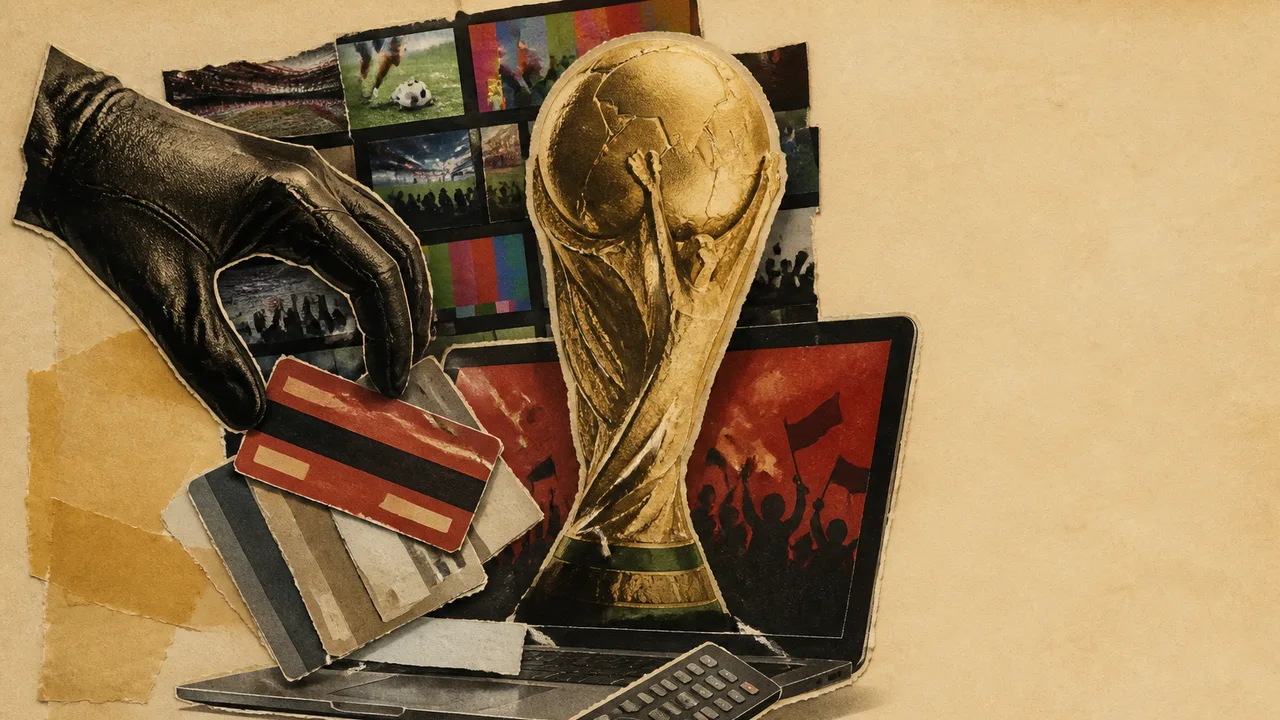
Every four years, the World Cup hands cybercriminals something they can't manufacture on their own: a deadline. Billions of people want to watch, many of them right now, and the friction between that demand and the patchwork of regional broadcast rights creates a gap that criminal operators have learned to monetize with considerable sophistication.
This year, that gap has a price tag. According to Fortune, HUMAN Security estimates the black market for stolen streaming accounts tied to World Cup activity is currently valued at nearly $220 million. That figure covers a secondary market where credentials for legitimate streaming services — accounts people actually paid for — are harvested, bundled, and resold at a fraction of their retail cost. The scale is substantial enough that it's stopped being a niche fraud story and started being a structural problem for how the sports rights industry distributes content.
The mechanics of a stolen-account economy
The pipeline here is worth understanding, because it's not as simple as "hackers steal passwords." The credential theft that feeds this market typically happens long before the World Cup kicks off, through phishing campaigns, data breaches at unrelated services, and malware deployed against users who reuse passwords across accounts. What the World Cup does is create demand-side pressure that makes it economically worth harvesting and packaging that inventory.
Flare's analysis of the illegal 2026 FIFA World Cup streaming underground maps the full attack surface: every "free stream" link shared on social media or distributed through piracy networks is a potential entry point for credential theft, malicious browser extensions, fake mobile applications, and large-scale tracking infrastructure. The user who thinks they're getting a free stream of a quarterfinal match is often paying in a currency they don't realize they're spending.
Crypto Briefing adds a dimension that tends to get underreported in piracy coverage: banking trojans deployed through these same piracy channels are specifically targeting cryptocurrency wallet holders. That's a meaningful detail. It tells you that the operators running these networks aren't just opportunistic account thieves — they're running diversified fraud operations that use streaming piracy as one acquisition channel among several.
Fortune reports that cybercriminals are approaching the tournament the way any business approaches a demand-surge event: expanding inventory and raising prices as consumer interest peaks. That's not a metaphor — it's a description of an actual pricing mechanism operating in real time. The accounts being sold aren't static stockpiles; the market is live and responsive.
The government response, and what it does and doesn't address
The Justice Department has moved on the most visible layer of this problem. According to a DOJ press release, federal authorities seized hundreds of internet domains used to illegally stream World Cup matches in real time — sites offering copyright-protected broadcast content as it aired, pulling rights from official broadcasters without authorization.
Domain seizures are a legitimate enforcement tool, and they do impose costs on piracy operators. But they address the distribution layer, not the credential-theft layer. Shutting down a streaming piracy site doesn't recover accounts already sold on underground markets, doesn't notify consumers whose credentials have been compromised, and doesn't touch the malware infrastructure that's harvesting new credentials in the background. The DOJ action is real; its scope just doesn't match the full architecture of the problem.
The FBI has focused its public-facing warnings on consumer behavior — specifically, the proliferation of fake FIFA websites and fraudulent livestreaming pages. WPBF reports that these counterfeit sites can look remarkably convincing and are engineered to harvest passwords, credit card numbers, and payment credentials. The FBI's posture here is essentially: be careful what you click. That's accurate advice. It's also advice that gets issued before every major sporting event and has not, so far, meaningfully moved the needle on consumer behavior at scale.
What the data tells us — and what it doesn't
The $220 million valuation from HUMAN Security, as reported by Fortune, and the scale of stolen accounts in circulation tied to World Cup activity are significant numbers that deserve some interrogation before we accept them as face value. Security firms have structural incentives to produce large, alarming figures — that's not a conspiracy, it's just how threat intelligence marketing works. A $220 million black market is a more compelling headline than a $40 million one, and it justifies larger client spend on the services being sold.
None of that means the figures are wrong. HUMAN Security has a legitimate research operation and there's no specific reason to doubt their methodology based on available information. But the responsible read is: this is one firm's estimate, derived from their particular visibility into the threat landscape, and the actual market size could be larger or smaller. What the data does establish convincingly is the shape of the problem — a live, pricing-responsive underground market that expands to meet World Cup demand — even if the exact dollar figure remains an estimate.
What's notably absent from the public record is a clear accounting of how many legitimate subscribers have actually discovered their accounts compromised and what remediation looks like. Streaming services have every incentive to detect and boot unauthorized sessions, but less incentive to publicize the scale of credential stuffing attacks against their platforms. The consumer harm is real but diffuse, which makes it easy for the industry to treat this as a background cost rather than an urgent accountability problem.
The structural tension underneath all of this
The piracy and credential theft that characterizes this World Cup moment doesn't exist in a vacuum. It exists in a specific context: a global event that billions of people want to watch, distributed through a rights licensing system that makes it expensive, geographically restricted, or simply unavailable through legitimate channels in significant parts of the world.
That's not an argument that piracy is morally neutral or that credential theft is acceptable. It isn't. People whose streaming accounts are stolen are real victims, and the fraud infrastructure that parasitizes piracy networks causes genuine harm that goes well beyond copyright infringement.
But the industry conversation that treats the demand for free or cheap streams as purely a law enforcement problem — solvable through domain seizures and FBI advisories — is missing something. The scale of the black market HUMAN Security identified isn't a story about a few bad actors taking advantage of sports fans. It's a story about what happens when content pricing and distribution decisions consistently fail to match the actual shape of global demand.
The streaming services and rights holders losing revenue to this market have legitimate grievances. They also have pricing power, regional licensing control, and packaging decisions that, in at least some cases, push consumers toward the door that the criminals have learned to stand beside.
Whether the industry's next move is better enforcement, broader access, or some combination of both is genuinely uncertain. What isn't uncertain is that a $220 million underground economy doesn't sustain itself on criminality alone — it sustains itself on unmet demand, and demand that size doesn't disappear when you seize a few hundred domains.
More Like This

USMCA Won't Be Renewed: What Annual Reviews Mean
The Trump administration has blocked USMCA's 16-year renewal, opting for annual reviews. Here's what that means for trade, business, and North America.

Piracy Is Now the Only Game Preservation Plan
Frank Cifaldi of the Video Game History Foundation says piracy is the only real game preservation method left. Sony's disc exit made the argument harder to ignore.
Bill Ackman's Art of Finding Invisible Money
Explore Bill Ackman's strategy of finding hidden value in companies, beyond standard metrics.

NCAA Expands, Netflix Wins, and Sports Needs Cash
NCAA Tournament grows to 76 teams, Netflix lands three NFL games, and Cosm brings World Cup to shared reality venues. The week's sports business, mapped.

France's World Cup Exit Handed Sportsbooks a Windfall
France's 2026 World Cup elimination relieved sportsbooks of their biggest liability. Here's how public betting patterns turned one team's loss into the industry's gain.

LLMjacking: When Hackers Steal Your AI API Keys
Hackers are stealing AI API keys and running up massive bills—one startup went from $180/month to $82K in 48 hours. Here's what's actually happening.

AI Company Logos All Look Alike. Here's What That Reveals
AI companies keep designing the same circular, gradient logo. Is it groupthink, strategic mimicry, or something more revealing about the industry itself?

France Sold Its Nuclear Turbine Crown Jewel to GE
How France sold the world's most powerful nuclear steam turbine to GE in 2015, then spent years engineering a buyback — and what it cost everyone involved.