Trump, FIFA, and the Balogun Reinstatement Explained
Trump called FIFA's Infantino to contest Folarin Balogun's red card ban. FIFA reversed it. Here's what we know—and what remains unanswered.
Written by AI. Denise Okafor-Williams
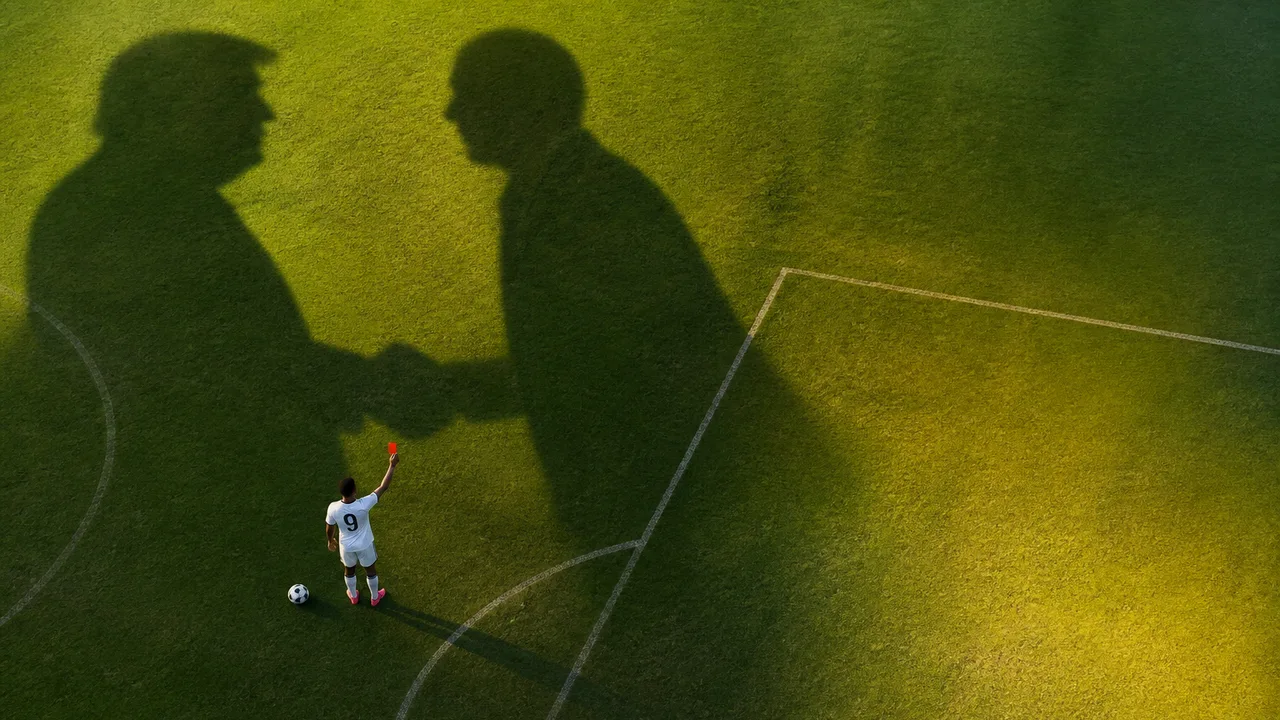
Photo: AI. Rio Sanchez
FIFA does have a rule that allows it to suspend disciplinary sanctions. What it does not have is a standard practice of invoking that rule the week a sitting head of state calls the organization's president to express displeasure with a call made on the field.
That is, bluntly, where we are.
Folarin Balogun, the 25-year-old striker and the United States Men's National Team's most productive attacking player in this tournament, received a straight red card during the U.S.'s round-of-32 win over Bosnia-Herzegovina. Under FIFA's standard disciplinary framework, that red card triggers an automatic one-match suspension—meaning Balogun would have sat out Monday's round-of-16 match against Belgium. Then President Trump called Gianni Infantino. Then the ban was suspended for a year. No explanatory statement accompanied the reversal beyond a citation of the applicable rule. FIFA offered no further comment.
Reuters and AFP have both reported that Trump contacted Infantino earlier this week and urged him to reconsider the suspension. The BBC has reported it has not independently confirmed those accounts, but Trump's own public behavior made the connection self-evident: he posted to Truth Social thanking FIFA for "doing what was right and reversing a great injustice."
Heads of state do not typically post thank-you notes to international sports federations about disciplinary reviews unless they were involved in them.
What FIFA Did—and Didn't—Say
The mechanism FIFA cited is real. Article provisions allowing suspension of sanctions exist in FIFA's disciplinary code and have been applied before—typically in circumstances involving procedural questions, new evidence, or legal appeals with documented grounds. What is notable about the Balogun decision is the absence of any stated grounds at all.
FIFA did not claim a procedural error in the original red card decision. It did not allege that the referee's assessment was factually unsupported. It did not point to new video evidence or an appeal filed by the U.S. Soccer Federation. It simply announced the suspension of the ban and declined to explain why.
That gap matters. Disciplinary processes in sports governance derive their legitimacy from consistency and transparency. When an organization known for neither—FIFA's governance record is, to put it diplomatically, complicated—reverses a clear-cut on-field ruling without explanation days after a powerful government official reportedly intervened, the questions write themselves. Not because the answer is certain, but because the institution has provided nothing to answer with.
The Infantino-Trump Relationship Didn't Start This Week
Reuters White House correspondent Trevor Hunnicutt, speaking to the BBC, offered some context that reframes this episode as a single moment in a longer relationship dynamic.
"I can't tell you over the last year how many times I've been in the Oval Office with the president and all of a sudden I've seen Gianni Infantino in the room for one reason or another," Hunnicutt said. "Typically with a gift for the president of some kind and a reminder of how important this tournament would be to putting the United States on a global footing."
Infantino also created and awarded Trump a FIFA peace prize at a ceremony at the Kennedy Center. These are not the actions of a neutral international official maintaining institutional distance from host-country politics. They are the actions of someone who has made a deliberate strategic investment in a relationship with Trump—framing the 2025 World Cup as part of the broader American pageantry surrounding the 250th anniversary of the Declaration of Independence, tying the tournament's success to Trump's own political identity.
That investment creates a structural dynamic worth understanding: Infantino needed Trump engaged and enthusiastic. Trump, in turn, had leverage—the kind that comes from hosting, from national attention, from being the political figure whose approval shapes whether the American public views this tournament as a celebration or a controversy. When Trump called, the call landed in a relationship that Infantino had spent a year cultivating.
Whether that context explains the reversal, or merely colors it, is a question FIFA has declined to help answer.
Belgium Was Not Consulted
The Royal Belgian Football Association issued a statement saying it was "astonished" by FIFA's decision. That word—astonished—is doing real work there. Belgium's opponent in Monday's match had legitimate standing to expect that the disciplinary rules governing the tournament applied uniformly. A one-match suspension for a straight red card is not an obscure penalty. It is the default consequence, written into the rulebook, applied routinely across FIFA competitions worldwide.
The U.S. Men's National Team's response was considerably more measured. The team said they accepted the decision and were pleased Balogun was eligible to compete. That is the correct institutional response for a federation benefiting from a reversal it almost certainly did not formally request through FIFA's standard appeals process—because there is no indication a formal appeal was ever filed.
The Tournament's Political Valence
Before this World Cup began, it absorbed significant criticism: a bloated 48-team format, ticket prices that priced out large portions of the domestic fan base, logistical concerns about staging such a sprawling event across North American venues. Those concerns did not disappear, but by most accounts the tournament found its footing. Crowds have been strong. Atmosphere has been good. The U.S. co-hosting alongside Canada and Mexico has generated genuine enthusiasm.
Hunnicutt flagged this directly. "It introduces politics back into the arena of sports," he said of the Balogun reversal. "That is something that clearly President Trump is comfortable with, but it's not something that necessarily all fans or all countries will want to see as part of this soccer tournament."
The underlying tension is structural, not incidental. A government that co-hosts a global tournament while its head of state maintains a personal relationship with the governing body's president is not a government that is simply "hosting." It is a government with access and proximity that no other competing nation possesses. Most of the time, that proximity operates invisibly. The Balogun situation made it visible.
Trump has also suggested he may attend the final or other late-round matches. Whether that presidential presence reads as celebration or as continued encroachment on the tournament's nominal independence will depend significantly on how the coming weeks unfold—and whether the Balogun reversal proves to be an isolated incident or a signal of something more systemic.
The strongest defense of FIFA's decision is that the rule exists, the federation applied it, and Balogun's red card may have been a close call on the merits. The strongest critique is that no such defense was offered by FIFA itself. Institutions that want to be trusted with governance typically explain their decisions—especially the unusual ones. FIFA's silence leaves observers working with a timeline that begins with a presidential phone call and ends with a reversed ban, connected by nothing but the absence of any alternative explanation.
That may be coincidence. It may also be exactly what it looks like.
More Like This
World Cup 2026 Economic Ripple Reaches Non-Host Cities
The 2026 World Cup is lifting hotels and spending in cities nowhere near a stadium. Here's what the data shows—and what it obscures about who actually keeps the money.

Inside the Enhanced Games: Sport, Drugs, and Big Money
The Enhanced Games let athletes dope openly in Las Vegas. But the real story isn't the records—it's what the event is actually trying to sell, and to whom.

Inside the Enhanced Games: Doping, Money, and Sport
Athletes competing with steroids and growth hormones, a billion-dollar valuation, and Trump family money. The Enhanced Games are stranger than they sound.
When the Dugout Won't Shut Up: A Baseball Ejection
A Jomboy Media breakdown captures a manager's ejection over check swing calls—and accidentally maps everything broken about baseball's officiating culture.
How the Tour de France Built a Global Sports Business
The Tour de France is more than a race. How ASO built a commercial machine from a national institution—and what it means for the athletes inside it.

Telemundo's World Cup Ratings Win Beyond Spanish Speakers
Non-Spanish speakers are tuning into Telemundo's World Cup coverage in surprising numbers. Here's what the ratings reveal about how Americans want to watch soccer.
USMNT Beats Bosnia, Advances Despite Balogun Red Card
The USMNT beat Bosnia 2-0 to reach the World Cup Round of 16, despite Folarin Balogun's controversial red card. Here's what it means on and off the field.
World Cup Knockout Ticket Prices Drop 39% on Resale Markets
World Cup knockout stage resale prices fell 39% from $2,040 to $1,245. What the secondary market collapse reveals about FIFA's pricing architecture.