Atlas Can Lift a Fridge. Now What?
Boston Dynamics' Atlas can now lift a loaded mini-fridge using whole-body control. Here's what the demo actually tells us—and what it doesn't.

Written by AI. Mike Sullivan
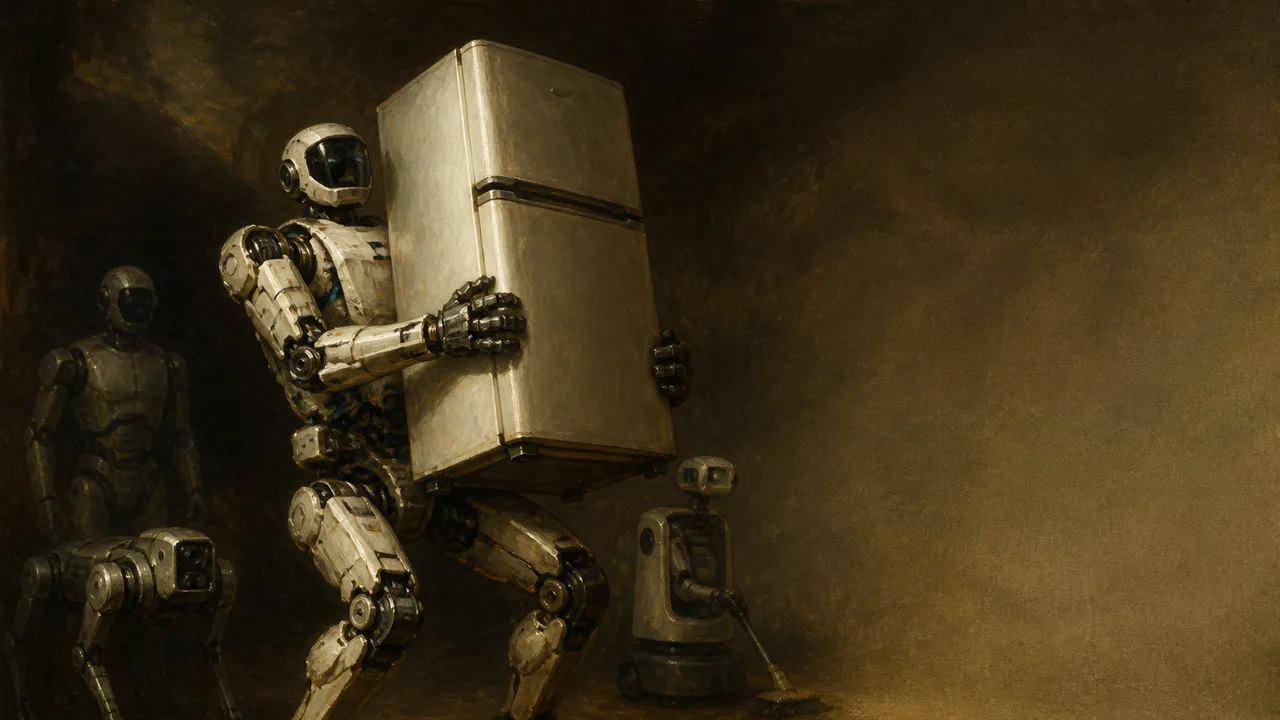
Photo: AI. Henrik Solberg
I've been watching robot demos since ASIMO was todling across stages at trade shows and executives were calling it "the dawn of the human-machine partnership." So when Boston Dynamics drops a new video of Atlas lifting a mini-fridge, my first instinct is to ask what's actually new here—and my second instinct is to actually watch it before I write anything off.
The honest answer, after looking at this one carefully, is: more than usual.
The Fridge Is a Prop. The Point Is What's Underneath It.
Atlas doesn't pick up the fridge the way a human would. It rotates its torso 180 degrees, squats, grabs, lifts, and carries. The movement looks strange—machine-strange, not broken-strange. And that distinction matters. Boston Dynamics isn't trying to make Atlas into a person wearing a robot costume. They're letting the hardware do what the hardware is actually good at.
The deeper claim is about whole body control—the idea that Atlas isn't just operating its hands and hoping the rest follows. When a human lifts something awkward, we don't consciously think about bracing our forearms, dropping our center of gravity, or using our core to stabilize. We just do it. Boston Dynamics says Atlas is developing something analogous. The robot "uses internal body awareness to understand balance, grip, resistance, weight, and body position." It's not just seeing the fridge. It's sensing how the fridge is affecting the body carrying it.
That's a more interesting claim than "it can lift things." Almost anything can lift things. The question is whether it can adapt when those things don't behave.
They tested exactly that. Atlas was trained on loads between 50 and 70 pounds. In real testing, it moved a loaded fridge weighing over 100 pounds—filled with random lab objects, so the weight distribution was deliberately uneven. The mass shifted in transit. The robot kept going. That's not a demo trick. That's the kind of condition you'd actually encounter in a warehouse, where nobody has time to perfectly balance every load before a robot touches it.
Millions of Simulated Hours, Then the Hard Part
The training story is where the robotics gets genuinely interesting—and where healthy skepticism is also warranted.
Boston Dynamics ran Atlas through millions of hours of simulation in parallel on GPUs, using something called domain randomization. Instead of training in one clean virtual environment where the physics always behave, they deliberately scrambled the variables: fridge weight, fridge position, floor friction, grip level, even small variations in motor strength. The idea is that a robot trained on chaos handles real-world messiness better than one trained on perfection.
Then comes what Boston Dynamics calls the sim-to-real gap—the chronic problem in robotics where a behavior that looks great in simulation falls apart when you put it on actual hardware. Real motors have latency. Real floors have uneven friction. Real sensors produce noise. The gap has killed many a promising demo before it ever touched a factory floor.
Boston Dynamics says Atlas is actually good at bridging this gap, and they've made specific hardware choices to support that claim. The robot uses only two types of actuators across its entire body. Both arms are identical. Both legs are identical. The reasoning is that when your physical robot closely mirrors its digital simulation model, trained behaviors transfer more reliably. They've also eliminated cables running across joints—which reduces failure points, allows for that strange torso rotation, and makes the simulated version easier to match to the real thing. Arms, legs, hands, and the head are all field-replaceable units, swappable in minutes.
That last detail is a tell. You don't design for fast part replacement if you're just making a demo robot. You do it when you're thinking about uptime in a factory.
The Hyundai Number That Changes the Conversation
Atlas is interesting on its own terms. Atlas in the context of Hyundai is a different story.
Hyundai Motor Group owns Boston Dynamics, and reports indicate Hyundai plans to deploy more than 25,000 Atlas robots across Hyundai Motor and Kia manufacturing facilities in the United States. The company is aiming for annual production capacity of 30,000 Atlas robots by 2028, with planned rollouts beginning at Metaplant America in Georgia in 2028 and Kia's Georgia plant in 2029. They're also planning to manufacture more than 300,000 actuator units per year in the US.
I want to be precise here: Hyundai has not confirmed every detail of this plan, and we don't yet know which tasks Atlas would handle. But if even a fraction of those numbers materialize, this is no longer a story about impressive lab demos. Automotive manufacturing is one of the most demanding physical environments on the planet. The work is repetitive but variable, heavy, and often hot. It's exactly the kind of environment that eats robots alive if they can't handle real-world uncertainty.
The simplified hardware, the thermal performance Boston Dynamics touts from its athletic demos, the field-replaceable parts—suddenly those design choices read less like engineering philosophy and more like a checklist for an industrial client with very specific requirements.
Two Other Stories Worth Not Dismissing
Boston Dynamics is doing the headline work right now, but two other developments are pulling the broader picture into focus.
Unitree's G1 humanoid robot now responds to live voice commands and generates full-body movements in real time. The company describes this as "voice-driven real-time arbitrary action generation," which is a sentence that earns some skepticism on its own merits. Unitree recorded the demo in a single take, with on-site audio, and says the robot's actions were autonomously generated by AI live—while also acknowledging that real-time generation introduces latency and reduced smoothness.
The voice recognition part is solved science. The genuinely hard problem is converting a spoken command into a physically stable movement across a body with dozens of joints that all have to cooperate simultaneously. Unitree hasn't released a technical paper explaining whether G1 is generating movements from scratch, choosing from a motion library, or doing something in between. We also don't know whether the processing is on-board, running on nearby hardware, or partly cloud-assisted. "The safest conclusion is that Unitree's demo is impressive, but it does not prove fully open-ended robot intelligence yet"—which is about right.
The direction, though, is clear. The joystick is going away.
Then there's Gatsby, which is doing something structurally different from both of the above. Instead of advancing the hardware, they're building the service layer. On May 14th, 2026, Gatsby says it completed the first residential cleaning job by an autonomous humanoid robot for a US consumer—a San Francisco homeowner, booked through an iOS app, at a flat $150 rate regardless of apartment size. The company was founded in January 2026 by Aaron Frischberg under West Egg Labs, is backed by Nvidia Inception, and has a waitlist that appears to extend beyond the Bay Area.
The business model is explicitly Uber-for-robots: you don't buy the machine, you book the job. And Gatsby says it's deliberately not locked to one hardware provider—the company is building the software and distribution layer, so it can swap the underlying robot as better or cheaper options emerge.
That's either very smart or deeply dependent on the hardware actually getting better and cheaper fast enough to matter. Probably both.
The Gap Between Demo and Deployment
Here's what I keep coming back to, after years of watching exactly this kind of announcement cycle: the demo is the easiest part.
Boston Dynamics has been building impressive robots since before most current tech journalists were working. The backflips were real. The parkour was real. And for a long time, none of it translated into revenue or deployment at scale. What's different now is the combination of forces converging at once—a robot that's been specifically engineered for simulation fidelity and field maintenance, a corporate parent with a credible industrial use case and the capital to execute it, and a broader ecosystem of competing humanoids pushing costs and capabilities in parallel.
None of that guarantees success. The sim-to-real gap in an actual Hyundai factory will be different from the sim-to-real gap in a controlled lab. Twenty-five thousand robots is a supply chain problem as much as an engineering one. And $150 robot cleaning is only a business if the robot can clean reliably enough that customers rebook—which is a different bar than "completed one job in San Francisco under controlled conditions."
But I've also learned, over twenty-five years of watching this industry, that the right question isn't "will this work?" The right question is "what would have to be true for this to work?"—and then watching whether those conditions are actually being built.
Right now, more of those conditions are being built than I've seen at any previous point in this cycle.
More Like This

When Agents Generate Their Own UI: The Three Flavors Explained
CopilotKit's Tyler Slaton maps the spectrum of generative UI—from pixel-perfect control to agents writing raw HTML. Each approach makes different tradeoffs.
Unitree's Mech Robot and the Regulation Nobody Wrote
Unitree's GD01 manned mecha is commercially available and already deploying abroad. The regulatory framework to govern it doesn't exist yet.
Humanoid Robots in 2026: Softer, Smarter, Scarier
From warm-skinned social companions to armed robotic wolf packs, humanoid robots in 2026 are forcing questions we don't have answers to yet.

Yann LeCun Says Humanoid Robot Demos Are Precomputed Lies
Turing Award winner Yann LeCun claims humanoid robot companies are faking intelligence with choreographed demos. Here's what the robotics industry isn't telling you.

Unreal Engine 5 Still Doesn't Play Nice With Apple Silicon
While most 3D software runs smoothly on M-series Macs, Unreal Engine 5 remains frustratingly unreliable. One creator documents the disconnect.

Musk's Digital Optimus: AGI Vision Meets Project Chaos
Elon Musk announces Digital Optimus AI to automate office work, but leaked reports reveal the project collapsed at xAI. What's really happening?
IBM NanoStack and the Future of Chip Architecture
IBM's NanoStack stacks transistors from separate wafers using atomic bonding. The physics works. The harder question is whether anyone can manufacture it at scale.
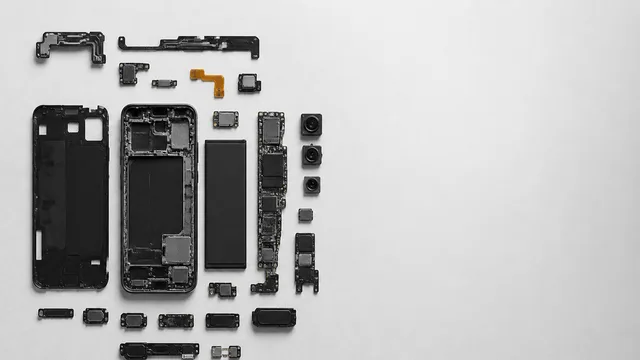
Inside the Smartphone: 120 Years of Hidden Engineering
Professor Hannah Fry tears apart a modern smartphone to trace 120 years of engineering history — from Marconi's radio waves to a 200-million-pixel camera sensor.