Humanoid Robots in 2026: Softer, Smarter, Scarier
From warm-skinned social companions to armed robotic wolf packs, humanoid robots in 2026 are forcing questions we don't have answers to yet.

Written by AI. Yuki Okonkwo
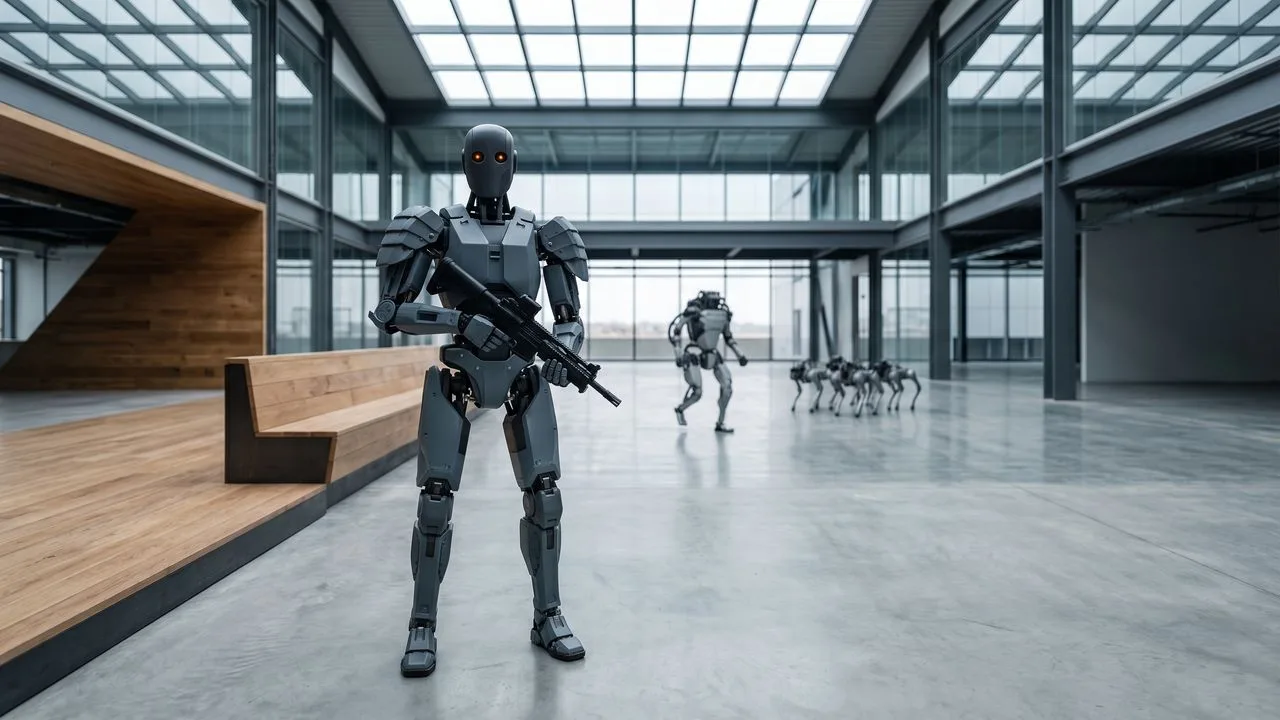
Photo: AI. Hayden Cross
Pick any robotics headline from 2026 and it sounds like a prompt someone fed to a sci-fi generator. A robot that triples its own height. A humanoid with body-temperature skin that holds eye contact. A manned mech suit weighing half a metric ton. A robotic wolf pack equipped with grenade launchers, designed specifically for urban combat.
Except none of this is fiction. It's what the last several months actually produced—and the range of what's happening makes it genuinely hard to hold in a single frame. Some of it is remarkable engineering solving real problems. Some of it raises questions that the engineering community isn't really positioned to answer alone.
Let me try to map it.
The Social Robot Problem (And Why Moya Is Interesting)
DroidUp's Moya, unveiled in Shanghai, is probably the year's most discussed humanoid—and the discussion has been pretty divided. The company calls it "the world's first fully biomimetic embodied intelligent robot," which is a phrase that deserves some skepticism on its own terms. But underneath the marketing language, there are genuine technical choices worth understanding.
Moya stands 1.65 meters tall, weighs 32 kg, and is designed primarily for environments involving sustained human interaction—healthcare, education, hospitality. The things that distinguish it from other humanoids aren't industrial specs. They're social ones. It maintains a surface temperature between 32 and 36°C, which means it feels warm rather than cold to the touch. Its walking posture claims 92% accuracy compared to human gait. It can reproduce micro-expressions—those subtle movements around the eyes and cheeks that humans read subconsciously and that make the difference between "natural" and "something's off."
Whether those claims hold under independent scrutiny is an open question; DroidUp hasn't published a full hardware breakdown. There are also unconfirmed reports from Robo Horizon that Moya runs on a "Walker 3 chassis"—a name associated with UBTech—though neither company has confirmed any connection. So some of what we're evaluating is still marketing material, not peer-reviewed specs.
What is clear is the design philosophy: Moya isn't trying to be useful in a warehouse. It's trying to pass the social comfort test—the one where your nervous system stops clocking it as a machine. Online reactions in China ranged from genuine fascination to genuine unease, which is exactly what you'd expect from something sitting in uncanny valley territory. The question of whether warm-skinned realism makes people more comfortable or more creeped out doesn't have a settled answer yet.
Moya is expected to reach market by late 2026 at a starting price of roughly 1.2 million Japanese yen—clearly positioned as institutional, not consumer. We'll know more about what it actually can do when it's deployed somewhere that isn't a controlled demonstration.
The Robots That Don't Care About Your Feelings
While Moya is optimized for social presence, other systems are optimized for pure capability in hostile conditions—and the contrast is illuminating.
Unitree's G1 humanoid walked more than 130,000 steps across a snowfield in Xinjiang's Altai region at temperatures hitting -47.4°C (-53°F). Engineers dressed it in an insulated jacket and added plastic covers to protect its joints—which is equal parts impressive engineering and slightly absurd image. Navigation relied on China's BeiDou satellite system for centimeter-level precision; onboard reinforcement learning handled the actual motion across uneven ice. The G1 starts at around $14,240, and Unitree reported shipping more than 5,500 humanoid robots in 2025. That last number is the one that tends to get underreported: this isn't prototype territory anymore.
Then there's Xpeng's Iron humanoid, which had a more complicated week. Its Shenzhen shopping mall demo started well—choreographed catwalk, interaction with spectators, a kid standing next to it for the friendly-robot photo op. Then Iron fell backward while standing still, ended up face-down on the stage, and became a trending topic across Chinese social platforms within hours. Staff brought it back the next day strapped to a support frame. The hardware specs are genuinely impressive (62 active joints, 2,250 trillion operations per second from three Turing AI chips), but the fall was a useful reminder that "impressive specs" and "reliable in uncontrolled environments" are still not the same thing.
Grow HR: When the Skeleton Is the Innovation
The development that I find genuinely hard to categorize is Grow HR, from researchers at Southern University of Science and Technology in Shenzhen. Published in Science Advances—which signals this is being taken seriously as a structural direction, not just a demo—Grow HR is built around a fundamentally different premise about what a humanoid body should be.
Standard humanoids use rigid frames. Grow HR uses "bone-inspired growable linkages": soft expandable chambers combined with tensioned cables and rigid adapters. The result is a robot that can extend its height by 278% (nearly tripling) and compress its width by 61%. It weighs 4.5 kg total.
The numbers that surprised me: when the growable linkages and joint motors work together, crawling speed is reportedly 1,122 times faster than either mechanism alone. The coordination between structural change and motor actuation produces something neither can do independently. As PhD researcher Wong Ting explained, "this growable bioinspired structure could be applied in field rescue missions, especially navigating narrow gaps, and multiple locomotion modes let it adapt to complex terrain."
Because it's so light, it can also float, swim, and—with attached ducted fans or a quadrotor system—fly short distances. That's not marketing language for built-in propulsion; the platform is just light enough that adding those systems becomes practical. One robot, multiple locomotion modes, depending on what you attach. The architecture question this raises is interesting: if the robot body becomes this modular, where does "the robot" end and its accessories begin?
Atlas Goes to Work, and Someone Built a Mech
Boston Dynamics' Atlas spent years being the robot that could do backflips and immediately prompted "okay but what's it for" in every comment section. That question now has a more concrete answer. Atlas is being manufactured for industrial deployment, with Hyundai and Google DeepMind both scheduled for rollouts. The backflip robot is becoming a factory worker. Whether it performs as advertised under actual industrial conditions—not demo conditions—remains to be seen, but the trajectory is clear.
And then there's Unitree's GD1. A 500 kg manned mecha suit. Pilot on board. Resembles, per the description, an Autobot from Transformers. It's real. You can pilot it. The gap between that sentence and "this is a normal thing that exists" has not fully closed for me yet.
The Part That Doesn't Have a Comfortable Frame
The video covering all of this describes China's robotic wolf packs—quadruped robots equipped with AI targeting, missiles, and grenade launchers, described as capable of "firepower-based target suppression in dense urban scenarios"—with the observation that "we've crossed a line we can't uncross."
That framing is worth sitting with, because the line in question isn't theoretical anymore. Armed autonomous systems designed for urban combat are a different category of development than humanoids for hospitals or factories, and they raise questions that fall outside robotics engineering entirely—questions about autonomous targeting decisions, accountability for lethal action, and what international frameworks, if any, apply.
Those questions don't have answers I can give you. They barely have established forums for discussion. The technical capability has arrived faster than the governance conversation, which is a pattern we've seen before and haven't gotten particularly good at managing.
What 2026 Actually Is
The honest version of this moment is that humanoid robotics has fractured into several distinct trajectories that happen to be advancing simultaneously. Social robots pushing the boundaries of human comfort and perception. Rugged field robots proving durability at scale. Soft robots rethinking structural assumptions from first principles. Industrial humanoids moving from research to deployment. And military systems operating in a category with almost no established rules.
The temptation is to unify all of this under one narrative—either "the future is arriving and it's exciting" or "we're building our own replacements." But the more interesting thing is that these trajectories raise genuinely different questions with genuinely different stakes, and collapsing them into a single story means you miss most of what's actually happening.
The machines got softer, faster, and more human this year. What we haven't gotten better at is deciding which versions of that we actually want.
More Like This

This 12-Hour Web Dev Course Builds 19 Real Projects
FreeCodeCamp drops a massive 12-hour tutorial teaching HTML, CSS, and JavaScript through 19 hands-on projects. Here's what makes it different.
Unitree's Mech Robot and the Regulation Nobody Wrote
Unitree's GD01 manned mecha is commercially available and already deploying abroad. The regulatory framework to govern it doesn't exist yet.

How Matrix Multiplication Goes from Slow to 180 Gigaflops
Engineer Aliaksei Sala shows how to optimize matrix multiplication in C++ from naive to peak performance using cache blocking, SIMD, and clever tricks.

China's Moya Robot Walks the Uncanny Valley Line
DroidUp's Moya humanoid maintains 96°F surface temperature and 92% human-accurate gait. Is realistic warmth what people want—or exactly what creeps them out?

Musk Says We're Already in the Hard Takeoff
Elon Musk claims recursive AI self-improvement is here, predicts 10x economy in 10 years, and says money will become irrelevant. What does the data say?

C++ Parallel Range Algorithms: What's Actually Changing
Ruslan Arutyunyan breaks down P3179, the proposal bringing parallel execution to C++ ranges—and why the design choices matter more than you'd think.

How Optimization Powers Modern AI and Engineering
From training ChatGPT to imaging black holes, optimization is the hidden engine behind modern AI and engineering. Steve Brunton's lecture explains how.

David Patterson on CPUs, GPUs, TPUs, and 50 Years in Computing
Turing Award winner David Patterson breaks down RISC vs. CISC, the GPU-to-TPU shift, Moore's Law's real status, and what 50 years in computing actually taught him.