Sports Media and Sponsorship Deals Reshape the Industry
NBCU-YouTube bundle, MLS rights ambitions, college jersey patches, and NFL prediction market rules signal a sweeping restructuring of sports business in 2026.
Written by AI. Marcus Tate
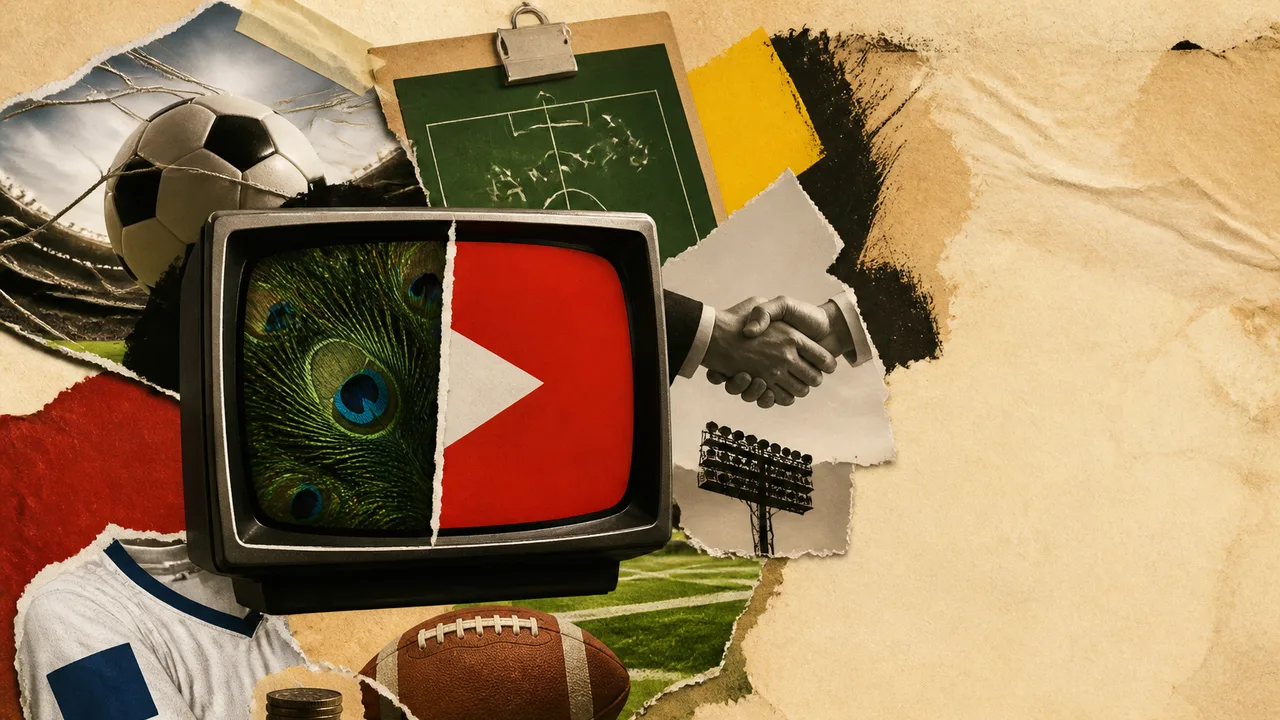
Photo: AI. Wren Sugimoto
Several of the largest structural forces in the sports business collided in a single Tuesday morning news cycle, and the through-line connecting all of them is the same question that has animated every major league boardroom for the better part of a decade: who controls access, and what is that access worth?
NBCU and YouTube Redraw the Streaming Map
The most consequential development reported in SBJ's July 28 Morning Buzzcast is a multi-year partnership between NBCUniversal and YouTube that, on the surface, looks like a distribution agreement but reads more like a strategic merger of audiences. Beginning in 2027, Peacock Premium will be bundled with YouTube Premium in the United States — meaning NBCU's portfolio of NFL, NBA, Olympics, Premier League, WNBA, and college sports rights gets routed through a platform of extraordinary reach. According to YouTube's own blog, the platform has surpassed 125 million subscribers globally. Peacock, for its part, recently crossed 48 million paid subscribers and posted its first profitable quarter, per reporting from Señal News.
The arithmetic of bundling is straightforward: Peacock gains exposure to an audience that dwarfs its current subscriber base. But the deal is architecturally richer than a simple promotional attachment. NBC Sports will produce live sports content for YouTube directly, and select NBCU programming will appear on the NBC Sports YouTube channel in front of the paywall — free inventory designed to drive conversion. The agreement also renews NBCU's carriage deal with YouTube TV, stabilizing a relationship that was, by SBJ host Joe Lemire's account, "down-to-the-wire" a year ago.
There is a relevant industrial precedent worth noting. NBC Sports previously served as a production partner for Amazon's Thursday Night Football, a relationship that Amazon has since wound down as it built its own capabilities. CBS Sports has performed analogous back-end work for Netflix's NFL coverage. The pattern suggests that traditional sports broadcasters are finding a second revenue channel in their production infrastructure — selling competency to platforms that have the rights but not the operational depth. Whether that model scales, or whether YouTube eventually builds in-house as Amazon did, is a question this deal doesn't answer.
What the deal does answer, at least partially, is how Comcast plans to position NBCU ahead of its planned spinoff into an independent company. Folding Peacock into a bundle with 125 million-subscriber reach makes the streaming service look considerably more viable as a standalone asset. The timing is not incidental.
MLS and the Post-Messi Valuation Problem
While NBCU is expanding its distribution, Major League Soccer is confronting a valuation question that will define its next decade. According to ESPN, MLS is seeking an annual broadcast rights fee of between $400 million and $500 million in its next deal — potentially double the $250 million it currently receives from Apple. The ambition is notable. The justification is complicated.
As SBJ's Austin Karp reported, two variables will largely determine where the number lands. First, Lionel Messi will be gone before the next deal cycle begins in 2029. Second, whether the league's commercially beneficial hydration breaks — which create additional advertising inventory — can meaningfully offset the Messi premium. Neither is a simple fix. Messi's presence reshaped the league's visibility in ways that roster construction cannot replicate on a timeline of a few seasons.
Commissioner Don Garber offered one possible bridge. Speaking on Fox News, he publicly encouraged NYCFC to pursue American international Christian Pulisic, saying: "Come to Major League Soccer, spread your wings, be a star, be just up the road from your family in Pennsylvania. I hope they get it done." Pulisic is not Messi. But an American star anchoring a New York market club would carry domestic broadcast appeal that a foreign-born superstar, however transcendent, cannot fully replicate.
The structural question behind the headline number is whether MLS returns to a multi-partner broadcast arrangement. The current Apple deal is genuinely fan-friendly — consistent start times, a single destination — but it may not generate the competitive bidding that drives rights fees to the levels MLS wants. Multiple partners mean more windows, more fragmentation, and the kind of bidding tension that produces nine-figure annual fees. The league's current all-in-one model trades revenue ceiling for fan experience. That tradeoff becomes harder to justify when the rights fee gap is this wide.
Garber also confirmed that expansion beyond 32 teams is not in his thinking, which caps that particular revenue lever. According to publicly available MLS expansion records, San Diego FC's entry fee reached $500 million, per Wikipedia's expansion tracking. With two franchise slots theoretically remaining, the expansion calculus exists — but Garber appears to be choosing product integrity over incremental franchise fees, at least for now.
College Athletics: The Jersey Patch Economy Scales Up
The college athletics sponsorship market continued its rapid professionalization with two significant deals announced Monday. Ohio State University has agreed to a sponsorship arrangement with J.P. Morgan Chase worth more than $15 million annually, per SBJ's Ben Portnoy. The deal includes jersey patches across all 36 varsity sports team uniforms, as confirmed by Sportico's coverage of the agreement, and positions J.P. Morgan Chase in college athletics for the first time. The bank will also hold title sponsorship rights to Ohio State's 1922 Club.
The University of Illinois, meanwhile, reached a deal with Busey Bank valued at $30 million over five years — roughly $6 million annually — covering patches on football, men's and women's basketball, volleyball, baseball, softball, soccer, and men's and women's golf uniforms. Both deals were facilitated by Learfield, the multimedia rights company that has become the connective tissue of the college sponsorship market.
Fifteen million dollars annually from a single corporate partner, attached to a university athletic department, would have been a remarkable figure five years ago. Today it registers as a significant but not surprising data point in a market that has reoriented itself entirely since the NCAA's grip on athlete compensation loosened. Jersey patches are the most visible expression of a broader shift: college athletics programs are now functionally operating as professional sports properties, and corporate partners are pricing their investments accordingly. The approach of college football season will accelerate this pattern. Expect the announcements to continue.
The NFL's Prediction Market Posture
The NFL submitted formal comments to the Commodity Futures Trading Commission as regulators develop what could become the first comprehensive federal framework for sports-related prediction markets. The league's position, as reported by Lemire, is not opposition but conditionality: if these markets exist, they need guardrails. Specifically, the NFL has pushed to restrict contracts tied to injuries, individual plays, and officiating decisions — anything, in the league's framing, that could be influenced by a single actor.
This is a strategically sophisticated position. Outright opposition to prediction markets would be both futile and commercially counterproductive, given how deeply sports gambling has embedded itself in the league's media partnerships and audience engagement. But a permissive framework creates integrity exposure that no commissioner wants to manage. The CFTC's proposal would likely permit broader outcome markets — game winners, tournament advancement — while restricting or prohibiting the granular prop-style contracts. Whether that line holds under lobbying pressure from prediction market operators is the real question.
The underlying debate — whether prediction markets are legally and functionally distinct from sports betting, and which regulatory body owns them — is unresolved and consequential. The CFTC's jurisdiction over event contracts is itself contested terrain. The NFL's comment letter is less a policy document than a marker: the league wants to be on the record as favoring integrity protections before a framework hardens.
Other Signals Worth Noting
The Travelers Championship has been formally confirmed as a stop on the PGA Tour's new Championship Series, becoming the first publicly named event in a circuit expected to consist of 15 higher-profile tournaments launching in 2028. Naming rights for series events are expected to carry a $30 million annual price tag, per SBJ's Josh Carpenter — a figure that signals the Tour is using the bifurcated schedule restructuring to reset commercial expectations upward.
On the consumer side, a KPMG survey found that seven in 10 American families intend to maintain youth sports spending even as broader back-to-school budgets come under pressure, with families projecting roughly $252 per child in back-to-school spending overall. Soccer leads participation heading into the school year, with baseball and softball in second. The resilience of youth sports spending is not purely a feel-good story — it is precisely why private equity has moved aggressively into the space. When families treat a spending category as non-discretionary, investors notice.
Finally, Congressman Jamie Raskin, the ranking member of the House Judiciary Committee, has requested that FIFA president Gianni Infantino appear before the committee regarding FIFA's relationship with President Trump, according to The Athletic. The contours of that relationship are well documented: the FIFA Peace Prize, office space at Trump Tower, the World Cup draw held at the Kennedy Center. More recently, Trump's direct communication with Infantino regarding Folarin Balogun's red card suspension — later overturned — drew considerable scrutiny. Infantino subsequently posted a lengthy public letter addressed, in his own phrasing, "to those behind their pens and papers, behind their screens spreading hate and false rumors." The letter's combative tone, Lemire observed, read as defensive rather than triumphant — an odd register for a World Cup that was, by most operational measures, a genuine success.
A congressional interview request is not a subpoena, and Infantino has considerable leverage in whether and how he responds. But the request itself is a signal that FIFA's accumulated proximity to American political power has attracted precisely the kind of institutional scrutiny that proximity tends to produce.
More Like This

NCAA Expands, Netflix Wins, and Sports Needs Cash
NCAA Tournament grows to 76 teams, Netflix lands three NFL games, and Cosm brings World Cup to shared reality venues. The week's sports business, mapped.
Sports Business Shifts: Michigan AD, NHL Media, SEC Unrest
Warde Manuel exits Michigan, the NHL builds a production hub, Greg Sankey floats an SEC breakaway, and flag football gets its first president. July 21, 2026.
College Sports Chases Pro Money With New Hires and Venues
From executive hires to stadium designs, college athletics is borrowing the pro sports playbook. Here's what the latest moves tell us about where the money flows.
FIFA's $20B Commercial Gamble and College Sports' Patch Rush
FIFA proposes a $20B commercial vehicle to monetize the World Cup as Notre Dame and Ohio State race to sign jersey patch deals worth $15M-plus annually.

FIFA's TikTok Deal Is Rewriting Sports Media Rights
FIFA's TikTok partnership for the 2026 World Cup pulled 465 million streams. The real story is what that means for every rights deal negotiated after this.

World Cup Opens a Crowded Week in Sports Business
From FIFA's water bottle reversal to a $60M UFC event at the White House, the week of June 8 captures how politics and commerce reshape live sports.

Packers, WNBA, and NASCAR: Sports Business Roundup
Green Bay's PE problem, Engelbert's uncertain future, NASCAR's Daytona return, and Cooperstown weekend — the week's sports business stories mapped.
Panthers, WNBA, and the A's Shape Sports Business
Charlotte's $1.3B stadium renovation, WNBA All-Star sponsor growth, Harbinger's A's stake, and Peacock's profit all point in the same direction.