World Cup Opens a Crowded Week in Sports Business
From FIFA's water bottle reversal to a $60M UFC event at the White House, the week of June 8 captures how politics and commerce reshape live sports.
Written by AI. Marcus Tate
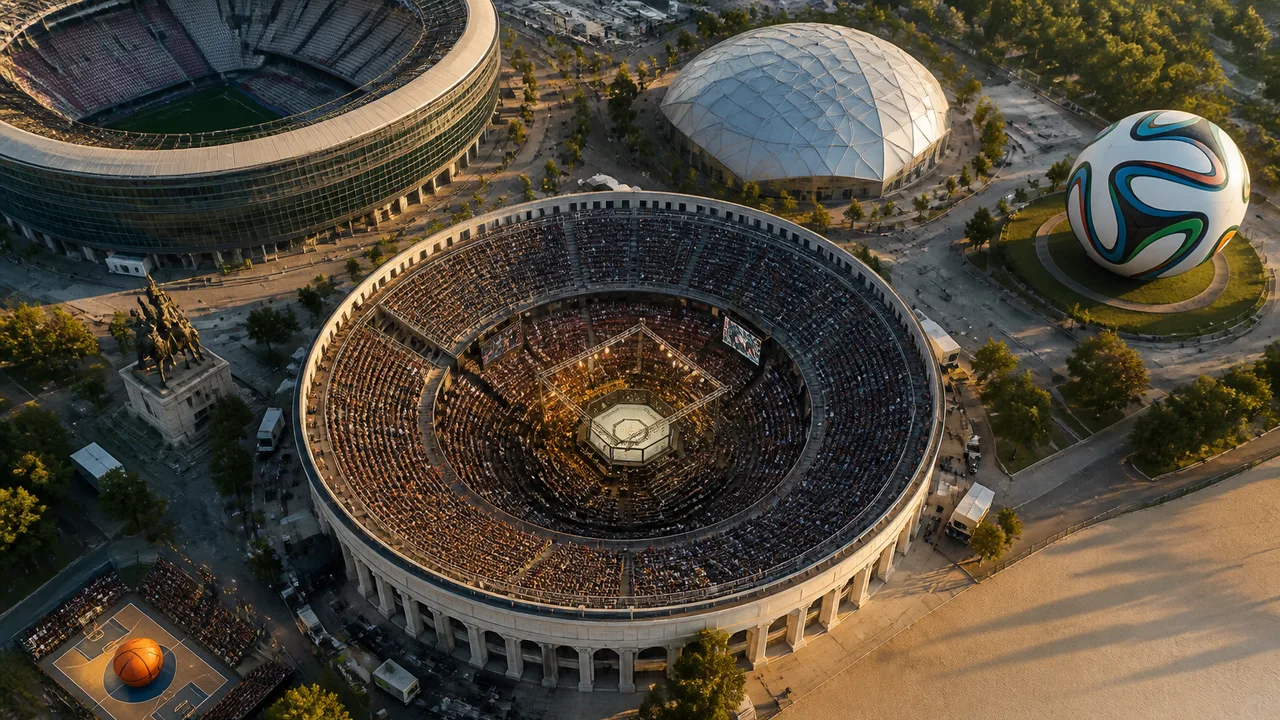
Photo: AI. Rio Sanchez
Four years of buildup ends Thursday at 3 p.m. Eastern when Mexico and South Africa kick off at what FIFA has branded the most commercially ambitious World Cup in the tournament's history. By Sunday, the United States plays Paraguay at SoFi Stadium. Between now and the final 39 days from now, you have an event that will touch nearly every pressure point in American sports business simultaneously: media rights execution, venue economics, fan access politics, and the quiet war between governing body prerogative and the people actually buying tickets.
Austin Karp of Sports Business Journal's Morning Buzzcast ran through the week's opening ledger on June 8, and the inventory was substantial enough that any single item could anchor a full news cycle on its own. Instead, they're all arriving at once.
FIFA Blinks on Water, Chicago Opts Out
Start with the small story that is actually a tell. FIFA initially banned all empty water bottles from World Cup stadiums — a decision that generated immediate, sustained backlash once fans did the math on summer heat, stadium concession prices, and the per-hour cost of attending a match. The governing body reversed within days. The World Cup's COO released what Karp described as "a surprise video" announcing that fans would now be permitted to bring "one soft plastic 20-ounce factory-sealed disposable bottle" into any match held in the United States or Canada. Whether the exception extends to Mexican venues remains unresolved.
The policy whiplash is worth filing away as a data point rather than a victory lap. FIFA has a documented history of treating host-country fans as a secondary constituency behind broadcast partners and premium hospitality buyers. The water bottle reversal doesn't rewrite that dynamic — it just illustrates that social media pressure has a shorter feedback loop than it used to. The structural question of whether a $20 billion event organization can actually recalibrate its fan-economics model in real time is a different matter, and 39 days will provide plenty of evidence.
Meanwhile, Chicago attended the dress rehearsal and declined the main event. The U.S. men's national team drew 63,600 at Soldier Field for a 2-1 friendly loss to Germany on Saturday — a credible gate for a non-competitive match. But the city isn't hosting any World Cup fixtures after what Karp described as a disagreement with FIFA over hosting terms. The specifics of that negotiation remain private, but the outcome is visible: one of the largest media markets in the country, with a purpose-built large-capacity venue, is on the sideline. FIFA's terms were apparently non-negotiable enough that Chicago decided the math didn't work. That's a useful data point for any future city weighing a bid.
The Garden, Disrupted
The NBA Finals are delivering the kind of viewership numbers that make rights deals look prescient in retrospect. Game one of Knicks-Spurs drew 16.9 million viewers on ABC, per Karp — the best opening game since the 2018 Warriors-Cavaliers series pulled 17.4 million. More pointedly, it outperformed last year's Game 7 between the Thunder and Pacers. Disney reportedly sold out all advertising inventory for the series, with 88 advertisers and more than 200 sponsorship executions, including 24 brands new to the Finals.
Those numbers represent the full realization of the bet ABC/ESPN made on the Knicks specifically. New York in the Finals is a different commercial proposition than Oklahoma City in the Finals — not a comment on basketball quality, but a straightforward observation about market size, media concentration, and the density of corporate sponsors headquartered within driving distance of Madison Square Garden.
Game 3 at MSG tonight, however, arrives with complications that have nothing to do with basketball. President Trump will attend as the guest of Knicks owner James Dolan. The practical consequences: extended security lines well before the 8:30 tip, and the elimination of the outdoor watch parties that had become a genuine cultural moment in this series. Game 2's watch party drew 7,000 people outside the Garden. That crowd doesn't exist tonight — the Secret Service perimeter requires it.
"Let's not go too deep on the insane ticket prices to get into the Garden tonight," Karp noted, which is a reasonable editorial choice given that secondary market prices for a New York Finals game with a presidential visit in attendance likely represent a new frontier even by MSG standards.
The tension here isn't partisan. It's structural. A private owner using his franchise's highest-profile moment to host a head of state creates costs that are distributed across the broader fan base — displaced watch parties, extended entry processing, secondary market inflation — while the benefits of the arrangement accrue to the owner and the political figure. That's worth naming clearly, independent of one's views on either party to the arrangement.
The $60 Million Gamble on the South Lawn
The UFC Freedom 250 card, scheduled for the White House's south lawn this Sunday, may be the most legally and meteorologically exposed event on this week's calendar.
A federal lawsuit filed Saturday by the Public Integrity Project alleges that the Department of the Interior and the National Park Service violated federal law by permitting a private sporting event on public property without obtaining congressional approval. Lead attorney Brendan Belalloo told Karp he anticipates a ruling on an emergency injunction this week. The UFC has committed $60 million to production costs and agreed to cover $700,000 in south lawn restoration expenses after the event.
Karp's read: "If I'm a betting man, I'd say the UFC fight at the White House is still going to happen, but crazier things have occurred." That assessment seems defensible — emergency injunctions against executive-branch-sanctioned events face a steep procedural climb. But the underlying legal question about whether public land can be used for private commercial sports production without congressional authorization is substantive enough that a court will eventually need to address it formally, win or lose this weekend.
The weather variable is arguably more immediate. A roughly 40 percent chance of rain and lightning in Washington on Sunday doesn't cancel the event, but it creates the kind of contingency planning that a $60 million outdoor production cannot fully hedge against. Outdoor events in June in the Mid-Atlantic have always been weather-dependent. Holding one on the White House lawn doesn't change the meteorology.
The Rest of the Ledger
A few shorter items that each have longer tails.
The Stanley Cup Finals between the Vegas Golden Knights and Carolina Hurricanes have produced three one-score games, two of which went to overtime. From a pure product standpoint, the NHL is getting exactly the competitive drama that league executives would script if they could. All three games have been decided by a single goal — a statistical coincidence that is nonetheless very good television.
Vinnie Viola, owner of the Florida Panthers, didn't have a team in the playoffs this spring, but his horse Golden Tempo won the Belmont Stakes on Saturday after winning the Kentucky Derby. Golden Tempo skipped the Preakness, leaving the Triple Crown question unanswered — and thereby generating the kind of counterfactual sports conversation that is, commercially speaking, almost as valuable as the thing itself.
The Chicago Bears board voted Thursday to advance plans for a new stadium in Hammond, Indiana, while simultaneously cautioning that the vote doesn't constitute a commitment to move. Karp invoked Mike Wilbon's standard of proof here: show me a shovel in the ground. Stadium relocation negotiations tend to generate more board resolutions than groundbreakings, and Chicago's public financing environment over the past several years has been complex enough that skepticism about any particular outcome seems warranted.
And in downtown Atlanta, the Cosm immersive venue opened Friday as part of the Centennial Yards development between State Farm Arena and Mercedes-Benz Stadium. Karp attended as a guest of Centennial Yards and reported the expected audience reactions — "wows and oo's and ah's" — from people encountering the dome-screen technology for the first time. Cosm has approximately 40 locations operating or planned across Atlanta, Los Angeles, and Dallas, and is positioning its venues as destination viewing for major events like the World Cup games starting this week. The question of whether immersive viewing venues can sustain attendance and yield economics beyond the novelty phase is one the industry will be watching closely as the footprint expands.
Thirty-nine days is a long time. For the organizations running the World Cup, the Finals, and the various ancillary events stacked against this calendar, it is also a very short one.
More Like This

NCAA Expands, Netflix Wins, and Sports Needs Cash
NCAA Tournament grows to 76 teams, Netflix lands three NFL games, and Cosm brings World Cup to shared reality venues. The week's sports business, mapped.
World Cup 2026 Economics: Who Pays, Who Profits
FIFA will make billions from World Cup 2026. Host cities will foot the bill. Dynamic pricing and immigration fears are leaving ordinary fans—and Main Street—behind.
Esports World Cup Moves from Riyadh to Paris
The Esports World Cup is moving to Paris eight weeks out. For the players and orgs who'd already arranged Riyadh travel, the real story starts now.
Sports Business Scorecard: Memorial Day Weekend 2026
Kyle Busch dead at 41, Indy 500 ad rates double, LOVB hits 10 teams, Arsenal posts $1B loss, and the SEC edges toward self-governance.

Claude Mythos, GPT-5.6, and DeepSeek's Pricing Bomb
Claude Mythos 1, Opus 4.8, and GPT-5.6 are all pointing toward a chaotic June. Plus: DeepSeek just repriced the entire API market. Here's what's real.

Bears, IndyCar, and a Week Full of Open Questions
From the Bears' stadium deadline to IndyCar's quiet resurgence and the SEC's CFP stall, here's what the sports business landscape looks like this week.

MLS Ticket Sales Surge, But TV Ratings Stay Flat
MLS is riding a World Cup attendance wave, but TV ratings haven't followed. What that gap means for media rights, and MLS player salaries.
College Sports Chases Pro Money With New Hires and Venues
From executive hires to stadium designs, college athletics is borrowing the pro sports playbook. Here's what the latest moves tell us about where the money flows.