Bears Stadium Limbo, NHL Reorg, and Portland's Women's Sports Bet
Illinois lawmakers adjourned without resolving the Bears stadium question. Meanwhile, the NHL restructured leadership and Portland doubled down on women's sports infrastructure.
Written by AI. Marcus Tate
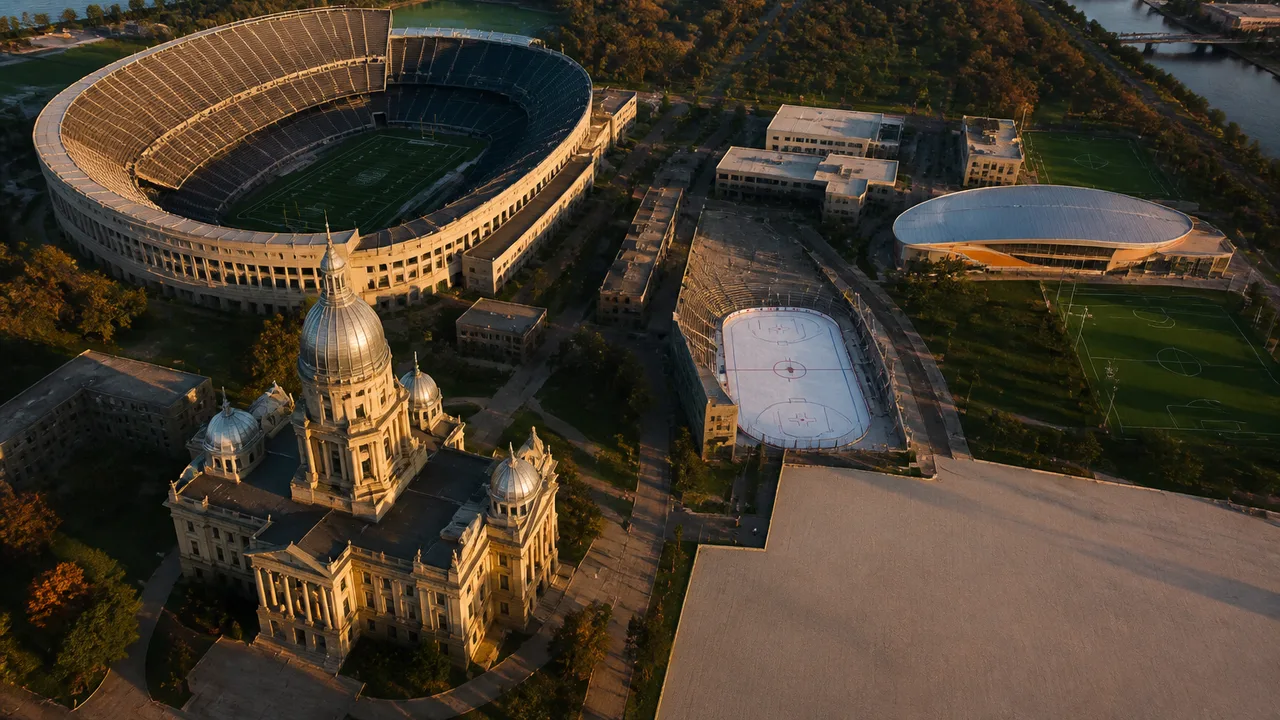
Photo: AI. Rio Sanchez
The Illinois legislature ended its session before sunrise on Monday without passing a Bears stadium bill — which, depending on where you sit in this negotiation, is either a catastrophe or a perfectly ordinary outcome in a process that was never going to resolve cleanly.
That's the thing about stadium deals: they rarely collapse at the end. They just keep not-quite-resolving until one day they do, or until the franchise relocates and everyone pretends to be surprised.
As SBJ's Abe Madkour reported Monday morning, Illinois Senate lawmakers introduced a compromise framework at 11 p.m. Sunday night — a last-ditch structure that would allow either Arlington Heights or the city of Chicago to enter into a deal with the Bears and, critically, permit the team to avoid paying property taxes on a stadium they would self-finance. The Senate voted to advance it. The House didn't bring it to a vote. House leadership subsequently ruled out a special session.
The property tax carve-out is worth pausing on, because that's the mechanism that determines who actually bears the cost of this asset over time. A team that finances its own stadium but escapes the property tax obligation on it is capturing a public subsidy through the tax code rather than through a direct bond issuance or appropriation — a structurally different arrangement, but a subsidy nonetheless. Whether that framing is acceptable to Illinois taxpayers, and whether it's sufficient incentive for the Bears ownership to commit to the state, remains unresolved. The House's inaction suggests at least some legislators aren't sold.
What happens next is genuinely unclear. The Bears have a standing option on the Arlington Heights site. Chicago has made its Soldier Field-adjacent pitch. Neither outcome is foreclosed, but neither has political momentum at the moment.
The NHL Quietly Rebuilds Its Business Side
Across the sports industry calendar, a league reorganization rarely generates headlines. The NHL's restructuring, announced last week, deserves more attention than it typically gets.
The headline hire is Sean Eggert as the league's new chief marketing officer. Eggert comes from Under Armour, where he spent seven years, and before that logged more than a decade at Red Bull — a brand that essentially invented the playbook for marketing to young consumers through event ownership and extreme sports adjacency. He also spent time at Gatorade. Madkour described him as "very targeted toward youth marketing, Gen Z marketing," noting that "he has some real street cred."
The youth orientation matters here. The NHL's core challenge isn't converting existing fans — it's replacing the ones it's losing to attrition with younger consumers who have more entertainment options and shorter attention spans than any previous generation of sports fans. Eggert's background suggests the league understands the assignment, even if executing it across a 32-team footprint with regional broadcast fragmentation is considerably harder than it looks on an org chart.
The structural dimension of the reorg is equally notable. The move reduces direct reports to Commissioner Gary Bettman and Deputy Commissioner Bill Daly from 14 to eight — a span-of-control problem that any operations executive would recognize immediately. Fourteen direct reports at that level isn't a management structure; it's a bottleneck. The consolidation pushes more responsibility to NHL Business president Keith Wachtel and COO Steve Mardell, which concentrates commercial execution at a layer below the commissioner's office.
Also worth watching: the league is exploring a new content and event production services business, to be led by president of content Steve Mayer, that would sell production capabilities to third-party clients. Mayer's portfolio includes the Winter Classic and the Stadium Series — marquee tentpole events that require exactly the kind of large-scale production infrastructure you'd need to offer those services externally. If the NHL can monetize that capability beyond its own schedule, it's a genuine revenue diversification play. The previous CMO, Heidi Browning, transitions to chief digital officer — a lateral move that preserves institutional knowledge while creating space for Eggert's mandate.
Notably, the restructuring came without layoffs or departures from hockey operations. The league's staff count sits at roughly 750 at the league level.
Portland Is Making a Structural Argument
The weekend's most commercially interesting data point came from Portland, Oregon, where the Portland Thorns (NWSL) and Portland Fire (WNBA) staged what Madkour called "really the first collaboration between the NWSL and WNBA teams" — a women's sports doubleheader that drew more than 20,000 to Providence Park for the Thorns' afternoon match and more than 19,400 for the Fire's evening game against Caitlin Clark and the Indiana Fever. The Fire figure set an attendance record for the franchise.
The ticket packaging strategy is worth noting: both events were bundled for $80, which is a deliberate affordability signal in a market where women's sports franchises are still building habitual attendance. The shared ownership structure — both teams are owned by Lisa and Alex Bhathal — made the coordination logistically straightforward, but the attendance figures suggest the market responded to the concept, not just the convenience.
What makes Portland's position more durable than a single strong weekend is the infrastructure commitment underneath it. The Kaiser Permanente Performance Center, scheduled for an August 22 ribbon cutting, is a $150 million training campus west of Portland that will be shared by both the Fire and the Thorns — the first facility of its kind shared by two professional women's teams in different sports. That is not a marketing claim. That is a capital allocation decision that signals long-term ownership commitment to both franchises in a single market.
The combination of co-owned franchises, coordinated scheduling, shared infrastructure, and a fanbase apparently willing to purchase both — that's a replicable model, and other markets with overlapping NWSL and WNBA footprints will be watching.
The Big 12 Takes a Position in College Sports' Governance Fight
On the college side, the Big 12 became the first power-four conference to have all of its member institutions sign the participation agreement with the College Sports Commission — the entity established to oversee and enforce the terms of the House v. NCAA settlement.
Madkour framed the broader context with some candor: "conferences and schools agree to the House settlement. Yet almost daily you're seeing the schools not wanting to play by the rules they agreed to. And almost daily they're challenging the College Sports Commission's authority."
CSC CEO Brian Cavale's position is genuinely difficult. He runs an enforcement body that was created by the parties it now regulates, whose authority those same parties are actively contesting. That governance structure — self-created, under-empowered, and facing principals with strong incentives to defect — is not a recipe for clean enforcement.
Big 12 Commissioner Brett Yormark's stated position is that his conference wants to "follow the rules and abide by enforcement and be a leader in that area." That is either a principled commitment to governance or a competitive positioning play by a conference that sees compliance as a differentiator — or, more likely, both simultaneously. All 68 power-four schools must eventually sign for the framework to function; only the Big 12's 16 members have done so.
The Big 12 also announced it will establish a Centralized Replay Operations Center in Irving, Texas, modeled on the ACC's version that made replay audio available to fans and broadcasters in real time. The transparency element — letting audiences hear officials reason through close calls — has shown genuine audience engagement value in the ACC's experience. Whether it reduces controversy or simply moves the controversy from the decision to the reasoning is an open question the Big 12 is about to answer empirically.
If the other 52 power-four schools are watching Portland build women's sports infrastructure and the Big 12 plant a governance flag, the question worth sitting with is which of those commitments has a longer half-life.
More Like This

Gamers Are Fighting the EU Over Digital Ownership
The Stop Killing Games movement reached 1.25M signatures and an EU hearing. Here's what's actually at stake—and why it's bigger than gaming.
Ted Turner, PWHL Detroit, and a Turbulent Sports Media Day
Ted Turner's death, PWHL's Detroit expansion, FanDuel's CEO ouster, and ESPN's NFL rights silence made May 7 a defining day in sports business.

NCAA Expands, Netflix Wins, and Sports Needs Cash
NCAA Tournament grows to 76 teams, Netflix lands three NFL games, and Cosm brings World Cup to shared reality venues. The week's sports business, mapped.

Anthropic's Subscription Mess Has a Regulator's Name on It
Anthropic's quiet pricing changes and Easter-weekend policy announcements aren't just bad comms—they may meet the FTC's definition of deceptive subscription practices.

Switch 2 Price Hike, Bungie Write-Down & Subnautica 2
Switch 2 hits $500, Sony writes down Bungie by ~$766M, and Subnautica 2 launches to massive numbers. Here's what it all means for players.

Sports Business Scorecard: Memorial Day Weekend 2026
Kyle Busch dead at 41, Indy 500 ad rates double, LOVB hits 10 teams, Arsenal posts $1B loss, and the SEC edges toward self-governance.

Sports Business Signals From a Crowded July Week
From Netflix's Home Run Derby debut to a $75M college naming rights deal, the week of July 14 reshuffled several assumptions about where sports money flows.

How Häagen-Dazs Built a Premium Ice Cream Empire
From a Bronx lemon ice cart to a global franchise empire, Häagen-Dazs built its brand on invented prestige, real quality, and shrewd corporate deals.