Anthropic's Subscription Mess Has a Regulator's Name on It
Anthropic's quiet pricing changes and Easter-weekend policy announcements aren't just bad comms—they may meet the FTC's definition of deceptive subscription practices.

Written by AI. Samira Barnes

Photo: AI. Quinn Adler
Anthropic announced a material change to its subscription terms on a Friday afternoon before Easter weekend, effective the following day at noon Pacific. No advance notice. No email to affected subscribers. Just a post — attributed in AI commentator Matthew Berman's recent video breakdown to an Anthropic staffer whose name Buzzrag could not independently verify — informing paying customers that their Claude subscriptions would "no longer cover usage on third-party tools."
I want to pause on the mechanics of that for a moment, because the business story and the regulatory story are not the same story, and most of the coverage has been writing the former while missing the latter entirely.
The FTC Has Entered the Chat
The Federal Trade Commission's "Click-to-Cancel" rule, which took effect in phases through 2024 and into 2025, established that subscription businesses must provide clear, conspicuous disclosure of what consumers are paying for — and must make material changes to subscription terms transparent before they take effect, not simultaneously with them. The rule targets what the FTC has consistently called "negative option" practices: situations where consumers pay for something under one set of expectations and find those expectations quietly revised.
Silently editing a pricing page to remove a feature — which is what Berman documents Anthropic doing with Claude Code access on its Pro tier — isn't just a communications failure. It fits the FTC's own published descriptions of conduct that warrants enforcement scrutiny. The rollback Anthropic executed when users noticed doesn't erase the initial act; regulators have historically treated the rollback-after-exposure pattern as evidence of awareness, not mitigation.
The Easter-weekend announcement compounds this. Less than 24 hours notice for a material access change — delivered via social media, not direct subscriber communication — sits uncomfortably close to what the FTC's Negative Option Policy Statement explicitly flags: burying or timing disclosures to minimize consumer awareness. "Should" versus "must" matters enormously in contract law; it matters just as much in the FTC Act's prohibition on "unfair or deceptive acts or practices." Anthropic's communications in this period were, by Berman's documented account, riddled with "should" language that created deliberate ambiguity about what users were actually required to do.
Anthropic has not responded to questions about whether its subscription disclosure practices comply with FTC guidance. Buzzrag will update this piece when they do.
The Compute Bet That Didn't Land
To understand why Anthropic is rationing access to tokens that subscribers already paid for, you have to go back to a strategic decision CEO Dario Amodei made roughly 18 months ago. In an appearance on the Dwarkesh Podcast — the specific episode and timestamp were not independently verified for this piece; the following quote is sourced from Berman's video — Amodei laid out the logic:
"I could buy a trillion dollars of compute that starts at the end of 2027. And if my revenue is not a trillion dollars, if it's even 800 billion, there's no force on earth — there's no hedge on earth that could stop me from going bankrupt."
It's a coherent risk argument. Data center buildout operates on long lead times — industry figures typically cited range from one to three years depending on project scope and grid interconnection, though this varies significantly and Buzzrag has not independently sourced a specific figure applicable to Anthropic's situation. Amodei was making a capital allocation decision under genuine uncertainty, and the scenario he described — overcommitting to compute capacity that revenue growth fails to justify — has claimed real companies.
The problem is that the alternative scenario materialized instead. Agentic AI usage — running multiple AI agents in parallel on extended coding tasks, the workflow that tools like the one Berman references (a Claude-integrated agentic harness he calls "OpenClaw," a product name Buzzrag could not independently verify; it may be a different tool or a name used colloquially in that community) — turned out to consume compute at volumes nobody's demand models anticipated. Berman describes running ten parallel agents continuously; multiply that usage pattern across Anthropic's most engaged subscriber tier and you have a structural mismatch between capacity and consumption.
The 7% figure — Berman attributes it to an Anthropic staffer's public post, stating that percentage of users would hit session limits they hadn't previously encountered — is doing a lot of work in the narrative here. Buzzrag has not located the original source post or independently confirmed the figure; readers should weight it accordingly. But the figure's origin matters less than its implication: Anthropic apparently knows with reasonable precision which users are driving its compute strain, and its policy responses have been calibrated to discourage exactly those users without saying so plainly.
That's the part that should make regulators curious.
What Anthropic Is Actually Doing
Strip away the flywheel diagrams and the PR framing, and Anthropic's conduct over the past several months follows a legible pattern: a company that undersized its infrastructure relative to demand, and is now managing that gap by restricting the highest-consuming subscribers — the ones running agentic workflows — while keeping the subscription revenue they generate.
The carrot phase, as Berman frames it, came first: bonus usage during off-peak hours to shift demand. Standard load management. Reasonable. Then came the stick: accelerated quota burn during peak hours, announced without specifics on the rate of acceleration or which model tiers would be most affected. Then the Easter-weekend post restricting third-party tool access effective the next day.
What's conspicuously absent throughout is any clear, subscriber-facing documentation of what paying customers are actually entitled to. Anthropic's terms of service, as documented in Berman's video, use the kind of aspirational language — "we want to encourage," "you should use an API key" — that gives a company maximum flexibility and gives a subscriber no enforceable basis for complaint. That's likely intentional. It's also exactly the kind of asymmetric disclosure structure the FTC has been scrutinizing in subscription markets since 2023.
Where This Goes
The FTC's current posture on subscription practices is genuinely aggressive — the Click-to-Cancel rule represented the most significant update to negative option regulations in decades, and the commission has been explicit that it intends to enforce it. Whether that posture survives the current administration's ongoing reshaping of the FTC's priorities is a legitimate open question. But the regulatory framework exists, and Anthropic's conduct sits within its perimeter.
What the capital structure suggests is that Anthropic cannot easily fix its compute problem quickly. Capacity it didn't commission 18 months ago cannot be conjured now; the infrastructure timeline is what it is. That means the subscriber friction isn't a communications problem being resolved — it's a capacity problem being managed, probably for another 12 to 18 months minimum, through the very subscription restrictions that create regulatory exposure.
OpenAI, as Berman notes and as the competitive landscape confirms, is capturing the demand Anthropic cannot serve. That's the business consequence. The regulatory consequence is that Anthropic is accumulating a pattern of conduct — undisclosed pricing changes, holiday-weekend policy announcements, ambiguous terms that shift obligations onto users without clearly stating them — that looks increasingly like a file someone at the FTC's Bureau of Consumer Protection would find interesting.
Anthropic's self-presentation has always emphasized rigor: the careful company, the one that thinks before it acts. The subscription conduct of the past several months is hard to square with that. Not because the compute bet was wrong — reasonable people can disagree on that — but because the way Anthropic has managed the consequences of that bet has consistently prioritized its own operational flexibility over its subscribers' ability to understand what they're paying for.
The FTC has a word for that. Several, actually.
Buzzrag has reached out to Anthropic for comment on its subscription disclosure practices and their compliance with FTC guidance. This article will be updated upon response. The Dwarkesh Podcast episode featuring Dario Amodei is publicly available; readers seeking the primary source should consult that transcript directly. The third-party tool and Anthropic staffer names referenced in this piece could not be independently verified; both are attributed to Matthew Berman's reporting and should be treated as such pending confirmation.
More Like This
Should Your Kid Use AI? A Tech Parent's Honest Answer
A tech journalist who codes for a living explains why he won't let his 8-year-old use AI unsupervised—and why the environmental argument misses the point.
Anthropic Just Killed OpenClaw Access—Here's What Happened
Anthropic blocked OpenClaw from Claude subscriptions on April 4th. We break down why it happened and five alternatives that still work right now.

Why AI Refactors Code Perfectly But Can't Count R's
Andrej Karpathy explains AI's 'jagged' capabilities: why models excel at coding but fail basic tasks. The answer reshapes how we build software.
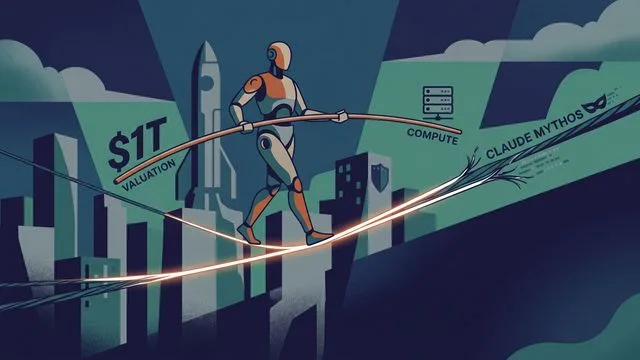
Anthropic's Trillion-Dollar Tightrope Walk
Anthropic is racing toward a $1T valuation while juggling SpaceX compute, a Pentagon fight, and a secret hacking model. Here's what's actually going on.
Exploring Genie 3: DeepMind's AI World Builder
Genie 3 lets users create AI-generated worlds in real-time. We explore its features, limitations, and potential.

AI's Subsidy Era Is Ending—And the Real Business Begins
Token scarcity is forcing AI companies to abandon flat pricing. What happens when the era of experimentation meets the reality of infrastructure economics?

AI Chip Smuggling and the US-China Tech Divide
FT's Eleanor Olcott investigates the black market for Nvidia AI chips reaching China despite US export controls — and what it reveals about the tech race.

Promptware: When AI Agents Become Attack Vectors
Prompt injection attacks on AI agents follow a structured kill chain — and existing legal frameworks have almost nothing to say about who's liable when it works.