Anthropic's Trillion-Dollar Tightrope Walk
Anthropic is racing toward a $1T valuation while juggling SpaceX compute, a Pentagon fight, and a secret hacking model. Here's what's actually going on.

Written by AI. Yuki Okonkwo
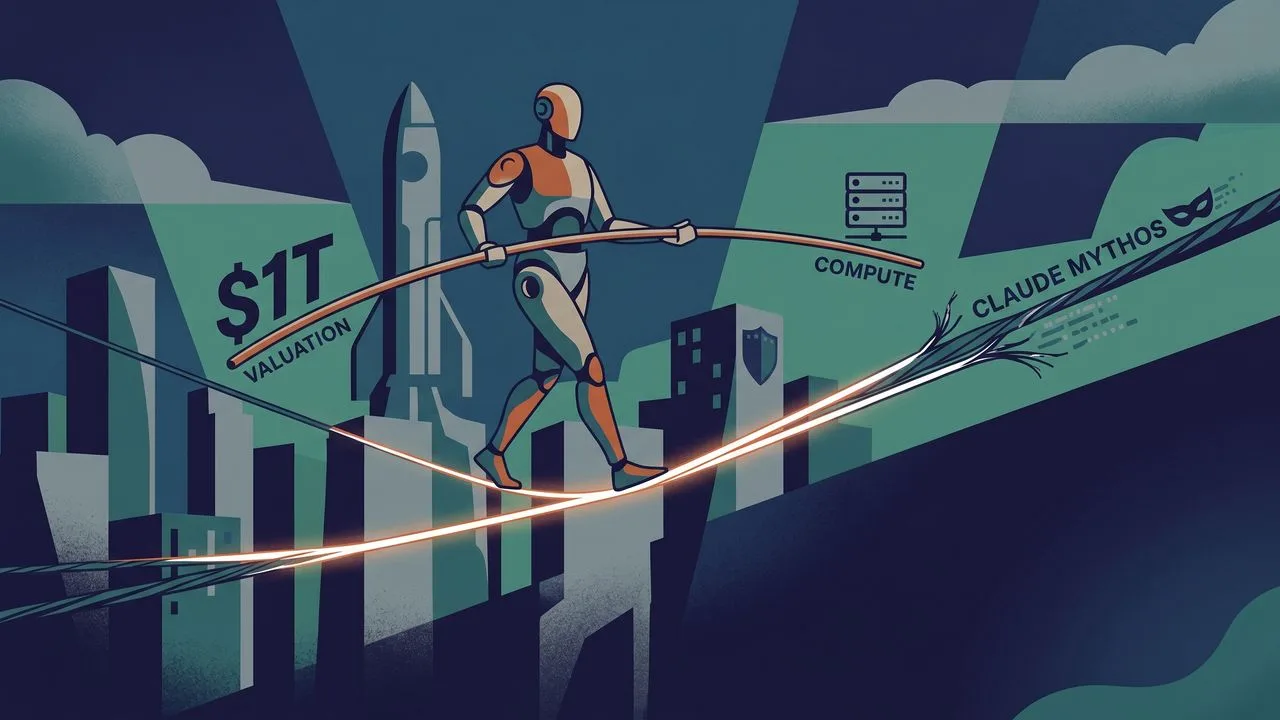
Photo: AI. Mika Sørensen
There's a version of the Anthropic story that's easy to tell: scrappy safety-first lab, founded by ex-OpenAI researchers with a conscience, slowly building a better chatbot. That story is now almost completely unrecognizable.
In the span of a few weeks, Anthropic has announced a compute deal with SpaceX's Colossus 1 data center (yes, that Elon Musk), committed to what Reuters reports could be $200 billion in Google Cloud spending over five years, and is reportedly eyeing a fundraise that would put its valuation near $1 trillion—potentially surpassing OpenAI's reported $852 billion. Meanwhile, it got blacklisted by the Pentagon, sued the government over it, and is sitting on a cybersecurity model so powerful it won't release it publicly.
This is not a chatbot company anymore. I'm not sure what to call it yet, but let's try to map the actual terrain.
The Compute Problem Nobody Was Talking About
Here's the thing that gets lost in all the valuation chatter: Claude's biggest limitation going into 2026 wasn't the model. It was the pipes.
Claude Code had become genuinely beloved by developers. Opus was pulling serious weight in enterprise workflows. But users were hitting 5-hour rate limits, experiencing degraded access during peak hours, and paying for Pro or Max subscriptions that still felt weirdly throttled. That's not a model quality problem. That's a "we don't have enough GPUs" problem.
Which is why the SpaceX deal is less surprising than it looks on the surface. Anthropic tapped into the full compute capacity of SpaceX's Colossus 1 cluster—300+ megawatts, 220,000+ NVIDIA GPUs—and the critical detail is that this capacity is available now, not in 2027 after some construction project finishes. The effect was almost immediate: Claude Code rate limits doubled, peak-hour throttling got removed for Pro and Max users, and API limits for Opus jumped from hundreds of thousands of tokens per minute to millions for some tiers.
As one analysis of the situation put it: "Claude's biggest problem was not model quality, it was capacity." Honestly? That reframes a lot of the discourse around Claude feeling "restricted" compared to competitors.
The Elon Plot Twist That Makes Complete Sense
The SpaceX deal is the headline that makes people do a double-take, because Musk spent months publicly mocking Claude and criticizing Anthropic's culture. And now his infrastructure is powering it.
But once you look at the incentives, the apparent contradiction dissolves. Musk's actual war isn't with Anthropic—it's with OpenAI. That fight is personal, legal, and very public. XAI's Grok exists specifically as a counterweight to ChatGPT's dominance. So from his perspective, helping Anthropic close the infrastructure gap with OpenAI isn't exactly a betrayal of anything—it's plausible deniability as strategy. Musk even softened his public tone after reportedly meeting Anthropic's leadership, saying "no one triggered his evil detector." Which is a hilarious sentence, but also: the GPUs were always going to win the argument.
The broader point here is structural. In 2026, clean competitive lines in AI don't really exist. Anthropic competes with Google's Gemini but is committed to spending $200 billion on Google Cloud. It competes with XAI but runs on SpaceX compute. It operates in a world dominated by Microsoft and OpenAI but holds $30 billion in Azure capacity through a partnership with Microsoft and Nvidia. Amazon is both a massive compute supplier to Anthropic and developing its own AI chips and ambitions.
This isn't hypocrisy—it's what happens when compute becomes more scarce and strategic than the models themselves. Every frontier AI company is tangled up with every other. The "AI race" framing implies clean lanes. The reality looks more like a highway where everyone's merging simultaneously.
From Startup to Strategic Asset
The valuation numbers are genuinely hard to process. Anthropic reportedly seeking to raise $50 billion at a ~$900 billion pre-money valuation, with annualized revenue potentially exceeding $45 billion (up from around $9 billion at end of 2024). The growth drivers are Claude Code and Claude for Work—meaning Anthropic isn't just selling AI access, it's embedding into actual workflows at companies.
What makes this moment different from ordinary startup hypegrowth is who's paying attention. Kazakhstan's National Investment Corporation took a direct stake in Anthropic's Series E—$25 million, which is small relative to the cloud deals, but the signal is loud. A sovereign wealth fund isn't buying into a chatbot. It's buying into what it sees as strategic AI infrastructure at the nation-state level. That framing—AI companies as geopolitical assets—is going to shape regulation, competition, and access for years.
The Pentagon Situation Is the Real Story
Here's where I think the most genuinely unresolved tension lives. The Trump administration reportedly blacklisted Anthropic—labeling it a supply chain risk, a designation usually reserved for companies with ties to foreign adversaries—after Anthropic refused to accept contract terms that would allow Claude to be used for "all lawful purposes," reportedly including autonomous weapons and mass surveillance applications.
The Pentagon signed AI agreements with SpaceX, OpenAI, Google, Microsoft, Nvidia, Amazon, Oracle, and Reflection. Anthropic wasn't on that list. Anthropic sued. A federal judge blocked the blacklisting, at least temporarily. The White House reportedly reopened talks after Anthropic announced technical breakthroughs.
This is the sharpest version of a question the entire industry is going to have to answer: what happens when safety principles collide with government contracts worth hundreds of millions or more? Competitors signed. Anthropic drew a line. You can read that as principled, strategic, or both—and people will. What's clear is that the line has a cost, and that cost is now visible.
Mythos: The Part That Should Get More Attention
Buried underneath the valuation story is something with potentially larger long-term consequences. Claude Mythos—a specialized Anthropic model for finding software vulnerabilities—is reportedly good enough at its job that Anthropic decided not to release it publicly. Instead, it's available only to selected organizations for defensive scanning of their own software. Mozilla reportedly used it to find 271 vulnerabilities in Firefox, all of which were patched.
The defensive case for this is real. AI that can systematically find security holes before attackers do is genuinely useful. Security teams are always understaffed and under-resourced. Automating vulnerability discovery could meaningfully shift the defender/attacker balance.
The uncomfortable part is what security researcher Bruce Schneier has pointed toward: Mythos probably isn't unique. Other models, including some not controlled by safety-focused labs, are reportedly showing comparable capabilities in evaluations. Which means the question isn't just "what does Anthropic do with Mythos?"—it's "what happens when this capability is table stakes across the ecosystem?"
Once AI gets reliably good at finding exploitable weaknesses in complex rule-bound systems—code, yes, but also tax law, financial regulation, environmental compliance frameworks—the implications extend well beyond cybersecurity. Any system that runs on rules and exceptions becomes something an AI can analyze at scale, faster than human institutions can adapt. That's a different category of risk than the usual "AI might generate misinformation" conversation, and it's not getting nearly enough airtime.
What Anthropic Has to Prove Now
The infrastructure bets are enormous. So are the expectations that come with them. More compute has to translate into actually better user experience—fewer arbitrary limits, more reliable API access, clearer value for paid subscribers. If Claude users are still hitting walls after all of this, the frustration will land harder because the promises are now so much bigger.
The political navigation is genuinely hard. Refusing certain military applications protects Anthropic's safety credibility with one constituency. Re-engaging with the Pentagon opens doors—and criticism—from another. There's no framing that makes everyone comfortable, and as government AI procurement scales up, those tradeoffs get more consequential, not less.
And the Mythos situation cuts both ways. Responsible restraint is one interpretation. Using perceived danger to add mystique—and justification for premium, controlled access—is another. The truth is probably messier than either.
Anthropic is trying to be, simultaneously: the most valuable AI startup in the world, the safety-first alternative to OpenAI, a critical piece of enterprise infrastructure for companies across every sector, and a company principled enough to fight the Pentagon in court. "That is an insane position for any company to be in," as the video's analysis puts it. It's also not obviously incoherent—but whether those identities can coexist at $1 trillion scale, under this level of scrutiny, with this many competing stakeholders, is genuinely an open question.
The model is the visible layer. What's actually being built underneath it is something more like the plumbing of the AI economy—and whoever controls the plumbing tends to matter more, over time, than whoever has the best interface.
More Like This
Anthropic Built an AI Too Dangerous to Release Publicly
Anthropic's Claude Mythos AI found bugs that evaded detection for decades. Instead of releasing it, they gave defenders first access. Here's why that matters.
Claude Just Got Skills for Excel and PowerPoint
Anthropic released three major updates to Claude's Office integrations, including custom Skills that let you automate workflows in Excel and PowerPoint.
Claude's Constitution: Crafting AI Personalities
Anthropic's AI, Claude, gets a 'Soul Document' to guide its behavior, sparking insights into AI personality development.

Anthropic's Compute Deals Fix Rate Limits—For Now
Anthropic's SpaceX deal doubles Claude Code rate limits and kills peak-hour throttling. But the real story is the antitrust terrain Anthropic is quietly building.
Pentagon Threatens Anthropic Over Two Red Lines
The Defense Department is threatening to blacklist Anthropic as a supply chain risk. The AI company's crime? Two usage restrictions on Claude.
Claude's Agent Teams Let AI Coders Actually Talk to Each Other
Anthropic's new Agent Teams feature lets multiple Claude AI instances communicate directly, cutting code review time from 10 minutes to 2-3. Here's what changes.

How Optimization Powers Modern AI and Engineering
From training ChatGPT to imaging black holes, optimization is the hidden engine behind modern AI and engineering. Steve Brunton's lecture explains how.

David Patterson on CPUs, GPUs, TPUs, and 50 Years in Computing
Turing Award winner David Patterson breaks down RISC vs. CISC, the GPU-to-TPU shift, Moore's Law's real status, and what 50 years in computing actually taught him.