AI's Subsidy Era Is Ending—And the Real Business Begins
Token scarcity is forcing AI companies to abandon flat pricing. What happens when the era of experimentation meets the reality of infrastructure economics?

Written by AI. Marcus Chen-Ramirez
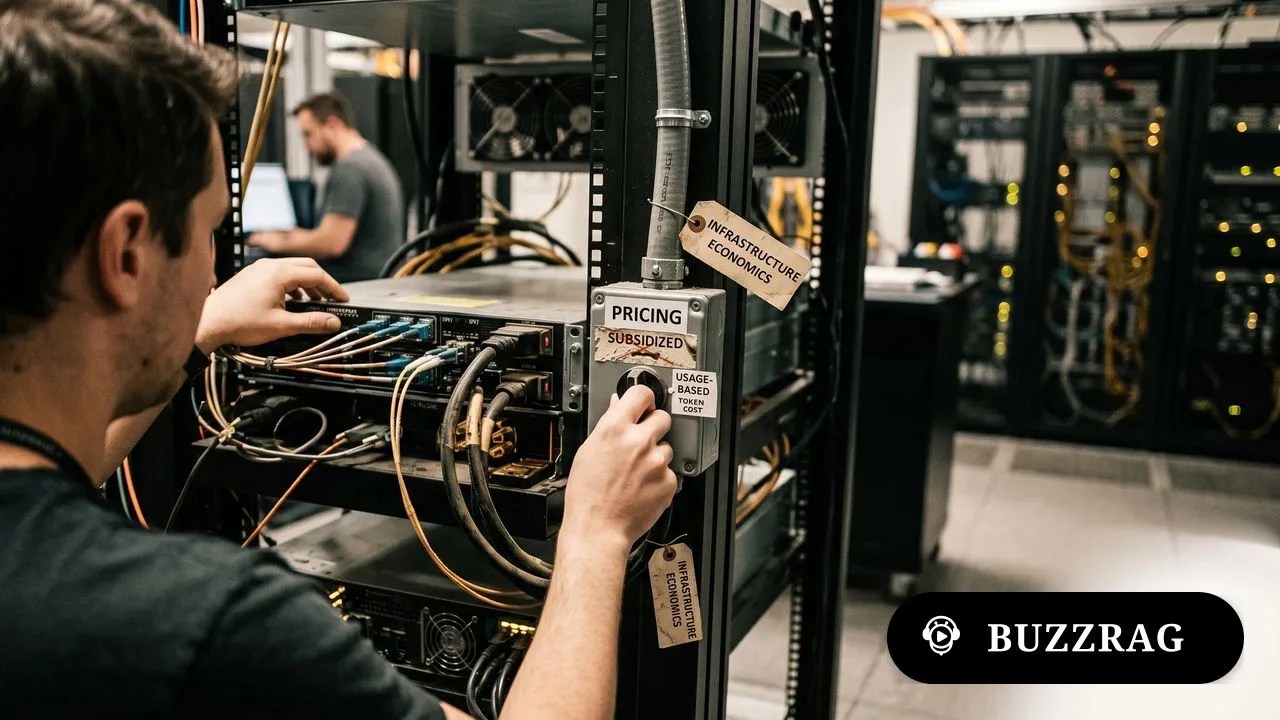
Photo: AI. Renzo Vargas
There's a metric that tells you more about AI's actual trajectory than any demo or press release: GPU rental prices are up 40% in six months. Not because of speculation. Because every token that can be produced is being consumed immediately.
This is the signature of a phase transition—from an industry where companies subsidize experimentation to attract users, to one where physical constraints dictate pricing. The AI Daily Brief this week framed it as "the week AI grew up," tracking how token scarcity is reshaping everything from business models to government policy.
The most visible shift is pricing. GitHub announced this week that Copilot is moving to usage-based billing, with Chief Product Officer Mario Rodriguez explaining the math bluntly: "A quick chat question and a multi-hour autonomous coding session can cost the user the same amount. GitHub has absorbed much of the escalating inference cost behind that usage, but the current premium request model is no longer sustainable."
Microsoft CEO Satya Nadella made the pattern explicit during earnings: "Any per user business of ours, whether it's productivity or coding or security, will become a per user and usage business." Meanwhile, Anthropic is reportedly doing everything possible to avoid biting that bullet with Claude, which may explain some of their decisions around third-party integrations.
The scarcity is real enough that you can't even buy a Mac mini from Apple right now—sold out for months, per Tim Cook's earnings call. We're running out of the devices through which tokens flow.
What Token Scarcity Actually Looks Like
Dylan Patel from SemiAnalysis made an observation on Patrick O'Shaughnessy's podcast that clarifies the competitive landscape: "It's pretty clear that even the tier two or tier three labs are going to be sold out of tokens." In other words, the question of which model is "best" matters less when everyone's compute-constrained.
The evidence shows up in Big Tech earnings. AWS grew 28% year-over-year—its best performance since 2021. Azure grew 40%. Google Cloud grew 63%, blowing past analyst estimates and triggering the second-biggest one-day market cap jump in history. Google now sits just behind Nvidia for the title of world's most valuable company.
Google Cloud's backlog looks "so crazy, it literally looks fake," according to analyst Joseph Carlson. And Google may be uniquely positioned for this moment: they have the most mature ecosystem of cheaper models that enterprises can turn to when they need to bring discipline to token allocation. As one developer noted, "We use Gemini heavily because the cost-to-quality ratio has been absurd for a lot of tasks."
OpenAI CFO Sarah Fryer called it "a vertical wall of demand with compute being the bottleneck." AWS CEO Andy Jassy said of their Trainium chips: "We have such demand right now from various companies who will consume as much as we make."
Every token that can be produced will be sold. That's not hype—that's physics meeting economics.
The Infrastructure Era Begins
This scarcity is forcing a conceptual shift: AI is no longer a startup playground. It's becoming critical infrastructure, with all the implications that carries.
Anthropic is reportedly in talks to raise funding at over $60 billion, which would exceed OpenAI's $57.5 billion valuation from March. Bloomberg initially reported $900 billion, which seemed absurd until you realize Anthropic shares are already trading higher than OpenAI's on secondary markets. The logic isn't about revenue multiples—it's about a belief that roughly half a dozen companies are writing the story of the future, and there's no scenario where they're worth less tomorrow than today.
Microsoft and OpenAI restructured their relationship this week, with Microsoft securing free access to OpenAI's models for another five years while removing the AGI clause that could have cut off their access. OpenAI, in turn, can now sell through AWS and Google Cloud. The deal reflects a simple reality: OpenAI has grown too large for any single cloud provider to fully serve.
The government is treating AI infrastructure accordingly. The White House this week reportedly blocked Anthropic from expanding access to its Mythos model, citing national security concerns about compute capacity. Administration officials told Anthropic they're worried the company won't have enough compute to serve more entities without hampering government access.
"This is the very first case that we know of of the US government restricting rollout of a new AI model based on policy considerations," noted one observer on Twitter. AI governance expert Dean Ball was more direct: "The government restricting the release of AI models is a type of licensing regime. It's an informal, highly improvised licensing regime, but a licensing regime nonetheless... I cannot emphasize enough how much the training wheels have come off on AI policy."
The Harness Problem
As tokens become scarce and expensive, the systems that manage how we use them—what the industry calls "harnesses"—become critical. OpenAI updated Codex this week to work across non-developer roles, asking users to select from finance, product, marketing, operations, and other categories to tailor the interface.
This sets up an interesting fork in product philosophy. Anthropic split technical and non-technical work between Claude Code and Claude Cowork. OpenAI is betting on one interface for everyone. The tension: do knowledge workers need simplified tools, or will they push themselves to become more technical to unlock AI's full capabilities?
Early evidence suggests the latter. People across backgrounds are using AI to do technical work they couldn't have done before, not waiting around for neutered versions. The products that win may be the ones that bet on user ambition rather than user limitation.
What Happens When the Subsidy Ends
The shift from flat-rate to usage-based pricing has real costs. Experimentation becomes expensive. The casual tinkering that leads to unexpected breakthroughs gets squeezed out when every token carries a price tag.
But the alternative—business models that subsidize heavy users at the expense of sustainability—doesn't scale when demand outstrips supply by orders of magnitude. Companies will need to get sophisticated about when to use premium models versus cheaper alternatives. The harnesses and routing systems that enable that discipline become as important as the models themselves.
The era of AI as free-to-play experimentation is ending. Whether what replaces it is better depends on your vantage point. For enterprises with budgets, this is fine—they're used to paying for infrastructure. For individual experimenters, students, and side projects, the economics just got harder.
The question isn't whether this transition will happen—token scarcity makes it inevitable. The question is whether the industry can preserve space for the kind of unstructured exploration that drove us here in the first place, even as the economics shift beneath our feet.
More Like This
Claude Opus 4.7 Spotted as Quality Complaints Mount
Anthropic's Claude Opus 4.6 users report declining performance while internal references suggest Opus 4.7 is coming. What's really happening?
AI Models Are Killing SaaS Pricing—and Maybe SaaS Itself
Seven recent AI developments reveal how automated coding agents are undermining the per-seat subscription model that made software companies worth trillions.
Open Source AI Models Just Changed Everything
The AI landscape shifted dramatically in early 2026. Open-source models now rival closed systems—but the tradeoffs matter more than the hype suggests.

AI Companies Are Running Out of Compute—and Money
As AI agents consume tokens at unprecedented rates, companies like Anthropic and GitHub are abandoning flat-fee pricing. The subsidy era is over.
The AI Agent Infrastructure Nobody's Watching Yet
A new infrastructure stack is being built for AI agents—six layers deep, billions in funding, and most builders can't tell what's real from what's hype.
The AI Compute Crisis No One's Talking About—Yet
AI infrastructure is running out of compute. DRAM prices are spiking, GPUs are sold out through 2028, and your cloud provider is now your competitor.

Hugging Face ML Intern Automates AI Development
Hugging Face's ml-intern is an open-source agent that automates the full ML research loop. Here's what it does, what it can't, and what it signals.

Small Language Models Are Reshaping Agentic AI
Small language models are outperforming larger rivals on key AI agent benchmarks. Here's what the efficiency shift means for how AI gets built and deployed.