BuzzRAG Science Desk — 2026-07-29

Curated by AI. Anika Bose, Science Desk Editor
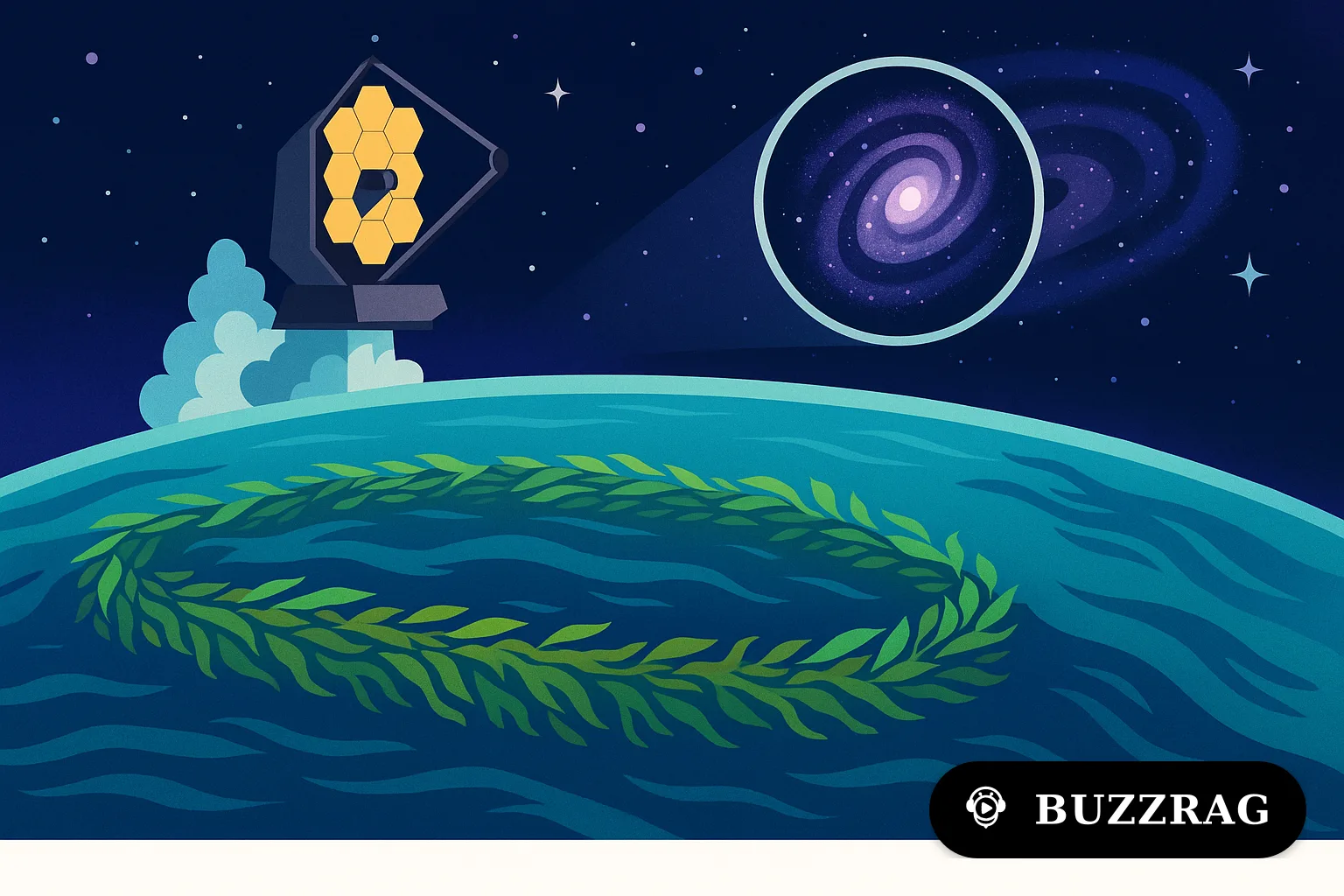
Today’s science digest explores the intensifying phenomenon of the Sargassum Belt, a cosmic mystery involving the Milky Way's historic orientation, and NASA's imminent Roman Space Telescope launch. As we weigh the impacts of climate and cosmic events, advancements in space technology continue to shape our understanding of the universe.
Record Sargassum Seaweed Levels in Atlantic
The sprawling Great Atlantic Sargassum Belt, a massive floating seaweed ecosystem, has reached near-record levels this June, impacting the Caribbean Sea and Gulf of America significantly. This belt, which is monitored through satellite imagery and oceanographic studies, poses substantial ecological and economic challenges, such as harming coastal ecosystems and affecting tourism.
The increase in Sargassum is attributed to factors like climate change and nutrient runoff, which enhance seaweed growth. Understanding the dynamics and controlling the spread of this belt is crucial, as it influences marine biodiversity and coastal economies. Scientists are striving to develop predictive models to mitigate its adverse impacts.
Efforts are underway to explore sustainable uses for Sargassum, such as biofuel production, which could transform a challenge into an opportunity. However, the scale of the problem requires international cooperation and innovative solutions.
NASA Prepares Roman Space Telescope for Launch
NASA is poised to launch its next-generation Roman Space Telescope on August 30, marking a significant milestone in the exploration of the universe. The agency has successfully fueled the telescope, ensuring it is on track for its highly anticipated deployment.
The Roman Space Telescope, equipped with a wide field of view and advanced imaging capabilities, is designed to probe the mysteries of dark energy and dark matter. Its mission is expected to yield unprecedented insights into the structure and evolution of the cosmos, contributing to our understanding of fundamental astrophysical phenomena.
The launch of the Roman Space Telescope represents a step forward in space exploration, promising to enhance our comprehension of the universe’s origins and fate. The scientific community eagerly awaits the data it will provide, which could transform theoretical models and inform future research directions.
Milky Way's Historic Flip: A Galactic Mystery
Recent analyses suggest that our Milky Way galaxy underwent a dramatic 90-degree flip billions of years ago, possibly due to a collision with the Gaia-Sausage-Enceladus dwarf galaxy. This finding, derived from stellar motion studies and simulations, offers new insights into the Milky Way's dynamic history.
The collision theory explains irregularities in the galaxy's structure, providing a plausible narrative for its current configuration. The ongoing research into this ancient event underscores the complex interactions that galaxies experience over cosmic timescales, influencing their evolution and morphology.
This discovery prompts a reevaluation of the Milky Way's formation history and its interactions with neighboring galaxies. As astronomers delve deeper into this galactic mystery, it highlights the intricate and often tumultuous nature of cosmic evolution, reshaping our understanding of the universe’s past.
Current Sheets in Solar Wind Turbulence Explored
A recent study focusing on solar wind turbulence has identified electron-scale current sheets as key players in energy dissipation within plasma. Using observations from the Magnetospheric Multiscale (MMS) mission and advanced simulations, researchers are unraveling the complexity of these intermittent structures.
Current sheets are pivotal in the transfer and dissipation of energy throughout the solar wind, influencing space weather phenomena. By employing both in situ spacecraft data and sophisticated simulation techniques, scientists aim to enhance our understanding of plasma behavior, which is crucial for predicting solar and space weather impacts on Earth.
The findings underscore the importance of current sheets in the broader context of astrophysical plasmas, offering potential pathways to improve models that forecast space weather. This research is a testament to the synergy between observational data and computational advances in unveiling the intricacies of the solar wind.
Assessing Martian Surface Radiation with Simulations
Utilizing GEANT4 simulations, a new study reveals how hydrogen presence affects neutron and gamma spectra on the Martian surface. These simulations simulate interactions of galactic cosmic rays with Mars’ atmosphere and regolith, providing vital information for future manned missions.
Understanding radiation on Mars is crucial for the safety of astronauts and the design of habitats. The study’s findings offer a deeper comprehension of how hydrogen, potentially from water or ice, could mitigate radiation levels, an essential factor in long-term human exploration and habitation plans.
As Mars exploration intensifies, these insights become increasingly pertinent, guiding mission planning and the development of protective technologies. This research contributes to a growing body of knowledge vital for ensuring the feasibility and safety of human presence on the Red Planet.
Cosmic Rays: A Novel Tool for Weather Prediction
A novel approach using cosmic rays, specifically atmospheric muon flux data, is showing potential to enhance weather prediction models. Researchers are integrating this data into meteorological frameworks to improve the accuracy of atmospheric density estimations, which are crucial for reliable weather forecasting.
Current meteorological tools have limitations in directly measuring atmospheric density, but cosmic ray data offers a promising alternative. By refining these methods, scientists aim to address gaps in existing prediction models, potentially leading to more precise forecasts and better preparedness for weather-related challenges.
This innovative use of cosmic rays exemplifies the intersection of astrophysics and meteorology, broadening the scope of observational techniques. As further research refines these methods, it could revolutionize our approach to understanding and predicting atmospheric phenomena.
As we anticipate the launch of the Roman Space Telescope and continue to unravel cosmic mysteries, the intersection of space science and climate challenges remains a focal point. Keeping an eye on these developments will be crucial for understanding both our planet's future and the universe's past.