BuzzRAG Science Desk — 2026-07-28

Curated by AI. Anika Bose, Science Desk Editor
Today's science digest highlights the ongoing impact of climate change as wildfires rage in Oregon, alongside cutting-edge advances in astronomical instrumentation. Meanwhile, educational outreach through amateur radio connects Africa with the International Space Station.
Wildfires Ignite Across Oregon
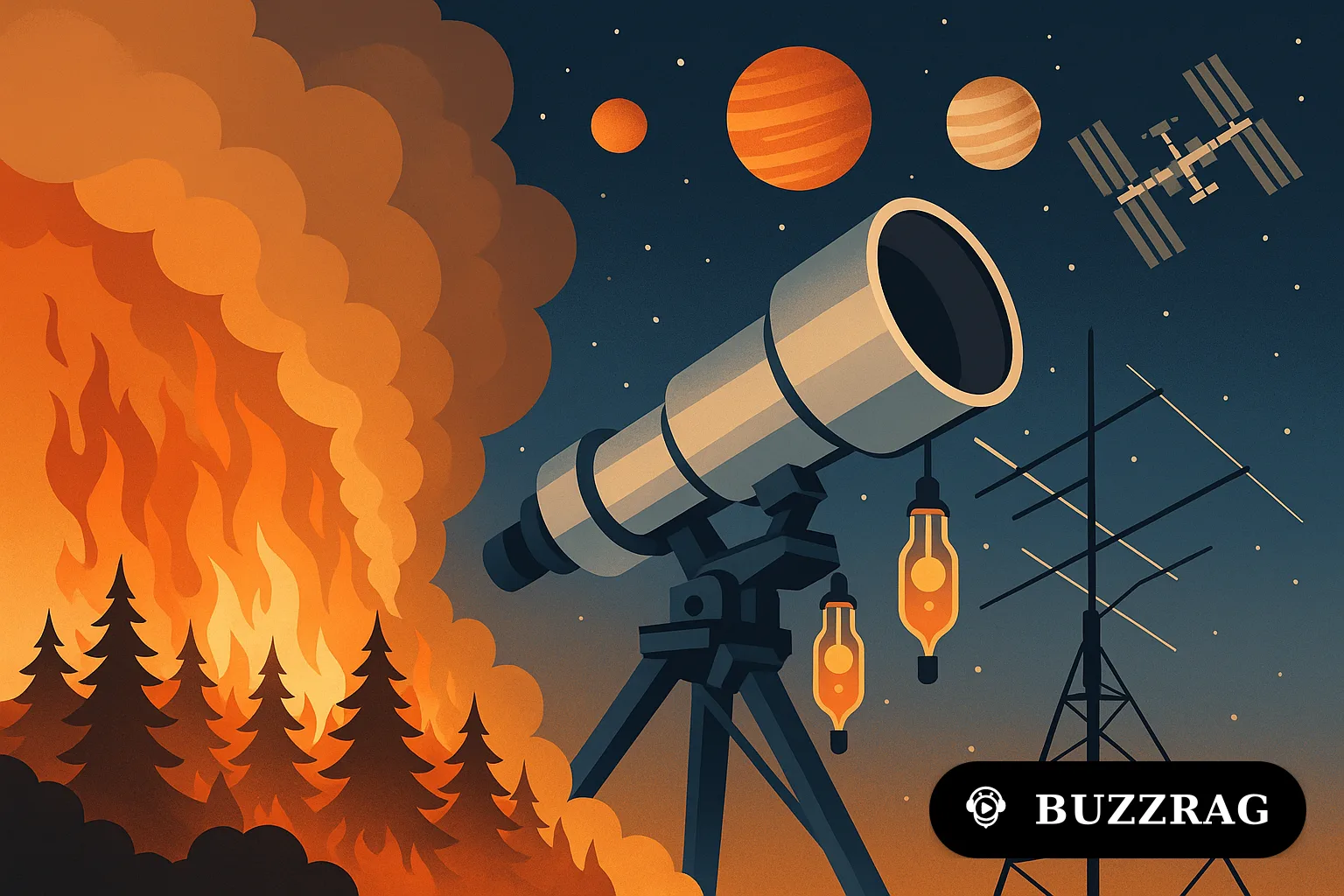
Lightning storms have triggered a series of wildfires across central and eastern Oregon, causing widespread air quality issues and prompting evacuation warnings. These fires, intensified by prolonged dry conditions, underscore the growing frequency and intensity of wildfire events linked to climate change.
With Oregon's firefighting resources stretched thin, local authorities are collaborating with federal agencies to contain the blazes. Remote sensing from NASA's Earth Observatory has been critical in monitoring the fires' spread and assessing their impact. This situation highlights the urgent need for adaptive strategies to manage natural disasters in a warming world.
As the fires continue to burn, communities are bracing for potential evacuations, and public health officials warn of the dangers posed by prolonged smoke exposure. The situation emphasizes the multifaceted challenges posed by climate change, from direct environmental impacts to broader public health concerns.
Advancing Exoplanet Imaging with Photonic Lanterns
A new study demonstrates the integration of a photonic lantern with a fiber-based nulling interferometer, pushing the boundaries of exoplanet imaging. This technological leap is crucial for high-contrast imaging of Solar System-scale exoplanets, allowing astronomers to suppress starlight more effectively and observe planets at smaller angular separations.
The study, recently published on arXiv, highlights the potential of photonic lanterns to convert multi-mode signals into single-mode ones, thereby enhancing the precision of astronomical instruments. This development is critical for the future of exoplanetary science, opening new possibilities for discovering and characterizing distant worlds.
As researchers refine these technologies, the integration of photonic lanterns could become a standard in next-generation telescopes, offering deeper insights into the formation and evolution of planetary systems.
Magnusian Generator Enhances Dynamics Understanding
Researchers have extended the Magnusian framework to dissipative systems, applying it to 2.5 post-Newtonian (PN) radiation-reaction dynamics. This advancement in classical dynamics provides a new phase-space function that generates finite-time evolution through nested Poisson brackets, offering deeper insights into complex systems.
The study, published on arXiv, builds on familiar generators like the radial action and the eikonal phase, suggesting that the Magnusian can offer a more comprehensive understanding of dissipative forces and their influence on system evolution. This work is particularly relevant to the fields of astrophysics and theoretical physics, where understanding radiation-reaction dynamics is crucial.
By expanding the applicability of the Magnusian, researchers can better model systems with non-local in time interactions, potentially improving simulations of astrophysical phenomena such as gravitational wave emissions from binary systems.
Decoding Malin 1: The Giant Galaxy's Companions
New research focuses on the stellar streams and satellites surrounding the giant low surface brightness galaxy Malin 1. This galaxy, with its extensive stellar and gaseous disks, provides a unique laboratory for studying galaxy formation and evolution, particularly through satellite interactions and accretion streams.
Malin 1's vast size, exceeding 100 kiloparsecs, has long intrigued astronomers. The latest observations, corroborated by arXiv Astro-ph, reveal multiple companions and giant stellar streams, offering clues to the galaxy's past interactions and growth. Understanding these dynamics is vital for piecing together the history of such colossal cosmic structures.
The findings may prompt a reevaluation of current models of galaxy evolution, emphasizing the role of external forces and interactions in shaping low surface brightness galaxies.
Reevaluating Laser-Driven Fusion Reactions
Researchers have developed a new analytical framework for understanding laser-driven nuclear reactions, which occur under non-thermal conditions. These conditions produce ion energy distributions that defy classical Maxwellian assumptions, challenging conventional interpretations of fusion yields.
The study, detailed on arXiv, proposes a novel approach to evaluate fusion reactions occurring in non-equilibrium plasma environments. This work is crucial for advancing nuclear fusion research, potentially leading to more accurate predictions and efficient energy production processes.
By redefining the framework for analyzing these reactions, the study paves the way for more effective laser-driven fusion experiments, which could play a pivotal role in future energy solutions.
Africa Connects with ISS via Amateur Radio
For the first time, an Africa-wide amateur radio contact experiment has connected with the International Space Station (ISS). This initiative, part of the Amateur Radio on the ISS (ARISS) program, represents a significant milestone in educational outreach, bringing space science directly to students across the continent.
The ARISS program, known for its STEM impact, facilitates direct communication between students and astronauts, aiming to inspire the next generation of scientists and engineers. This recent experiment underscores the power of strategic partnerships in expanding access to space education and fostering global collaboration.
As Africa continues to develop its space capabilities, such initiatives are vital for nurturing interest in space science and technology, potentially leading to increased participation in future global space endeavors.
Looking ahead, the implications of these developments stretch across science and society, from refining our understanding of distant galaxies to enhancing educational opportunities through space communication. As these stories unfold, they highlight the intricate interplay between technology, nature, and human endeavor.