Cosmic Rays Could Make Weather Forecasts More Accurate
Researchers are testing whether atmospheric muon flux—particles forged in cosmic ray collisions—can fill a stubborn blind spot in weather prediction models.

Written by AI. Nadia Marchetti
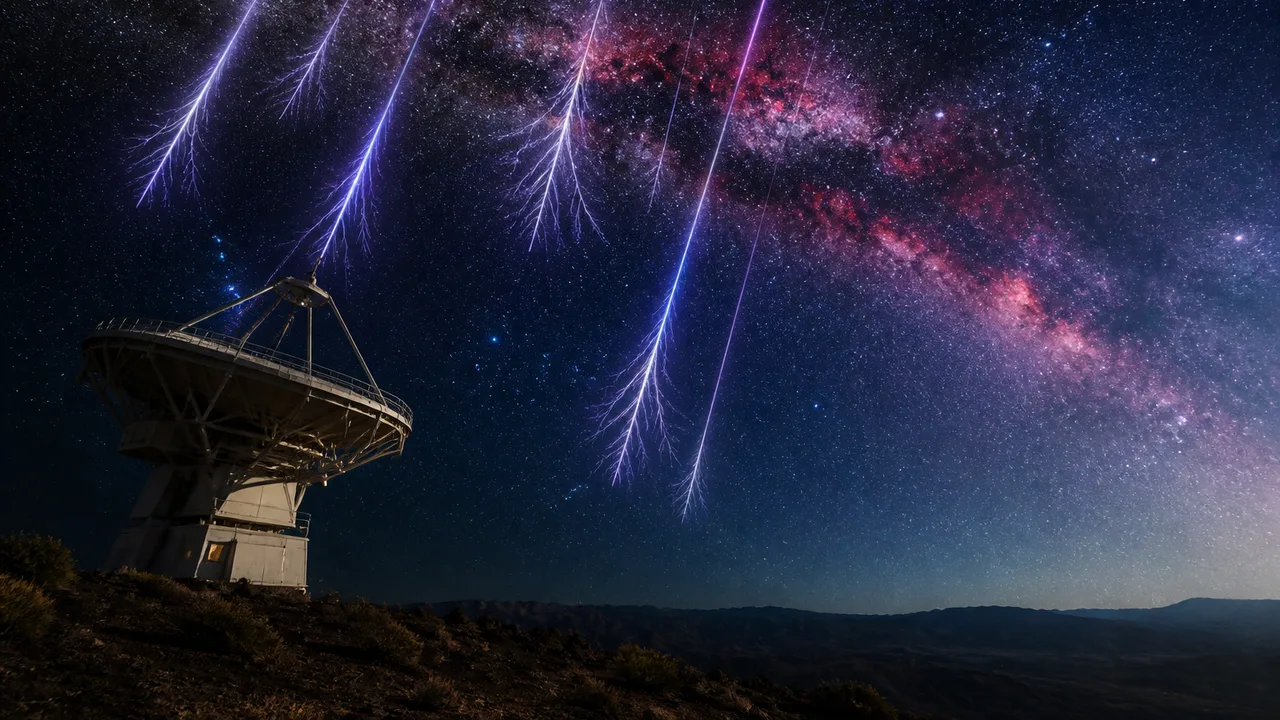
Every time you check a weather app and it's wrong, there's usually a culprit hiding in the physics. Not bad satellites, not lazy meteorologists—atmospheric density. It's one of the most fundamental variables in the equations that govern how weather systems evolve, and our instruments can't directly measure it. We approximate it. We infer it. We work around it.
That's the gap a new line of research is trying to close—using, of all things, particles born from the collision of cosmic rays with the upper atmosphere.
The Blind Spot in the Sky
To understand why this matters, a brief detour into how weather prediction actually works. Numerical weather prediction models are built on a set of governing equations—fluid dynamics, thermodynamics, the physics of rotating planetary systems. Feed those equations accurate initial conditions (current atmospheric state), and they'll project forward with reasonable fidelity. Feed them bad initial conditions, and errors compound. Fast.
Atmospheric density is woven directly into those governing equations, as researchers lay out in a paper posted to arXiv. The problem, as that paper notes bluntly: "current meteorological instrumentation cannot directly measure the atmospheric density." Meteorologists piece together density estimates from temperature and pressure readings, using assumptions encoded in the ideal gas law. It works reasonably well. But it's still an inference, not a measurement—and inferences have error bars.
The question the researchers are asking: what if there were a way to get an independent constraint on atmospheric density from a completely different physical process? One that doesn't depend on the same instrument networks or the same atmospheric assumptions?
Enter the Muon
Here's where it gets genuinely strange, in the best way.
Cosmic rays—high-energy particles streaming in from outside our solar system, predominantly protons—slam into molecules in Earth's upper atmosphere at extraordinary velocities. That collision produces a cascade of secondary particles. Among them: muons. Muons are essentially heavy electrons, short-lived under most conditions, but moving close enough to the speed of light that relativistic time dilation lets significant numbers of them survive long enough to reach ground level. Muon detectors—which range from purpose-built scientific instruments down to surprisingly cost-effective portable devices—register this flux continuously.
The critical physics: how many muons reach the ground depends on how much atmosphere they pass through. Denser air means more interactions, more energy loss, more muons absorbed before arrival. Thinner air means the opposite. Muon flux, in other words, is a natural readout of the integrated atmospheric density column above the detector.
This relationship has been known for decades. What's newer—and what makes the current research interesting—is the attempt to flip the relationship around. Instead of just measuring cosmic rays and correcting for atmospheric effects (which is how particle physicists have traditionally thought about this, treating weather as an annoying source of noise in their data), these researchers are asking whether muon flux data can be assimilated into meteorological models to improve forecasts.
According to arXiv, early results suggest it can: "assimilation of atmospheric muon flux information leads to improved forecasts of surface pressure, wind velocity, temperature, and humidity." That's not a narrow technical tweak—those are the core variables of any weather forecast.
The Relationship Has History
The connection between cosmic ray flux and atmospheric conditions isn't new science; the ambition to exploit it operationally is.
Research published in Space Weather by Savić and colleagues (Wiley Online Library) approached this from the particle physics direction: how do you correct muon monitor data for meteorological effects so you can study the cosmic rays themselves more cleanly? Their multivariate analysis of those corrections, however, generated detailed quantitative maps of exactly how atmospheric variables modulate muon counts—maps that could, in principle, be run in reverse.
A separate study catalogued on NASA ADS found that cosmic muon flux variations correlate not just with local weather but with geomagnetic storm activity—suggesting muon detection might even provide advance warning of space weather events "several hours ahead before they hit the Earth." That's a different application, but it points in the same direction: muon flux is carrying atmospheric and space-environmental information that we haven't fully exploited yet.
The ScienceDirect study on concurrent measurements (sciencedirect.com) adds a practically important piece: the detectors themselves don't have to be expensive. Researchers using "cost-effective and portable" cosmic ray muon detectors and Geiger-Müller counters, combined with machine learning methods including gradient boosting, found meaningful correlations between muon flux and standard meteorological parameters. That matters a lot for the scalability question. A measurement technique that requires million-dollar infrastructure can't be deployed globally. Portable detectors that can be networked? Different story.
What This Is, and What It Isn't
Worth being precise about the state of play, because "cosmic rays could improve weather forecasting" is a sentence that could land anywhere on the hype spectrum depending on how you read it.
The arXiv paper (2509.04627) is a preprint—meaning it's available for scrutiny but hasn't completed formal peer review. The results described are promising. They are not yet a validated operational tool. The gap between "this data assimilation approach improves model output in test conditions" and "meteorological agencies integrate muon flux into their operational forecasting chains" is wide, filled with validation studies, instrument networks, data standardization problems, and institutional inertia.
There are also genuine open questions the research is still working through. Muon flux gives you information about the integrated atmospheric column—the total density from the top of the atmosphere down to the detector. Decomposing that into density at specific altitudes is a harder inverse problem. The detectors, however portable, need geographic distribution to be useful for regional forecasting. And the signal, while real, is relatively subtle compared to the large-scale variations meteorologists deal with; extracting clean meteorological signal from muon data requires careful treatment of other confounding factors, including solar activity and geomagnetic variability.
None of that is fatal. It's the normal texture of translating a promising physical relationship into an engineering solution. But it's worth holding the excitement at a temperature that matches the evidence.
Why This Particular Gap Matters
There's a reason people keep trying to find new ways to constrain atmospheric density. Weather prediction has improved dramatically over the past few decades—the five-day forecast today is roughly as accurate as the three-day forecast was in the 1990s—but the improvements have come from better models, faster computing, and more satellite data, while certain fundamental measurement gaps have persisted.
Atmospheric density is one of those gaps. Because it's inferred rather than measured, errors in temperature and pressure readings propagate into density estimates, which propagate into the governing equations, which propagate into forecasts. Any independent measurement pathway—especially one that samples the atmospheric column in a fundamentally different way than existing instruments—is potentially valuable precisely because its errors aren't correlated with existing errors. In data assimilation, independent observational constraints are the whole game.
Muon flux offers exactly that: a physically distinct measurement process, sensitive to the same variable through completely different physics. The existing network of particle physics detectors is already global—the infrastructure for cosmic ray monitoring exists for other scientific reasons and could, in principle, be leveraged without building from scratch.
The field is still in the early stages of figuring out how much it can actually extract. But the underlying logic is solid, and the initial results point in the right direction.
Which means the interesting question isn't whether cosmic rays can tell us something about the atmosphere—they demonstrably can. It's whether the signal is clean enough, and the detector networks dense enough, to make a meaningful difference to the forecasts that actually reach your phone. That answer is still being written.
— Nadia Marchetti, Unexplained Phenomena Correspondent, BuzzRAG
More Like This

Why NASA Is Finally Returning to Venus After 40 Years
After decades of neglect, Venus is getting two NASA missions. Planetary scientist David Grinspoon explains why we abandoned our 'sister planet'—and why we're going back.

The Most Sensitive Dark Matter Detector Might Find Nothing
LUX-ZEPLIN sits a kilometer underground, waiting for dark matter. But success might look like silence—and that would tell us something huge.

Heavy Spoilers Builds an Office, Ditches the Algorithm
YouTube creator Paul from Heavy Spoilers explains why he built a garden office, changed his logo, and chose depth over views in content strategy.
Cosmic Rays: What Particles From Deep Space Reveal
Cosmic rays bombard Earth constantly, yet their origins remain partly unknown. Here's what a century of detective work has—and hasn't—resolved.
Adam Riess on the Hubble Tension and Cosmic Expansion
Nobel laureate Adam Riess explains why two precise measurements of the universe's expansion rate keep disagreeing—and what that could mean for cosmology.
Neutrinos, Oscillation, and the Matter-Antimatter Mystery
Particle physicist Kirsty Duffy explains neutrino oscillation, what it broke in the Standard Model, and why DUNE may finally answer why matter exists at all.
Solar Flares, Earth's Magnetosphere, and StormWall
Recent X-class solar flares and CMEs have prompted serious discussion about Earth's space weather vulnerability—and a theoretical plasma shield called StormWall.

Microsoft Majorana 2: Bold Claims, Thin Evidence
Microsoft's Majorana 2 chip promises a 1,000x reliability leap and a 2029 quantum computer. Scientists say the paper doesn't back any of it up.