Neutrinos, Oscillation, and the Matter-Antimatter Mystery
Particle physicist Kirsty Duffy explains neutrino oscillation, what it broke in the Standard Model, and why DUNE may finally answer why matter exists at all.

Written by AI. Amelia Nwofor
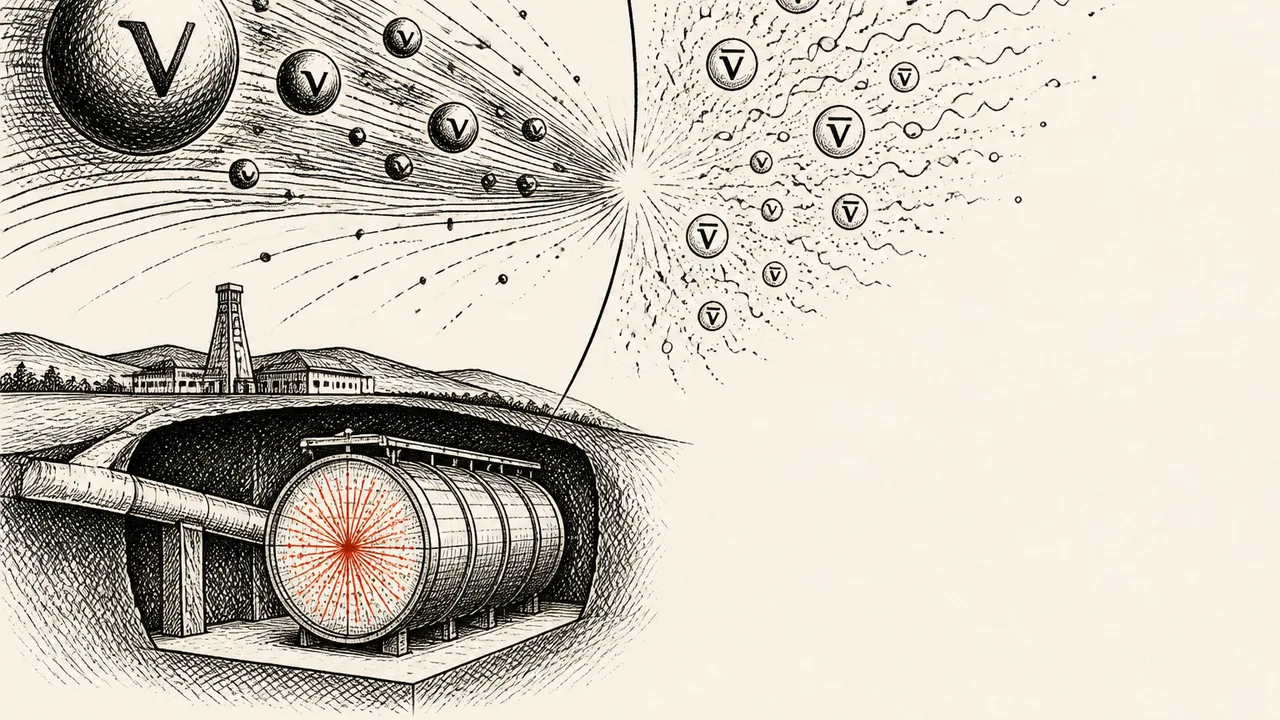
Photo: AI. Eira Pendragon
Right now, as you read this, roughly 100 billion neutrinos are passing through your thumbnail. Not metaphorically. Not approximately. One hundred billion, per second, mostly from the sun, and every single one of them is completely indifferent to your existence.
That's the entry point Kirsty Duffy — particle physicist, Oxford associate professor, and physics lead for the MicroBooNE collaboration at Fermilab — chose for her May 2025 Royal Institution lecture on neutrino physics. It's a good entry point because it immediately establishes the central tension: these particles are everywhere, they are the most abundant matter particles in the universe (outnumbering protons and electrons roughly a billion to one), and yet across your entire lifetime, statistically only one or two of them will actually collide with an atom in your body. The other hundred-billion-per-second just pass through you as if you're not there. Because to them, you're not.
The particle that broke the textbook
Duffy's lecture isn't really an introduction to neutrinos. It's the story of how neutrinos kept forcing physicists to revise their most confident theories — and what that pattern of revision might mean for the deepest question in cosmology.
Start with the Standard Model, particle physics' periodic table. It accounts for everything from quarks to Higgs bosons and has held up against experimental scrutiny for decades. Neutrinos sit within it as three distinct "flavors" — electron, muon, and tau — each paired with its corresponding charged lepton. Clean, tidy, three generations of matter in organized columns.
The problem arrived in the 1960s, when physicist Ray Davis built a detector in a South Dakota mine: 600 tons of dry cleaning fluid, selected because its chlorine content would react with incoming electron neutrinos and produce countable argon atoms. The experiment expected to register about 36 argon atoms per month. It found roughly half that. For years, the field debated whether the experiment was wrong, or whether solar physicists had simply miscalculated how many neutrinos the sun produces.
Neither turned out to be the answer.
What was actually happening — and what required decades of additional experiments to confirm — is that electron neutrinos produced in the sun's core were changing identity during their 150-million-kilometer journey to Earth. By the time they arrived, roughly half had become muon or tau neutrinos. Davis's detector, sensitive only to electron neutrinos, was seeing exactly what it should have seen. The neutrinos hadn't disappeared. They had transformed.
What "oscillation" actually means
Duffy has clearly spent time workshopping how to explain neutrino oscillation to non-specialists, and the analogy she lands on is genuinely useful. Imagine wearing glasses with duct tape over everything except a narrow central slit. You hold a beach ball painted in three colors and see only a sliver of red at the top — so you reasonably conclude you're holding a red ball. You throw it to a friend wearing the same glasses. They catch it, look down, and see blue. You both conclude the ball has magically changed color. What you've actually got is a beach ball you can't see all of at once.
This is more than pedagogical hand-waving. It maps onto something real in quantum mechanics: the three neutrino "flavors" that we detect (electron, muon, tau) are not the same as the three neutrino "mass states" that actually propagate through space. Each flavor is a quantum superposition of the three mass states, and because those mass states have slightly different masses, they travel at slightly different speeds. The superposition shifts as they travel. The probability that you'll detect a given flavor oscillates, rhythmically, as a function of distance.
"The probability that you are going to measure a particular type of neutrino oscillates up and down as they travel," Duffy explains. "Send a muon neutrino a thousand kilometers and you'll barely detect it as a muon neutrino anymore — you'll see electron and tau neutrinos instead. Go even further, and the muon neutrinos come back."
The experimental confirmation came in two pieces, both earning the 2015 Nobel Prize in Physics. The Sudbury Neutrino Observatory (SNO) in Canada showed that when you measure all neutrino flavors arriving from the sun, the total matches solar models perfectly. Only when you filter for electron neutrinos specifically does the count drop — to about 40% of expected. The flavor-changing was real. Super-Kamiokande in Japan then showed the effect scaled with distance, using atmospheric neutrinos arriving from different angles (and therefore having traveled different distances through the Earth). The data matched oscillation predictions; it didn't match a no-oscillation hypothesis.
The point where the Standard Model cracks
Here is where the story pivots from interesting to genuinely consequential.
Neutrino oscillation requires neutrinos to have mass. In the Standard Model, they don't. So the experimental confirmation of oscillation isn't just a curiosity about neutrino behavior — it's a falsification of the model's prediction, a clear signal that our best theory of particle physics is incomplete. The Standard Model needs patching, and researchers don't yet agree on how.
What's more unsettling is the list of things still unknown. We don't know the actual mass values — only that the three mass states differ from each other and are far smaller than any other particle's mass, too small to measure directly yet. We don't know the mass ordering (which is heaviest?). We don't know whether the mixing pattern we observe has a deeper explanation. And there's a possibility, which Duffy flags with deliberate restraint, that neutrinos might be their own antiparticles — a property called being "Majorana" fermions — which would have implications reaching far beyond neutrino physics.
Physicists have proposed that neutrinos get their mass through a different mechanism than other particles, not through the Higgs field in the usual way. Some of these proposals involve hypothetical heavy "sterile neutrinos" that don't interact through any known force — particles that would extend the Standard Model rather than simply patch it. Recent experimental results have complicated the picture of whether sterile neutrinos actually exist in the theoretically predicted form, which is its own ongoing argument in the field.
Why any of this might explain why you exist
The most ambitious claim in Duffy's lecture — and she's careful not to oversell it — is that neutrinos could hold the key to why the universe contains matter at all.
The problem is this: standard cosmological models predict that the Big Bang produced equal amounts of matter and antimatter. Matter and antimatter annihilate each other on contact. If the early universe was perfectly symmetric, everything should have annihilated, leaving a universe consisting entirely of photons — no atoms, no galaxies, no anything. The universe we observe is made almost entirely of matter. Something, somewhere, tipped the balance.
You only need a small imbalance — roughly one extra matter particle per million matter-antimatter pairs — to produce the observable universe after all the mutual annihilation. But generating even that small asymmetry requires physics to behave differently for matter than for antimatter. The technical term is CP violation (violation of charge-parity symmetry). CERN has observed CP violation in certain mesons, but as Duffy notes, the magnitude of that asymmetry is orders of magnitude too small to account for the matter excess we see — particle asymmetry measurements at CERN have pushed this frontier but haven't closed it.
Neutrinos are the one sector of particle physics where CP violation hasn't been thoroughly measured, largely because neutrinos are so difficult to study. The question Duffy's research addresses is whether neutrinos and antineutrinos oscillate differently. If they do — if the flavor-changing probability curves look different for matter versus antimatter — that asymmetry could be large enough, in principle, to have contributed to the matter excess that made the universe habitable. This connects to broader questions about antimatter at CERN that researchers have been circling for years without a definitive answer.
Current experiments — T2K in Japan and NOvA in the US — have produced hints of such asymmetry but lack the statistical power to confirm it. Both send accelerator-produced neutrino beams over hundreds of kilometers and compare what arrives against what was sent. Both have seen suggestive signals. Neither has the precision to call it.
DUNE: the infrastructure of a definitive answer
Which is why about a thousand physicists from across the world are currently building DUNE — the Deep Underground Neutrino Experiment.
The setup: Fermilab, just outside Chicago, will fire a neutrino beam 1,300 kilometers through the Earth's crust to a detector complex at the Sanford Underground Research Facility in the Black Hills of South Dakota. That's the same mine where Ray Davis ran his cleaning-fluid experiment in the 1960s. The caverns have been excavated — Duffy showed photographs where the scale is almost incomprehensible until you spot a person in a high-visibility jacket somewhere near the floor. Four detectors, each 66 meters long — longer than a 787 Dreamliner — will be filled with liquid argon at minus 186°C. That's 17,000 tons of argon per detector.
The detector technology — liquid argon time projection chambers, read out via planes of wires spaced 5 mm apart — offers millimeter-scale tracking resolution throughout an enormous volume. The wire planes themselves are mostly being manufactured in Daresbury, UK, shipped in temperature- and shock-monitored containers, and will eventually be lowered down the mine shaft — dangled below the lift cage, since they don't fit inside it — and assembled underground like a ship in a bottle.
DUNE is expected to come online near the end of this decade. If the neutrino-antineutrino oscillation asymmetry is real and substantial, DUNE should have the statistical power to measure it definitively. If it's not there, or if it's too small to see, that tells you something too.
The honest answer, for now, is that nobody knows which outcome to expect. The hints from T2K and NOvA are suggestive but not conclusive. The theoretical motivation is real but doesn't specify a magnitude. Neutrino physics has a long history of surprising its practitioners — Davis's missing neutrinos, oscillation itself, the Standard Model's broken prediction — and there's no strong reason to assume DUNE's results will be what anyone currently predicts.
What's clear is that the question being asked is not a narrow one. Whether neutrinos and antineutrinos behave differently during oscillation is, at bottom, a question about whether there's a fundamental asymmetry between matter and antimatter — and whether that asymmetry is large enough to explain why anything in the universe survived the Big Bang at all.
A particle that passes through the Earth without noticing it might, in the end, be what explains why the Earth exists.
More Like This
Sterile Neutrinos: A Particle Physics Puzzle
Recent experiments challenge the existence of sterile neutrinos, reshaping our understanding of the universe.
CERN's Particle Asymmetry: Cracking the Universe's Mysteries
Exploring CERN's recent findings on matter-antimatter asymmetry and their implications for understanding the universe.
When Basic Physics Secretly Rewrites the World
Don Lincoln explains how Maxwell's equations revealed the speed of light — and why what we ignore in physics today may determine our climate future.
The Most Sensitive Dark Matter Detector Might Find Nothing
LUX-ZEPLIN sits a kilometer underground, waiting for dark matter. But success might look like silence—and that would tell us something huge.
How Nanoparticles Are Already Changing Everyday Life
From self-cleaning glass to cancer detection, UCL's Professor Ivan Parkin maps what nanoparticle science can actually do right now — and where it still falls short.
Nanodomains, Pulsars, and What We Can't See Yet
Izzy Jayasinghe and Alfredo Carpineti discuss heart disease, invisible light, and what super-resolution microscopy reveals about the body's smallest structures.

Donald Hoffman: Evolution Hid Reality From Us
Cognitive scientist Donald Hoffman argues on StarTalk that evolution gave us a VR headset, not a window—and the math behind Darwin backs him up.
Gravity's Strangest Effects, From Time to Cosmic Voids
From gravitational time dilation to the Dipole Repeller and LIGO's detections, here's what gravity actually does—and what it still can't explain.