Fasting and Connective Tissue: What the Science Shows
A 2024 Nature Metabolism study tracked 3,000+ proteins during a 7-day fast. The findings on collagen remodeling and muscle preservation are harder to dismiss than you'd expect.

Written by AI. Amelia Nwofor
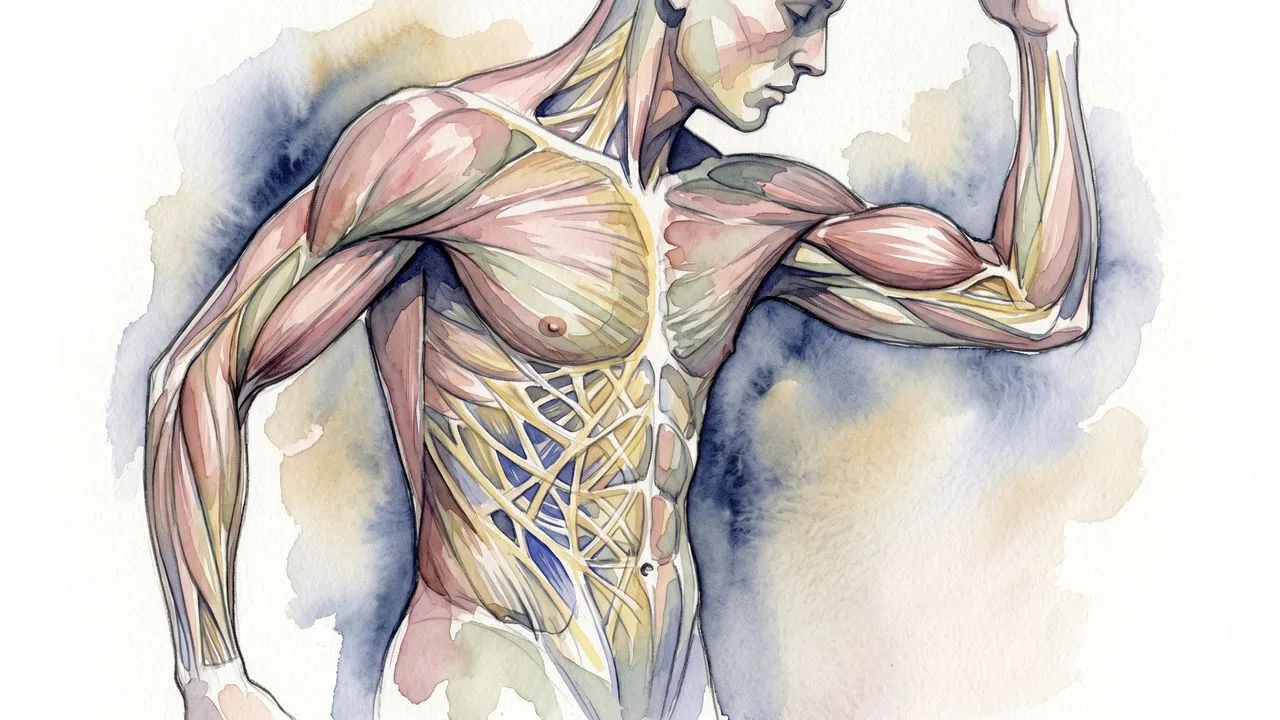
Photo: AI. Júlia Almeida
The conventional critique of prolonged fasting has always had a certain intuitive force: you're starving your body of building blocks, so obviously repair suffers. Muscles waste. Joints deteriorate. Recovery tanks. It's a tidy narrative—and it may be substantially wrong.
A 2024 paper published in Nature Metabolism tracked over 3,000 proteins across participants undergoing a 7-day fast. Fitness commentator Thomas DeLauer recently walked through its findings on his YouTube channel, and while the video comes packaged with a supplement sponsorship and the usual optimization-community energy, the underlying study deserves a look on its own terms.
The results are genuinely interesting. And some of the nuances are getting lost in how they're being communicated.
What the Study Actually Found
The research wasn't measuring gym performance or subjective wellbeing—it was doing something more granular. Proteomics. Tracking which proteins increased, decreased, and changed in character over time, day by day, across multiple physiological systems.
Two findings stand out.
First: muscle protein breakdown markers didn't spiral upward with extended fasting. They actually decreased after the 48-hour mark. Nitrogen excretion—a rough proxy for muscle catabolism—remained low even through day seven. This contradicts the longstanding fear that a multi-day fast is a muscle-wasting event. DeLauer notes that "the occasional longer-term fast barely breaks down muscle at all," and on this specific point, the proteomics data appears to support him. The caveat he acknowledges matters: chronic undereating after a fast is a different problem entirely.
Second—and this is the more surprising finding—the extracellular matrix (ECM) underwent significant remodeling. The ECM is the scaffolding around your cells: collagen, fibronectin, the structural proteins that hold connective tissue together. After roughly 48 hours of fasting, proteins associated with collagen turnover and wound healing increased substantially. The body, deprived of incoming fuel, appears to redirect signaling toward internal repair processes.
Part of this involves a protein called FGF-21 (fibroblast growth factor 21), a metabolic stress signal that rises significantly after about 48 hours of caloric deprivation. FGF-21 does several things—it accelerates fat utilization, modulates glucose, and seems to amplify the broader shift toward repair-mode physiology. It's a real mechanism, not a hand-wavy appeal to "detox."
The Stem Cell Claim: Intriguing, But Handle With Care
DeLauer makes a comparison that's worth examining carefully. He suggests the collagen turnover findings could "rival even stem cells in many ways," and acknowledges that previous stem-cell-adjacent fasting claims "sounded like gobbledygook." His framing: the new data gives those earlier intuitions more credibility.
This is where I'd pump the brakes slightly—not because the comparison is wrong, but because it's doing a lot of work in a few words. The regenerative biology of fasting-induced autophagy and stem cell mobilization is real and active research territory (Valter Longo's lab at USC has published extensively on this). But "could rival stem cells" is a large leap from "we observed increased wound-healing proteins in the ECM." The study doesn't make that comparison directly. Proteomics changes in a 7-day fast are a promising signal, not a clinical outcome.
That said, DeLauer is careful enough to say "early data" and "could be the case." It's worth holding him to that hedging rather than either dismissing or inflating it.
The Immune System Piece
One of the more underreported findings in the study—at least in how it's been discussed publicly—concerns immune function. The fast didn't simply suppress inflammation, which is the usual simplified story. It appears to have reorganized immune activity: pro-inflammatory cytokines went down, while proteins associated with immune surveillance increased. The immune system became, in the study's framing, better at finding threats rather than just quieter about existing ones.
This distinction matters. "Anti-inflammatory" is a word that's been laundered of almost all meaning by wellness marketing. What the study describes is more specific: a shift in how the immune system operates, not just a dimming of its overall activity. Chemokines—signaling molecules that direct immune cells toward pathogens—changed in character. That's a more interesting finding than "fasting reduces inflammation," even if it's harder to put on a supplement label.
The Refeeding Problem Nobody Talks About Enough
The most practically significant section of the study—and DeLauer's video—concerns what happens after the fast ends. The researchers measured participants through days 8–14, and the data is instructive: the benefits accrued during the fast are not automatically retained once eating resumes.
The postprandial inflammatory response is real and normal. Every meal triggers some degree of systemic inflammation. The question is magnitude and what you're eating. DeLauer's argument, grounded in the study's post-fast data, is that eating in a way that spikes inflammation immediately after a prolonged fast likely undermines the remodeling work the body spent days setting up. As he puts it: "when you break a fast and you inflame yourself with oxidized oils, with poor quality saturated fats and trans fats, low-quality sugars and refined carbs... what's happening is you're creating an inflammatory response."
This isn't novel nutritional advice, but the mechanism is more interesting when you connect it to the proteomics data. You're not just making a vague "eat clean" choice—you're potentially interrupting a specific ECM remodeling process that took 48+ hours to initiate.
The practical implication he draws: two to three days of low-inflammatory eating after a fast of 36 hours or more to consolidate the gains. Whether that specific window is correct isn't something the study directly establishes—that's DeLauer's inference from the data, and it's a reasonable one, but it's still an inference.
What Isn't in the Video
A few things worth flagging that the video doesn't address, not as criticism but as orientation for readers doing their own digging.
The study involved a 7-day water fast under controlled conditions. Most people doing "extended fasts" are doing 24–72 hours, often with some caloric intake. How much of the ECM remodeling translates to more common fasting protocols is an open question. DeLauer's claim that "you can get many of the benefits of a multi-day fast in just 36 hours" is plausible—FGF-21 does rise in that window—but the full proteomics picture at 36 hours isn't the same as at 7 days.
The study population also matters. Extended fasting in individuals who are metabolically healthy, well-nourished beforehand, and not dealing with active tissue injury or chronic illness may show very different protein signatures than in other groups. Personalization, as always, is the gap between population-level findings and individual decisions.
And the video has a paid partnership with a multivitamin brand. That's disclosed clearly, but it does mean the implicit recommendation threading through the piece—that you should be supplementing around your fasts—has a commercial interest attached to it. The underlying science doesn't require you to buy anything.
Where This Leaves Us
The Nature Metabolism study is legitimately interesting science. The ECM remodeling findings, the muscle preservation data, the immune system reorganization—these aren't fringe claims. They're peer-reviewed proteomics in a high-impact journal, and they do push back against some reflexive anti-fasting positions that were never especially evidence-based to begin with.
"This isn't just about calories anymore," DeLauer says. "There are signaling devices happening. There are signaling proteins. There are genetic changes that are occurring." That framing is actually correct, even if the language is imprecise. What we're learning about fasting is increasingly about information, not just energy arithmetic.
The harder question is what people do with this information. The jump from "interesting proteomics findings in a 7-day fast study" to "this fasting method completely restores connective tissue" is where the science and the headline diverge. The data is promising. "Complete restoration" is a different claim entirely—and one the study doesn't make.
The science here is worth your attention. The title is worth your skepticism.
More Like This

When Feeling Stuck Is Actually Feeling Safe
The Art of Improvement argues comfort—not laziness—is what keeps people stuck. The idea is compelling. It's also worth examining carefully.
Understanding Emotion Regulation with Dr. Marc Brackett
Explore emotion regulation with Dr. Marc Brackett, focusing on practical strategies for emotional intelligence in personal and professional contexts.

How Childhood Trauma Shapes Adult Relationships
Explore how childhood trauma influences adult relationships and discover pathways to healing.
MyFitnessPal Bought CalAI. Here's Why That's Telling.
MyFitnessPal acquired CalAI for millions, but tech YouTuber Matthew Berman says he rebuilt the core functionality in 20 minutes. What does that tell us?

Fitness Is Tracking the Wrong Scoreboard
The wellness industry optimizes for calories and scale weight—not health. A climate entrepreneur's insight about broken metrics applies directly to your body.
Loneliness Is Wrecking Your Biology, Not Just Your Mood
Dr. Molly Maloof joins Dave Asprey to explain how isolation damages your cells, why connection is medicine, and what peptides may support longevity.

Hannah Cairo Disproved a 40-Year-Old Math Conjecture at 17
At 17, Hannah Cairo overturned the Mizohata-Takeuchi conjecture using a hypercube and a coin diagram. Here's what she actually did—and why it matters.

How Language Shapes Thought, According to Lera Boroditsky
Cognitive scientist Lera Boroditsky explains how the language you speak shapes memory, color perception, and thought—and what's lost when languages disappear.