How Nanoparticles Are Already Changing Everyday Life
From self-cleaning glass to cancer detection, UCL's Professor Ivan Parkin maps what nanoparticle science can actually do right now — and where it still falls short.

Written by AI. Amelia Nwofor
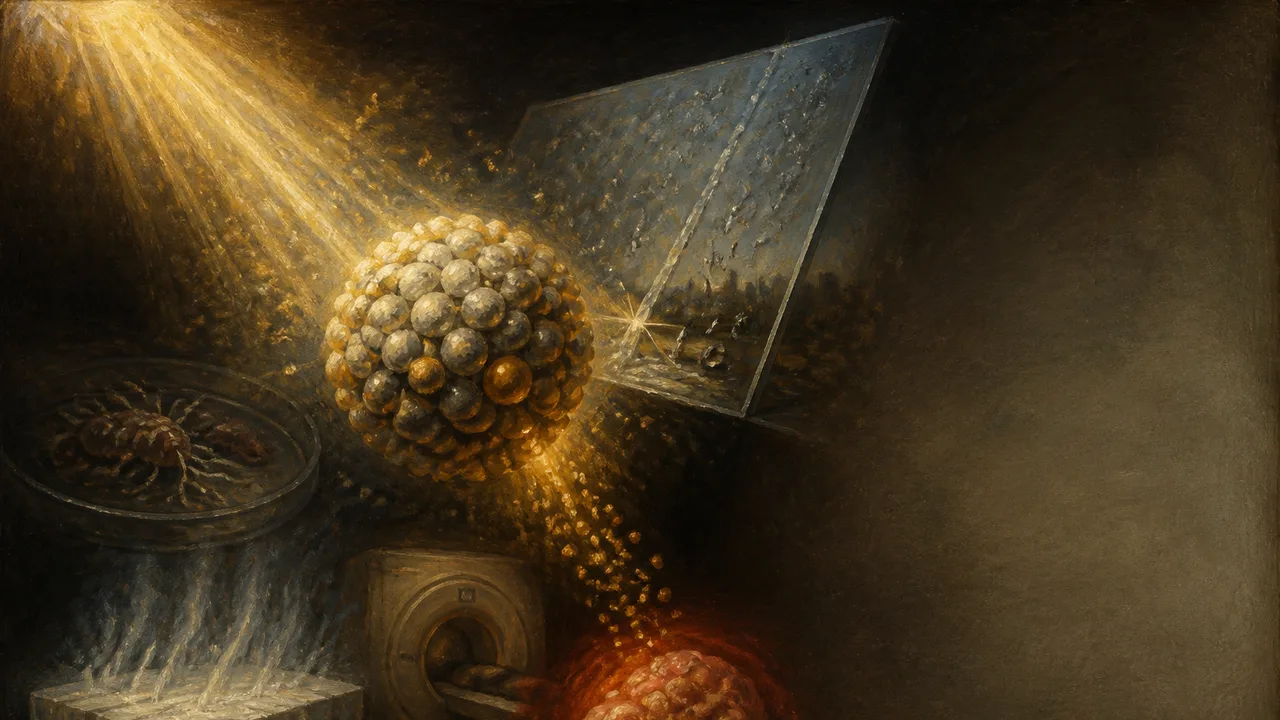
Photo: AI. Henrik Solberg
Michael Faraday didn't know what he was making. In 1857, working in what is now the Royal Institution building in London, he dissolved gold salts in carbon disulfide, reacted them with phosphorus, and produced something that glowed a deep, luminous ruby red. He described it, documented it, and moved on. Those same solutions still exist — sealed, slightly toxic, sitting in the Ri museum — and what Faraday had actually made, we now know, were gold nanoparticles.
That historical detail is where UCL materials chemist Professor Ivan Parkin opens his recent Royal Institution lecture, and it sets the tone well. Nanoparticles aren't a new invention. They're a new understanding of something that's been happening under our noses — sometimes literally — for centuries. The Romans accidentally embedded metal nanoparticles in glass when they tossed coins into molten melts for good luck. The Lycurgus Cup, dating to the 4th century AD, changes from green to red depending on the direction of light passing through it: a nanoparticle optical effect the Romans couldn't explain and didn't need to. They just thought it looked good.
The talk, delivered at the Ri in April 2026 to mark UCL's 200th anniversary, covers roughly a decade's worth of active research across half a dozen different application areas. Parkin — Sir William Ramsay Professor of Chemistry and Dean of Mathematical and Physical Sciences at UCL, with over 1,000 publications — doesn't present a single triumphant narrative. What he presents is closer to a working map: here's what nanoparticle science can demonstrably do, here's where it's been commercialised, and here's where the physics is clear but the engineering hasn't caught up yet.
That honesty is worth pausing on, because popular coverage of nanoscience has a long history of conflating "we can make this in a lab" with "this is about to change everything."
The 25-nanometre coating on your conservatory roof
The most commercially established example Parkin discusses is self-cleaning glass — specifically Pilkington Activ, a product with around £200 million in annual sales that coats roughly 40,000 conservatories a year in the UK alone. The functional layer is titanium dioxide, and it's 25 nanometres thick. To put that in Parkin's own terms: about the distance your fingernail grows in 30 seconds.
At that thickness, titanium dioxide becomes transparent. But it retains its core photocatalytic property — exposed to UV light, it generates electrons and holes that break down organic dirt on the surface. It also makes the glass superhydrophilic: water spreads into a thin sheet rather than beading up, which means rain effectively rinses the surface clean as it runs off. Two mechanisms, one coating, no moving parts.
UCL researchers were involved in early testing and in developing the APCVD (atmospheric pressure chemical vapour deposition) process used in manufacturing — applying the coating while the glass is still hot on a kilometre-long float glass production line, which avoids a separate heating step. Parkin is careful to credit Pilkington NSG as the company that drove commercialisation: "We helped develop that. I don't take the credit for it — that was done by the company — but we worked with them and did a lot of testing."
His group has since worked on improving on baseline TiO₂. Doping with nitrogen and sulfur increases photocatalytic activity. Stacking alternating doped and undoped layers increases it further. Most significantly, combining titanium dioxide with tungsten oxide — growing tungsten oxide needles and then overcoating them with TiO₂ to create a heterojunction — produced what Parkin describes as "one of the most photoactive films I've ever seen." The key finding, confirmed through computational modelling with collaborator Professor Richard Catlow, is that the enhancement only occurs at the junction between the two materials. Interrupt the junction with a carbon spacer layer, and the effect disappears entirely. The mechanism is electron-hole separation at the interface — a precise structural requirement, not a bulk property.
When water acts like a marble
The lecture includes several live demonstrations, and the superhydrophobic surface section produces the most visually striking results. Where titanium dioxide makes surfaces more wettable (superhydrophilic), a separate class of nanoparticle-engineered surfaces does the opposite: water contact angles above 150 degrees, meaning droplets sit on the surface like spherical marbles and roll off, collecting dust, bacteria, and viruses as they go.
The design principle, as Parkin explains it, combines two things: a surface that water has low affinity for, and a nanoscale-rough texture. The roughness is critical. A smooth low-energy surface doesn't achieve superhydrophobicity reliably; the nano-scale texture traps air pockets that prevent water from making proper contact. This is, in essence, what plants have been doing for millions of years — the lotus effect — and what Parkin's collaborators published in Science after successfully making the coating mechanically rugged enough to survive real-world handling, not just lab conditions.
The cotton wool demonstration — dipping treated and untreated samples into concentrated grape juice — is the kind of tactile proof that makes abstract contact angles feel real. Untreated cotton comes out saturated with purple dye. Treated cotton comes out clean.
The gap between lab demonstration and durable, scalable deployment is where most superhydrophobic research currently sits. The Science paper on mechanical robustness was a step forward precisely because it addressed a known limitation the field had been sidestepping.
The harder problems
Two areas of Parkin's talk illustrate the distance between scientifically promising and practically solved.
The first is photoelectrochemical water splitting — using light to split water into hydrogen and oxygen, which can then be recombined in a fuel cell. The physics is sound. The efficiency isn't. "We can only get to about one or two percent," Parkin says, and adds, with characteristic directness: "If there's anyone in the audience who's very young — if you want a Nobel Prize, get this catalyst to work at around 25% efficiency. You'll be pretty close to it." UCL has built demonstrator devices. They work in principle. But until efficiency improves by an order of magnitude, this stays in the "important but unsolved" category.
The second is radiative cooling. The underlying principle is elegant: certain mid-infrared wavelengths can pass through the atmosphere and radiate heat directly into the coldness of space. Engineer a coating that emits strongly in that window, and you get passive cooling — no electricity, no refrigerant, just physics. Parkin's group has developed water-based nanoparticle coatings ("PolyCool") that achieve 10–15°C of cooling under the right conditions, and they're currently scaling to 80 litres for trials on four London buses. The material is also superhydrophobic and abrasion-resistant.
But the caveats matter: it works less well under cloud cover, the performance depends on ambient conditions, and the team acknowledges they're moving from lab-scale (small vials) to applied scale (bus rooftops) with understandable anxiety. Commercial radiative cooling products already exist — French supermarkets use them on rooftops to cool refrigeration systems — but the technology is still early. Parkin's projection is that widespread impact is five to ten years away.
Nanoparticles in the body
The healthcare applications section covers the most medically consequential work, and also some of the most counterintuitive materials science. Gold, as an element, is famously inert — Parkin gestures to his 34-year-old wedding ring as exhibit A. But gold nanoparticles at roughly two nanometres in size (around 180 atoms) become chemically reactive. Combined with photosensitising dyes and exposed to light, they can kill MRSA and E. coli at clinical levels. UCL-linked antimicrobial keyboards are currently in use at UCLH.
The diagnostics applications go further. Magnetic nanoparticles developed by Professor Quentin Pankhurst — working at the intersection of UCL and the Ri — form the basis of Endomagnetics' breast cancer staging technology, which has now been used in over 500,000 patients. Sugar-coated magnetic particles injected into patients allow clinicians to assess lymph node involvement in breast cancer with a small magnetic sensor rather than radioactive tracers. That's not a laboratory curiosity. That's an approved clinical device deployed at scale.
A separate technique, PIERS (photo-induced enhanced Raman scattering), combines the photocatalytic surfaces Parkin's group developed with gold nanoparticles to amplify Raman spectroscopy signals by tenfold to a hundredfold. The result is a reusable sensor platform capable of detecting TNT vapour at trace concentrations — work developed in collaboration with UCL's Professor Darren Caruana and the UK Ministry of Defence.
What emerges from this hour of materials chemistry isn't a single story about nanoparticles conquering everything. It's a more textured picture: some applications are already embedded in products people buy without knowing the mechanism; others are at the trial stage with honest performance limitations attached; and a few — water splitting chief among them — remain genuinely open problems that represent some of the most important unsolved chemistry in the field.
The coating on your conservatory glass is already doing its job. The London buses are a summer away from their first real test. And somewhere, presumably, a very young researcher is staring at a photoelectrochemical cell and doing the maths on what 25% efficiency would actually require.
More Like This

Exploring the Enigma of Antimatter at CERN
CERN's antimatter factory reveals mysteries of the universe's matter-antimatter asymmetry and the quest for new physics.

Can Directed Heat Beams Help Reverse Global Warming?
Caltech researcher Yae-Chen Lim thinks we can engineer thermal radiation into directed beams—and aim our waste heat straight into outer space.
Casimir Inc Raised $12M on Quantum Vacuum Claims
Casimir Inc claims its microchip harvests unlimited energy from the quantum vacuum. The physics says otherwise—and $12 million is riding on that gap.

OpenAI's Prism Wants to Fix Scientific Writing's Pain
OpenAI launches Prism, embedding AI directly into LaTeX for scientists. But can a tool designed to eliminate drudgery change how research actually works?

Why Light Beams Seem to End: Physics Explained
Discover why searchlight beams appear to stop and how physics and atmospheric conditions contribute to this phenomenon.

Ultrasound's New Role in Engineering Safety
Explore how ultrasound tech uncovers hidden structural flaws, preventing disasters in engineering.
Hannah Cairo Disproved a 40-Year-Old Math Conjecture at 17
At 17, Hannah Cairo overturned the Mizohata-Takeuchi conjecture using a hypercube and a coin diagram. Here's what she actually did—and why it matters.

How Language Shapes Thought, According to Lera Boroditsky
Cognitive scientist Lera Boroditsky explains how the language you speak shapes memory, color perception, and thought—and what's lost when languages disappear.