Nanodomains, Pulsars, and What We Can't See Yet
Izzy Jayasinghe and Alfredo Carpineti discuss heart disease, invisible light, and what super-resolution microscopy reveals about the body's smallest structures.

Written by AI. Amelia Nwofor
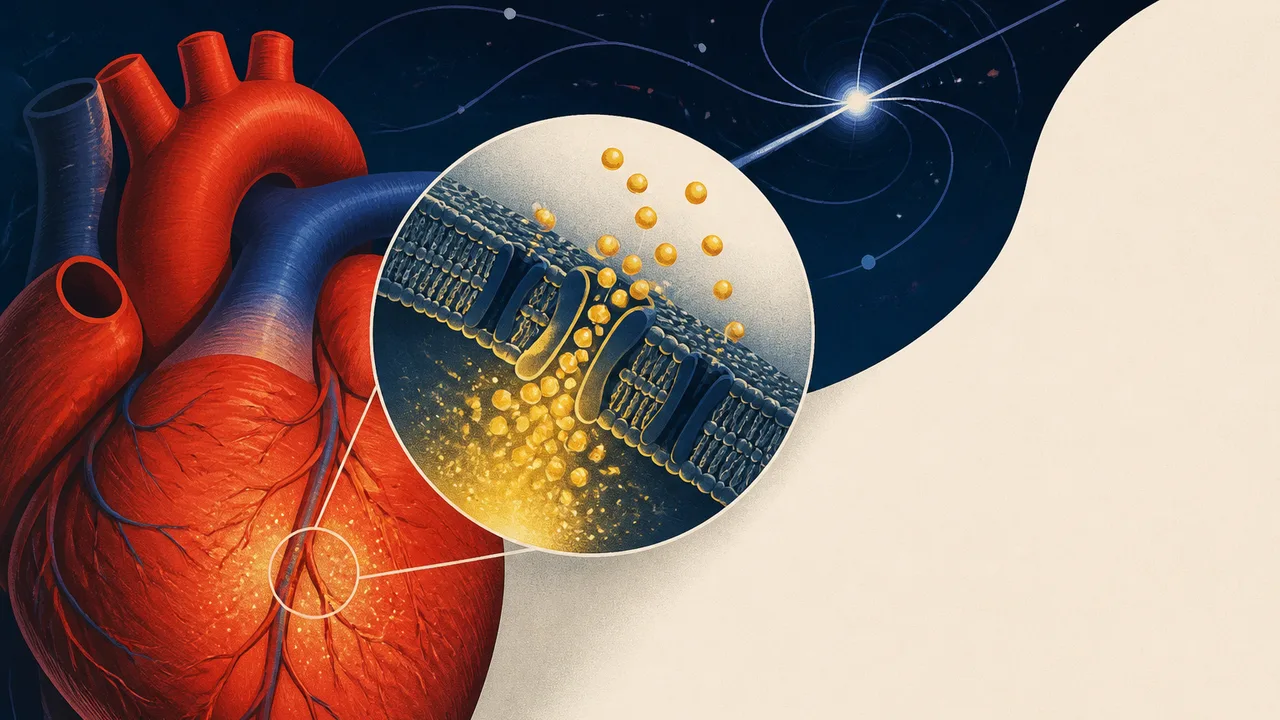
Photo: AI. Mika Sørensen
There's a particular kind of scientific honesty that doesn't make it into press releases. It sounds like this: we know these objects exist, we know they're emitting radio waves, and we are still struggling to work out exactly what's going on. Alfredo Carpineti, astrophysicist and founder of Pride in STEM, is talking about pulsars — neutron stars that pulse in radio waves, discovered in 1967, studied for nearly six decades, and still not fully explained. "I found it so wonderful," he says, without a trace of disappointment.
That comfort with incomplete knowledge runs through a recent Royal Institution Science podcast episode featuring Carpineti and Izzy Jayasinghe, Head of Molecular Medicine at UNSW Sydney. The two come at science from wildly different scales — one studies protein clusters inside heart cells measured in hundreds of nanometers; the other writes about supermassive black holes and the expansion of the universe. But they share a disposition: the most interesting part of a scientific story is usually the gap between what we've managed to see and what we haven't.
The city inside a cell
Jayasinghe's research centers on structures called nanodomains — and before you glaze over at the terminology, her framing is worth holding onto. "Every cell is a bit like a city," she explains. "They have different structures for transport and different structures for making decisions." Nanodomains are the communication infrastructure: densely packed clusters of signaling proteins, hundreds of nanometers across, sitting near the cell membrane where signals from outside first arrive. A single cardiac cell can contain between 30,000 and 100,000 of them.
The messenger they're built around is calcium. It's a useful messenger for the same reason it sounds trivial: it's literally the size of an atom, which means it moves fast. Fast enough to drive the heartbeat. Fast enough to trigger muscle contraction across the body. Calcium signaling is how a cell receives a rapid instruction and acts on it — and nanodomains are where those instructions get processed, amplified, filtered, or blocked.
In a healthy heart, this infrastructure works smoothly. In a diseased one, the nanodomains change structure. The research community has known this since around the turn of the millennium, but the question that's driven two decades of work is causation versus correlation: does nanodomain disruption cause heart disease, or does it result from it? Jayasinghe is careful not to overstate what's settled. "We certainly know that the changes in structure definitely do not help the function of the cell. So, even if it is the effect of the disease, you would want to try and reverse it or recover it."
That's a significant hedge, and it's the right one. Heart failure generally doesn't have a cure — it's managed, not resolved. Drugs targeting the mechanisms that drive nanodomain changes exist in research settings, but they haven't reached clinical use. Whether they ever do is, as Jayasinghe notes with a kind of clear-eyed pragmatism, "a decision that's made beyond the hands of the scientist." The science produces candidates; the pathway to a patient's bedside involves a different set of gatekeepers entirely.
Making the invisible visible
The bigger problem, for much of the twentieth century, wasn't the biology — it was optics. You can't study what you can't see, and nanodomains are too small for conventional light microscopes to resolve. Electron microscopy existed but required conditions that made routine, detailed study difficult. For decades, the architecture of these structures was inferred more than observed.
Super-resolution microscopy changed that calculus. The technique — which comes in several variants and can now run on hardware as modest as a 3D-printed plastic microscope — allows researchers to image individual proteins in their actual, functioning cellular environment. Not approximations. Not averages. Individual molecules, positioned in space, interacting with their neighbors.
What Jayasinghe emphasizes is that these images aren't photographs in any traditional sense. "Images are no longer a sort of analog photograph — they are very much a digital map that we can use to count, measure, and use as benchmarks for testing drugs, measuring changes in disease." The image encodes quantitative information about protein behavior, location, density. It's a data structure as much as a picture.
Her lab's extension of this is expansion microscopy — a technique that sidesteps optical resolution limits by physically inflating the sample itself. The cell structure gets transferred, like a three-dimensional stamp, onto a water-absorbing gel. The gel expands, and suddenly the structures that were too small to resolve are large enough to see clearly. You've made the cell bigger rather than the microscope more powerful. Current protocols can inflate a sample many thousands of times. At that scale, the limiting factor shifts from optics to chemistry.
The computational layer has transformed alongside the hardware. Fifteen years ago, Jayasinghe notes, processing a single image could take an hour. Now it happens in real time, opening the door to reconstruction-based imaging where what you see is a computed model derived from the raw data rather than a direct optical view. AI is beginning to push this further still — inserting information back into images in ways that weren't previously possible, accelerating both acquisition and interpretation. The practical consequence is that experiments can now ask questions that were simply unanswerable before.
Rainbows in the wrong light
The scale jump to Carpineti's work is considerable, but the underlying epistemological tension is the same: what does it mean to study something you can only detect indirectly?
His book Invisible Rainbows traces the astronomy done with light the human eye can't register — radio waves, microwaves, infrared, ultraviolet, X-rays, gamma rays. The title came from a conversation about Titan, Saturn's largest moon, where methane rain likely produces rainbows that no human could ever see because visible light barely penetrates the atmosphere. Infrared does. "The idea that there are invisible rainbows there," Carpineti says, and you can hear that he found the phrase before he found the book it would name.
The pulsar example is the one that most clearly demonstrates what this kind of astronomy reveals about the limits of knowledge. We know pulsars exist because of their radio pulses. The pulses are our only evidence. And after nearly sixty years of study, the mechanism producing them remains contested. Carpineti's reaction to learning this mid-research — "what do you mean we don't know? Come again?" — is the correct journalistic response. It's something well-known within pulsar astronomy that essentially never escapes into public science coverage, because coverage tends to lead with what we understand rather than what we don't.
He describes finding this "so human" and "wonderful," which might sound like a consoling spin on ignorance. But there's a more defensible reading: the existence of clean, bounded unknowns is actually a sign that a field is in good shape. You can only say we don't know exactly how pulsars produce radio waves if you know enough to have precisely defined what you're missing.
The workplace problem nobody wants to call structural
Both conversations eventually turn to representation in STEM — it's a Pride Month episode, so this isn't incidental framing. Jayasinghe's argument for LGBTQ+ inclusion operates on two distinct tracks: institutional duty of care (research from the UK, US, and elsewhere consistently shows that LGBTQ+ colleagues and students experience negative behaviors at disproportionate rates) and epistemic benefit (diverse teams, with different life experiences and ways of thinking, simply produce better science).
The second claim gets less scrutiny than it deserves in most coverage, which tends to treat it as self-evidently true. The evidence base for diversity improving scientific output is real but context-dependent — it matters which kind of diversity, in what team structure, doing what kind of work. Jayasinghe isn't making an overclaimed argument here; she's pointing to a general pattern in the literature while being careful to frame it in terms of creative and intellectual benefit rather than demographic box-ticking.
Carpineti's origin story for Pride in STEM is, fittingly, accidental. A group of recently graduated scientists who used to march in Pride with their universities found themselves with no institutional affiliation to march with, so they marched together. The emails started arriving almost immediately — people asking for advice, for networks, for connection. A decade later, Pride in STEM has contributed to parliamentary guidance, a bilateral UK-US meeting on STEM retention, and the establishment of November 18th as the International Day of LGBTQI+ People in STEM. The organization's most cited impact might be the simpler one: an early-career researcher who told Carpineti they'd been following Pride in STEM since their A-levels, and that knowing there were other queer scientists was the reason they became one.
"I'm not the only queer person that likes science," Carpineti quotes back. "This is why I have become a scientist."
That's a data point, not a study. But it's pointing at a real mechanism: visibility changes the probability that someone will enter a field. Which means the composition of a scientific community isn't just a social question — it's a question about which problems get studied, by whom, and what they already know how to see.
More Like This
The Deeper Geometry Behind the Pythagorean Theorem
Explore why the Pythagorean Theorem appears in unexpected places, from geometry to relativity.

What Rocks Know That Scientists Forgot
Earth scientist Anjana Khatwa argues indigenous knowledge and geology tell the same stories. Mei Zhang on why that matters—and who decides which stories count.
Why Light Beams Seem to End: Physics Explained
Discover why searchlight beams appear to stop and how physics and atmospheric conditions contribute to this phenomenon.
How Nanoparticles Are Already Changing Everyday Life
From self-cleaning glass to cancer detection, UCL's Professor Ivan Parkin maps what nanoparticle science can actually do right now — and where it still falls short.
Did a Catholic Priest's Faith Corrupt the Big Bang?
Three cosmologists unpack whether Georges Lemaître's faith compromised his science—and why the real threat to cosmology is political, not theological.
Ten Scientific Discoveries Nobody Saw Coming
From Fleming's contaminated petri dish to Hubble's blurry mirror, accidental observations have repeatedly reshaped what we know about life and the cosmos.

Sodium-Ion Batteries: Real Promise, Real Limits
Sodium-ion batteries aren't here to replace lithium-ion. They're here to do different jobs—and understanding which jobs matters more than the hype.
Intelligence Beyond the Brain: Michael Levin's Radical Rethink
Biologist Michael Levin argues intelligence exists on a continuum reaching down to cells and molecules. Here's what the evidence actually supports—and where it gets murky.