The Rogers-Ramanujan Identity: Beauty in Partition Theory
A math professor's classroom moment reveals why the Rogers-Ramanujan identity—linking partition types through generating functions—is genuinely surprising and beautiful.

Written by AI. Amelia Nwofor
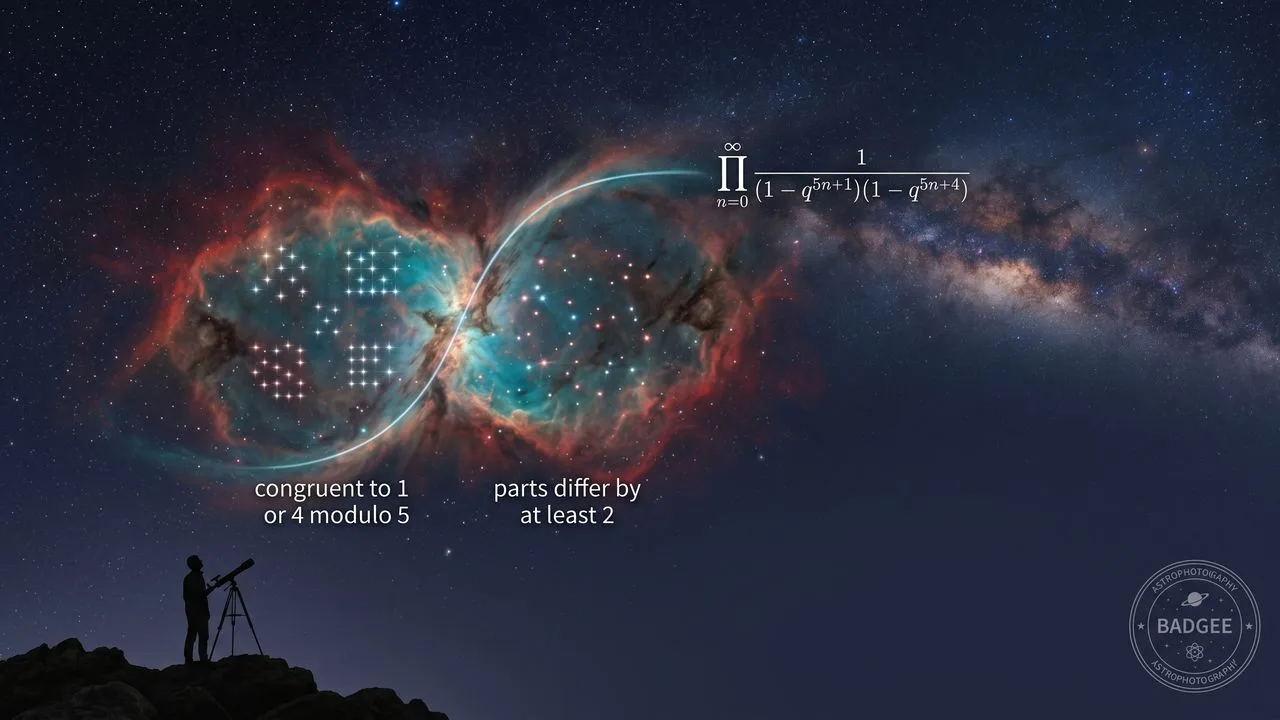
Photo: AI. Castor Belov
There's a particular kind of mathematical statement that feels like a magic trick even after you understand how it works. The Rogers-Ramanujan identity is one of those. It says, in essence: two completely different ways of counting things always give you the same answer. Not approximately. Not on average. Always, exactly, for every positive integer. That should feel strange. It does, even to people who spend their careers around it.
Mathematician Michael Penn recently walked his class through one version of this identity, and the resulting video is worth your attention—not because it's a perfect polished lecture (Penn himself gets "discombobulated" mid-derivation about whether a term should be plus or minus one), but precisely because it isn't. What you get instead is a real mathematician thinking out loud about something they genuinely find beautiful, which turns out to be a much better window into what mathematics actually is.
Two Ways to Slice a Number
The identity Penn is working with concerns partitions—the ways you can write a positive integer as a sum of positive integers. The number 4, for instance, can be partitioned as 4, or 3+1, or 2+2, or 2+1+1, or 1+1+1+1. Five ways total. Partition theory asks: if you impose constraints on which partitions you allow, what happens to the counts?
The Rogers-Ramanujan identity (first version) says this: the number of ways to partition n using only parts that are congruent to 1 or 4 modulo 5—meaning parts from the set {1, 4, 6, 9, 11, 14, ...}—is always equal to the number of ways to partition n such that consecutive parts differ by at least 2.
Penn works through n = 9 with his class to make this concrete. The "mod 5" partitions of 9 are: 9 itself (since 9 ≡ 4 mod 5), then 6+1+1+1, then 4+4+1, and then 1+1+1+1+1+1+1+1+1. Four partitions. The "differ by at least two" partitions of 9 are: 9, then 8+1, then 7+2, then 6+3, then 5+3+1. Also four. The coincidence—if you want to call it that—holds.
This kind of numerical verification doesn't prove anything, of course. But it does something arguably more important for how humans engage with mathematics: it makes the identity feel real before the machinery kicks in.
The Generating Function Bridge
Here's where partition theory gets genuinely interesting as a methodology. Rather than trying to count partitions of each number directly, mathematicians encode an entire infinite family of counts into a single function—a generating function—where the coefficient of q^n tells you the number of partitions of n satisfying whatever rule you're studying.
For the mod-5 partitions, the generating function is a product: one factor of 1/(1-q^k) for each allowed part size k. This is the "purple" side in Penn's color-coded presentation. The structure is transparent once you see it: each factor encodes the choice of how many times to use part k (zero times, once, twice, ...), and the product of all these choices generates every valid partition.
The "blue" side—partitions where consecutive parts differ by at least 2—is, as Penn puts it, "a little more slippery." Its generating function is a sum rather than a product:
$$\sum_{n=0}^{\infty} \frac{q^{n^2}}{(1-q)(1-q^2)\cdots(1-q^n)}$$
The Rogers-Ramanujan identity is the claim that these two expressions—one a product, one a sum—are equal as formal power series. That equality is what encodes the partition coincidence for every n simultaneously.
"Like, this is not clear to me immediately," Penn admits to his class. "Like, after seeing these for a long time, it gets kind of clear to me, but it's not clear at all."
That honesty matters. There's a tendency in mathematical exposition to present identities as though they were obvious in hindsight, which is both false and pedagogically damaging. The Rogers-Ramanujan identity was first proved in 1894 by Leonard Rogers, largely ignored, rediscovered by Srinivasa Ramanujan around 1913, and only properly connected when Rogers and Ramanujan corresponded after Ramanujan found Rogers's forgotten paper. The history alone should tell you something about how non-obvious this is.
The Derivation's Hidden Gem
Penn sketches the argument for why the sum-side generating function actually counts what it claims to count. The approach is clever: rather than directly summing over valid partitions, you do a change of variables. If a partition has parts λ₁ ≤ λ₂ ≤ ... ≤ λₙ with each consecutive pair differing by at least 2, you can write each part as a "minimum skeleton" plus a free non-negative integer.
The smallest part must be at least 1. The second-smallest must be at least 3. The third at least 5. And so on—the odd numbers appear as the structural scaffolding that enforces the gap condition. This is where a lovely fact about odd numbers surfaces organically: 1 + 3 + 5 + ... + (2n-1) = n². The sum of the first n odd numbers is always a perfect square.
"1 + 3 is 4. 1 + 3 + 5 is 9, 3 squared. 1 + 3 + 5 + 7 is 16, 4 squared. You get a perfect square," Penn walks through with his class. "Yeah. You can prove that with induction, right?"
This fact—which you can prove geometrically by noticing that adding an L-shaped border of odd numbers to a square gives the next square—is what puts the q^(n²) in the numerator of the generating function. The squared exponent isn't arbitrary notation; it's a direct footprint of how the gap-2 constraint forces an odd-number scaffolding structure.
The denominator, 1/(1-q)(1-q²)···(1-q^n), then counts the "free" parts: how many unrestricted ways to partition the remaining slack, using at most n parts. Re-indexing over n assembles the full generating function.
Where the Proof Gets Hard
Penn is upfront that he's skipping steps, particularly the re-indexing that converts the sum over constrained partition pairs into the closed form. "The proof of this is hard," he says. "Like, hard." This is worth flagging because the informal sketch can make the identity seem more accessible than it is. The full proof requires careful combinatorial bookkeeping, and complete proofs appear in graduate-level combinatorics texts for good reason.
The identity also sits inside a larger family. Penn gestures at this when he notes that if you replace "differ by at least 2" with "all distinct" (differ by at least 1), you recover Euler's theorem connecting distinct-part partitions to odd-part partitions—a classical result that's genuinely elementary to prove. Push it further, to "differ by at least 3," and you land in territory Penn associates with the Andrews-Bressoud identities (his hedge: "don't quote me on that—it might be something else"). There's a whole landscape here, and Rogers-Ramanujan occupies a sweet spot: hard enough to be remarkable, structured enough to have a clean statement.
What This Kind of Mathematics Is Actually Doing
Partition theory might look like recreational mathematics—a clever puzzle about counting ways to break up numbers. But it connects to serious physics (the Rogers-Ramanujan identities appear in the study of two-dimensional statistical mechanics and conformal field theory), to algebraic structures (affine Lie algebras), and to q-series that show up throughout combinatorics and special functions.
The video doesn't go there, and it doesn't need to. What Penn's classroom captures is something equally valuable: the moment when a mathematical identity stops being a formula you verify and becomes a thing you feel. The back-and-forth between professor and students, the correction mid-stream ("I'm all discombobulated as to whether this should be plus one or minus one"), the collective working-out of why odd numbers sum to squares—this is mathematics as a social, exploratory process, not as a monument.
That process is what produced Rogers-Ramanujan in the first place. Two mathematicians, working independently on a hard problem, reaching the same strange truth from different directions. That the identity turned out to describe particle physics is almost a footnote. The thing itself is remarkable enough.
More Like This
The Deeper Geometry Behind the Pythagorean Theorem
Explore why the Pythagorean Theorem appears in unexpected places, from geometry to relativity.
The Mathematical Pattern Everyone Believes But No One Can Prove
For 150+ years, mathematicians have believed in a pattern that seems obvious—yet remains unproven. Here's why the Riemann Hypothesis matters.
How Big Is a Rubik's Cube? Absurdly, Mathematically Big
A mathematician walks through the combinatorics of Rubik's Cubes, from 43 quintillion states to 10^349—and the numbers stop feeling like numbers.

Space Developments: Tech Triumphs and Challenges
Exploring recent space missions, tech innovations, and their broader impacts on humanity's cosmic ambitions.
Exploring the Enigma of Recamán's Sequence
Delving into Recamán's sequence, a simple rule with complex questions. Does every integer appear?
The Riemann Hypothesis: Math's Greatest Mystery
Explore the Riemann Hypothesis, the $1M question linking prime numbers and quantum physics.
Gravity's Strangest Effects, From Time to Cosmic Voids
From gravitational time dilation to the Dipole Repeller and LIGO's detections, here's what gravity actually does—and what it still can't explain.
JWST's Little Red Dots May Be Cocooned Black Holes
New JWST spectral data on a single "little red dot" galaxy offers the strongest case yet that they're supermassive black holes wrapped in dense gas cocoons.