Euclid Space Telescope Maps the Dark Universe
The Euclid Space Telescope is rewriting cosmology—mapping dark matter, finding ghost galaxies, and forcing scientists to rethink what the universe is made of.

Written by AI. Nadia Marchetti
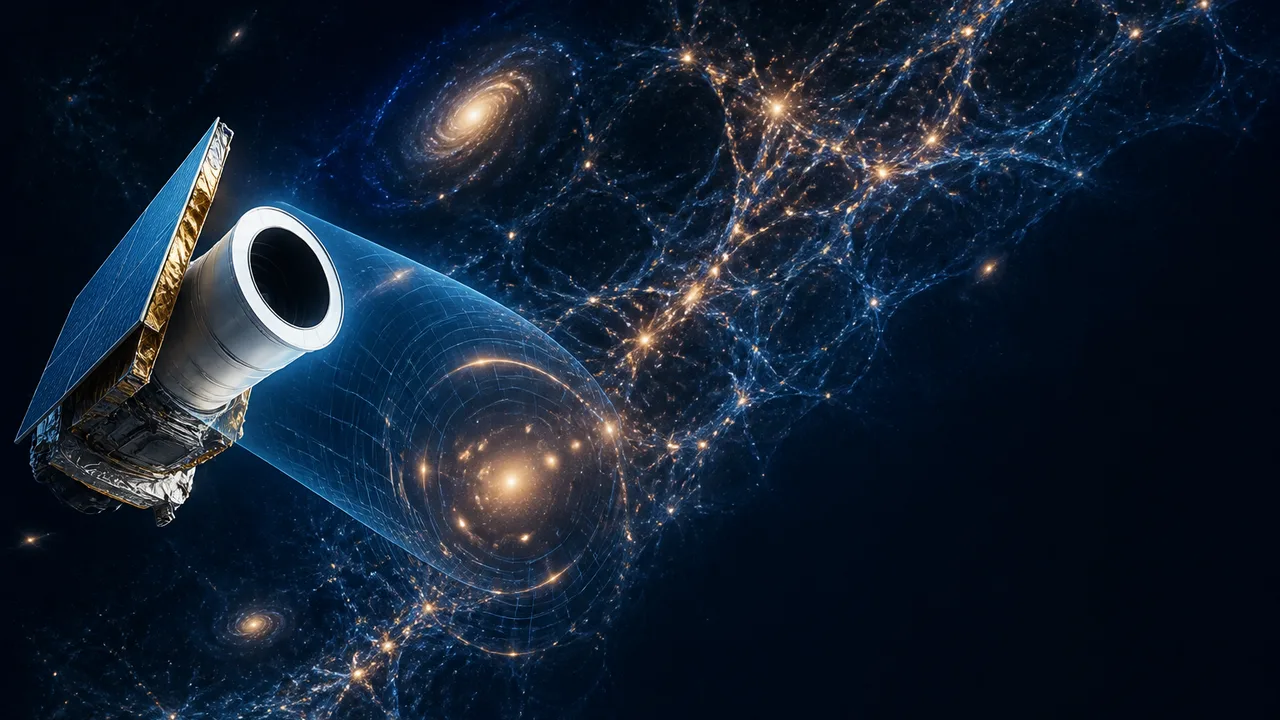
Photo: AI. Dante Nwosu
The universe, it turns out, is mostly missing.
That's not a metaphor or a tabloid provocation — it's the actual accounting problem at the heart of modern cosmology. The matter you can see, touch, and build particle accelerators to study? It comprises roughly 5% of what the universe contains. The other 95% is something else entirely: dark matter (about 27%) that exerts gravity but emits no light, and dark energy (about 68%) that appears to be pushing the entire cosmos apart at an accelerating rate, origin completely unknown.
For decades, this has been the field's biggest open tab. Now, a telescope built specifically to settle it is three years into a six-year mission — and what it's returning is stranger and more detailed than most scientists dared anticipate.
The Machine Behind the Mission
Euclid launched on July 1, 2023, from Cape Canaveral, the product of 23 countries, 80 companies, 300 institutes, and roughly 3,500 people. It currently orbits at Lagrange Point 2, about 1.5 million kilometers from Earth, sitting alongside the James Webb and Gaia telescopes in a gravitational sweet spot that keeps the Sun, Moon, and Earth permanently out of its field of view.
What makes Euclid distinct from its neighbors isn't just resolution — it's scope. Where James Webb is a surgical instrument, pointed with extraordinary precision at specific targets, Euclid is a surveyor. Its ultra-wide lens captures four times the resolution of ground-based telescopes and fifteen times the near-infrared sensitivity, but across enormous swaths of sky simultaneously. In a single observation, it records cosmic structures at multiple scales at once — galaxy clusters and individual stars in the same frame. It's designed to map a third of the entire night sky before its mission ends.
The goal is a 3D map of the universe stretching back 10 billion years — a map detailed enough to trace how dark energy's influence has changed (or hasn't) across cosmic time. Two instruments do the heavy lifting: a visible imaging system for galaxy shapes and positions, and a near-infrared spectrometer that measures redshifts, placing galaxies in three-dimensional space.
In the words of one Euclid project scientist, reacting to the first data release: "We have never seen astronomical images like this before, containing so much detail. They are even more beautiful and sharp than we could have hoped for, showing us many previously unseen features in well-known areas of the nearby universe."
That's not press-release hyperbole. The actual results bear it out.
What It's Already Found
Euclid's first major image release in late 2024 covered just 1% of its planned survey area — 260 pictures of the southern sky, stitched into a mosaic spanning an area 500 times the size of the full moon. That 1% alone contained 100 million sources of light.
Inside that data, several discoveries stand out.
In the Perseus Cluster, a galaxy congregation 240 million light-years away, Euclid identified more than 630 previously unknown dwarf galaxies. This matters because cosmological models predict dwarf galaxies should cluster where dark matter filaments intersect — but they've been nearly impossible to observe directly, drowned out by brighter objects. Finding 630 of them at once is a significant empirical validation of those models, and a new data set for testing where dark matter actually concentrates.
Caldwell 5 — the "hidden galaxy," a Milky Way lookalike 11 million light-years out, obscured behind our own galactic disc — was imaged in remarkable detail using Euclid's near-infrared instruments, which pierce through the dust that blocks visible light. As Euclid consortium scientist Leslie Hunt noted: "We can trace the history of star formation and better understand how stars formed and evolved over the lifetime of the galaxy." Since we can't step outside our own galaxy to study it, studying a structural twin from outside is the next best thing.
In the Horsehead Nebula — 1,375 light-years away, the nearest massive star-forming region — Euclid's sensitivity revealed free-floating planets smaller than any previously documented there. One research paper concluded that free-floating planets in that zone "appear to be ubiquitous and numerous." The Horsehead is now a live laboratory for comparing star formation in dark molecular clouds versus bright, UV-irradiated regions — a controlled experiment the universe has been running for us, and that we're only now equipped to read.
The Data Problem (And Its Solution)
Here is where the story gets technically interesting in a way that has implications beyond astronomy.
Euclid's maps are measured in petabytes — each petabyte being 1,000 terabytes, which is itself 1,000 gigabytes. Storing some of these star maps requires the equivalent of nearly a thousand consumer computers. That 1% release? Already 100 million light sources. The full survey will be exponentially larger.
The human mind can't process that. No team of astronomers, however large, could manually review it in any reasonable timeframe. Which creates a genuine methodological challenge: Euclid's primary dark matter detection strategy depends on identifying weak gravitational lensing — subtle statistical deviations in the positions of background galaxies, caused by the gravitational mass of intervening galaxy clusters bending their light. The signal isn't a dramatic ring; it's a faint, population-level statistical smear that only resolves into meaning when you're looking at thousands of examples simultaneously.
You cannot find that with your eyes. You need machine learning.
AI trained on existing gravitational lens examples has already demonstrated the capability. When applied to data from the Subaru telescope in Japan, an AI trained on 20,000 galaxies identified by 10,000 human volunteers went on to correctly identify 410,000 more galaxies in the same dataset — at 98% accuracy. Similar approaches have been applied to exoplanet detection in Kepler data. The Euclid collaboration is now deploying these tools at scale, with thousands of scientists guiding, training, and verifying the machine learning programs.
The discovery pipeline is, essentially, a collaboration between human scientific judgment and machine pattern recognition operating at a scale neither could manage alone.
The Dark Galaxy
In February 2026, that pipeline produced something genuinely novel.
Working in conjunction with data from Hubble and Subaru, Euclid's detection techniques identified what researchers are calling a "dark galaxy" — designated CDG2. It contains just four globular star clusters, compared to the Milky Way's 150. Globular clusters are dense enough to be reliably detectable even at great distances; scientists knew something was there because the clusters existed. But the surrounding structure — the galaxy itself — emits almost no light.
Researchers estimate that 99% of CDG2's mass is dark matter. This makes it the first galaxy ever detected solely through its globular cluster population, and one of the most extreme dark matter ratios ever measured.
It is, to use a precise term, a ghost. A gravitational structure the size of a galaxy, with almost no stars to announce its presence. It exists. It has mass. We can measure it. We just can't see it.
The fact that we found one raises the immediate question of how many more are out there, quietly shaping the structure of the cosmos with no light to give them away.
What We Don't Know
It's worth pausing here, because the genuine scientific uncertainty in this territory is substantial and shouldn't be smoothed over in the excitement about the instrumentation.
Dark energy remains, at root, unexplained. The three leading frameworks — Einstein's cosmological constant (energy inherent to empty space), quantum vacuum energy from virtual particle pairs, and a varying field called quintessence — each carry serious problems. The virtual particle explanation produces a theoretical energy value larger than observed by a factor of 10 to the power of 120. That's not a rounding error; it's a signal that something fundamental is missing from the theory. The cosmological constant works mathematically but offers no physical mechanism. Quintessence introduces a fifth fundamental force with no independent evidence for its existence.
Euclid won't resolve these theoretical puzzles directly. What it will do — and is already doing — is constrain the observational data those theories have to account for. If dark energy's influence has been constant over 10 billion years, that rules out some models. If it's varied, that rules out others. The 3D map Euclid is building is essentially a stress test for competing frameworks.
That's not a small thing. Ruling out wrong answers, when the answer space is this vast, is how physics eventually narrows to the right one.
Euclid has completed 35% of its sky survey. Four years remain. It has already found a galaxy made almost entirely of something we can't see, identified hundreds of previously invisible dwarf galaxies, and is building the infrastructure — both computational and observational — to ask questions cosmology has never had the tools to pose.
The dark universe is still dark. But it's getting harder to hide.
More Like This
Could We Have Detected Dark Matter at Last?
Scientists may have detected dark matter's signal in the Milky Way, hinting at potential breakthroughs in understanding the universe.
Gravity: What Physics Knows and Cannot Explain
Gravity shapes everything from falling apples to galaxy clusters—yet physicists still can't explain what it fundamentally is. Here's where the science actually stands.
Have Astronomers Found the Universe's Missing Mass?
Astronomers may have discovered the universe's missing mass in cosmic filaments, a breakthrough in understanding cosmic evolution.
Exploring Cosmic Time Delays and Dark Energy
Time delay cosmography may unveil dark energy mysteries, resolving Hubble tension with new cosmic insights.
Hubble Tension: The Universe's Unsolved Mystery
Explore the Hubble tension and its implications for our cosmic understanding.
El Gordo's Mass and Merger Put Dark Matter to the Test
El Gordo's enormous mass and merger offer a test of self-interacting dark matter, though its history and measurement uncertainties complicate the picture.
Jared Isaacman on the Moon, Mars, and Life in Space
NASA Administrator Jared Isaacman lays out plans for a 2028 lunar base, nuclear propulsion to Mars, and what he actually thinks about life beyond Earth.
The Fermi Paradox: Why Silence From Space Makes Sense
Brian Keating and Shawn Ryan unpack the Fermi Paradox — from cosmic scale to civilization lifespans — and why silence might be the expected answer.