El Gordo's Mass and Merger Put Dark Matter to the Test
El Gordo's enormous mass and merger offer a test of self-interacting dark matter, though its history and measurement uncertainties complicate the picture.

Written by AI. Mei Zhang
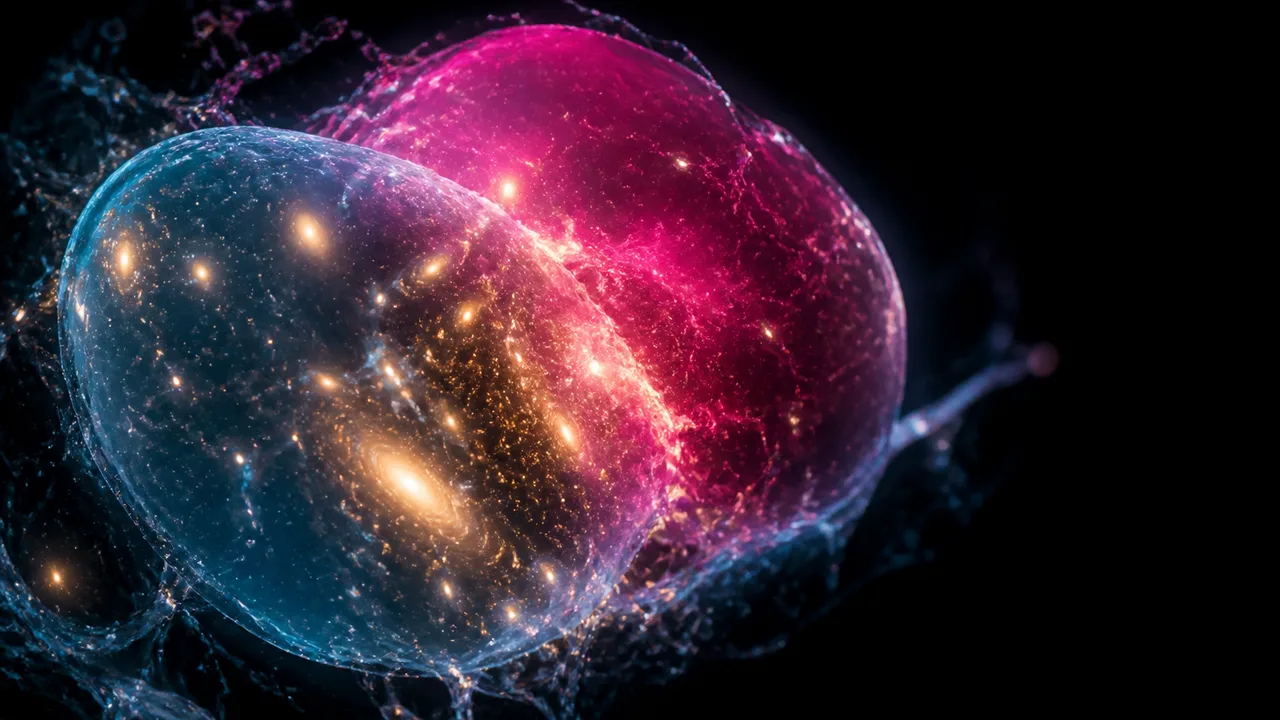
El Gordo sits roughly seven billion light-years away, yet its collision has become a nearby problem for theories of dark matter. Two enormous regions of galaxies are merging there. Together, they have an estimated mass exceeding two quadrillion Suns. Astronomers have to explain how so much matter assembled at that point in cosmic history, and what happened to its invisible component when the two regions met.
The nickname means “the fat one,” which is efficient branding for an object of that size. The science takes more unpacking. One proposed explanation involves self-interacting dark matter, whose particles respond to gravity and, in this model, can also scatter off one another. El Gordo offers a chance to look for the effects of those interactions. Its mass, its merger and the limits of what astronomers can measure must all stay in the picture at once.
Why Its Size Raises Questions
Astronomers think most of a galaxy cluster’s mass is dark matter. Stars and hot gas are easier to see, but gravity provides the fuller inventory. Light from more distant objects can bend around a cluster, helping researchers map where mass lies, including mass that emits no light. Each measurement is an ingredient in the estimate; there’s no cosmic bathroom scale with a two-quadrillion-Sun setting.
Distance adds a time dimension. Light reaching us from El Gordo left billions of years ago, so we see the cluster at an earlier stage of the universe. In the standard picture of cosmic structure, small concentrations of matter grow under gravity and merge into larger ones. A very massive cluster seen far away therefore prompts a statistical question: How often should structures of that size have formed by the time we observe them?
“Rare” needs a denominator. To judge whether El Gordo strains a model, researchers need estimates of its mass, the volume of sky searched and how many comparable objects the model predicts in that volume. A spectacular find can look surprising on its own and less surprising after accounting for the many places astronomers looked. Uncertainty in a mass estimate also matters when the biggest clusters are scarce: shifting an object into a slightly lower mass range can change how unusual it appears.
Those considerations do not make the size question disappear. They define the test. Researchers can compare observations with simulations of structure formation while accounting for how the cluster was found and how its mass was inferred. If the predicted population still falls short, they can ask which assumptions drive the shortfall.
What a Collision Can Reveal
El Gordo’s two merging regions offer another way to study dark matter. A cluster merger is messy: galaxies, gas and dark matter enter the encounter together, but they need not move through it in the same way. Gas can collide and slow down. Galaxies are separated by so much space that direct crashes between them are unlikely. Dark matter’s behavior depends on the properties of particles astronomers have yet to identify.
In the usual working model, dark matter interacts with ordinary matter chiefly through gravity and does not substantially collide with itself. In a self-interacting model, dark matter particles can scatter off one another. Think of two clouds passing through each other: if their contents almost never meet, the clouds carry on; if encounters happen often enough, their shapes and motion can change. For El Gordo, researchers would examine whether a model with scattering better reproduces the distribution of mass during the merger.
Self-interacting dark matter has been proposed as an explanation for El Gordo’s unusual properties, but a fit to one complex cluster would not identify a particle interaction on its own. Merger speed, viewing angle and the initial shapes of the two regions can also affect the patterns astronomers observe. The competing explanations have to face the same measurements.
The size question and the collision question also ask different things of a model. The first concerns how often an enormous cluster should form. The second concerns how mass behaves during a merger. Letting dark matter scatter might help explain a feature of the collision without automatically explaining El Gordo’s abundance at that distance. A convincing account would specify which feature it improves, then check what it predicts elsewhere.
Building a Fair Test
A useful comparison starts with maps rather than adjectives such as “huge” or “strange.” Researchers can compare the positions of galaxies, the distribution of hot gas and maps of total mass inferred from gravitational lensing, the bending of background light by the cluster’s gravity. Each traces something different. Combining them can reveal whether visible material and most of the gravitating mass follow the same paths through the collision.
Then comes the hard part: reconstructing a three-dimensional event from light arriving along one line of sight. Two structures that look close together on the sky can sit at different depths. A merger viewed from another angle can produce a different apparent separation. Measurements and simulations need to allow for those possibilities before researchers assign a feature to new dark matter physics.
Simulations also have to include ordinary matter carefully. Gas has its own dynamics during a collision, and assumptions about it can affect a reconstruction. A comparison that changes the dark matter model while oversimplifying the gas risks giving the new model credit for solving the wrong problem. The clearest result would be one that survives plausible choices about merger history, measurement uncertainty and the physics of visible material.
There’s a wider check, too. A proposed rate of dark matter self-interaction has consequences beyond El Gordo. Researchers can compare its predictions across clusters with different masses and merger conditions. If the same particle behavior helps explain several systems, that is more informative than tuning a model to one remarkable collision. If the predictions fail elsewhere, El Gordo may instead be pointing to a mistaken reconstruction of this merger or a gap in how clusters are simulated.
El Gordo gives astronomers two unusually sharp questions about the dark universe: how early a structure this massive could assemble, and how its mass moved when its components collided. The next useful result will separate those questions more cleanly, so that any answer has to explain the cluster we see and the wider universe it came from.
More Like This

Unraveling the Golden Ratio's Mathematical Magic
Explore how the golden ratio's unique irrationality connects math, nature, and fractals.
Astronomers May Have Found a Starless Galaxy
Astronomers are investigating a potential starless galaxy, a dark matter-rich structure with no stars. Here's what it could mean for how galaxies form.
Exploring Cosmic Time Delays and Dark Energy
Time delay cosmography may unveil dark energy mysteries, resolving Hubble tension with new cosmic insights.
Euclid Space Telescope Maps the Dark Universe
The Euclid Space Telescope is rewriting cosmology—mapping dark matter, finding ghost galaxies, and forcing scientists to rethink what the universe is made of.

Dark Matter’s WIMP Era Is Splintering Into New Searches
A single LZ recoil has inspired rival dark-matter models as researchers widen detector targets and revisit the assumptions inherited from the WIMP era.
Gravity: What Physics Knows and Cannot Explain
Gravity shapes everything from falling apples to galaxy clusters—yet physicists still can't explain what it fundamentally is. Here's where the science actually stands.

Pancreatic Cancer Treatments That Could Change Everything
NALIRIFOX, daraxonrasib, and a personalized mRNA vaccine are reshaping pancreatic cancer treatment. Here's what the breakthroughs mean—and who can actually access them.
Primordial Black Holes as Dark Matter Candidates
After decades of failed WIMP searches, physicists are turning to primordial black holes as a serious dark matter candidate. Here's what the evidence actually shows.