Astronomers May Have Found a Starless Galaxy
Astronomers are investigating a potential starless galaxy, a dark matter-rich structure with no stars. Here's what it could mean for how galaxies form.

Written by AI. Mei Zhang
In genetics, one of the stranger things you can find in a genome is a gene that's fully intact, has all its regulatory machinery, sits right where it's supposed to sit, and simply never turns on. All the instructions are there. Nothing fires. Biologists call these silent sequences, and they have a habit of humbling researchers who thought they understood how genomes work.
I keep thinking about that frame while processing the news that astronomers may have found the cosmic equivalent. 🧬
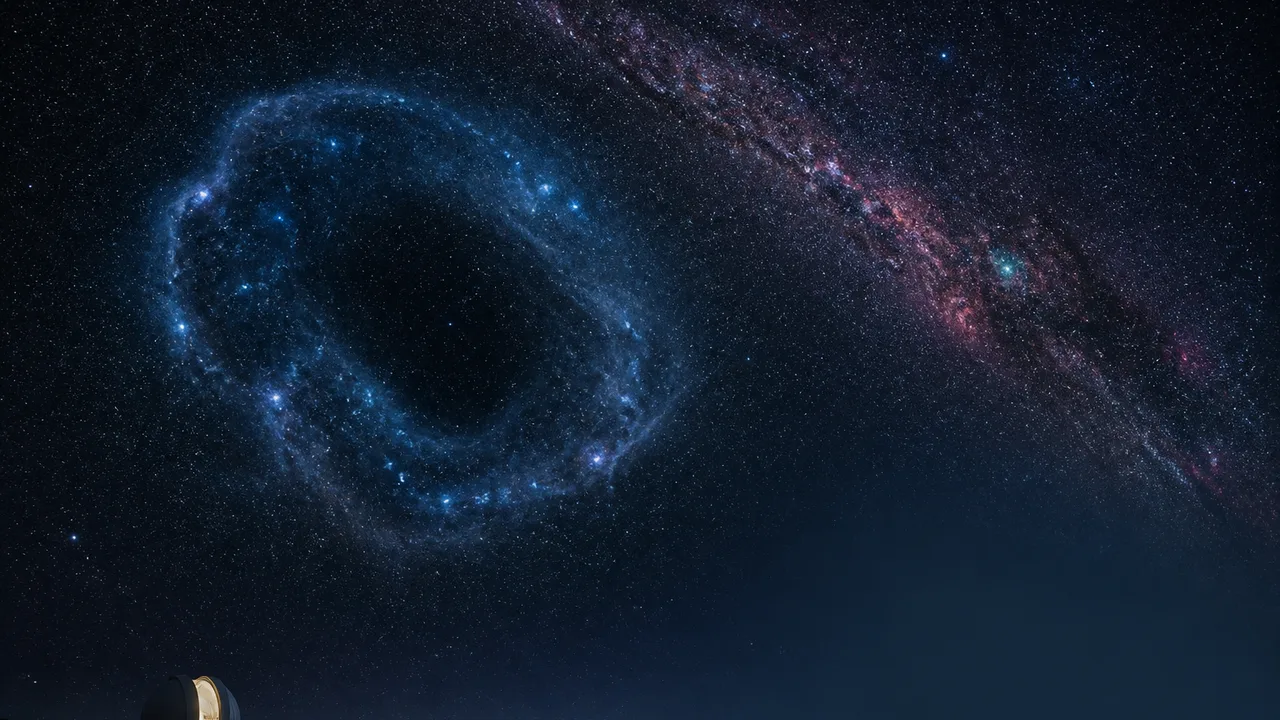
According to Space.com, researchers are investigating a candidate object being described as a potential "failed" galaxy: a structure with what appears to be a dark matter halo and an abundance of gas, but no stars. The machinery for galaxy formation seems to be present. Nothing fired.
If confirmed, this would be a first. And the implications run well beyond a cool headline.
What even is a galaxy without stars?
Fair question. The standard picture of galaxy formation goes something like this: dark matter concentrations create gravitational wells. Gas falls in, cools, fragments, collapses under its own gravity, and eventually ignites into stars. Gravity wins, stars happen. Repeat across billions of years and you get the observable universe as we know it.
The candidate object described by Space.com seems to have the early chapters of that story, just not the ending. Dark matter, check. Gas, check. Stars, conspicuously absent.
There are a few hypotheses for how this happens. Feedback from nearby galaxies might have stripped or heated the gas before it could collapse. The halo might not have had quite the right density profile. Or, and this is the one that keeps cosmologists up at night, our models of the conditions required for star formation might just be incomplete.
A structure like this is hard to detect for an obvious reason: without stars, there's no visible light. Astronomers hunting for it would be looking for the gravitational signature of dark matter and the radio signal of cold neutral hydrogen gas. The specific detection method used for this particular candidate hasn't been confirmed in the reporting, but radio astronomy tools designed to map neutral hydrogen across the sky are precisely the kind of instrument you'd reach for. The Square Kilometre Array (SKA), a next-generation radio telescope designed to probe exactly these kinds of faint, diffuse signals, represents the direction this field is heading.
The silent gene problem, scaled up by billions of light-years
Here's why the genetics framing won't leave me alone.
In molecular biology, a silenced gene doesn't stop being real. It's present in every cell. It has history; it evolved for reasons; it might have been expressed in an ancestor species or during a developmental window we haven't studied yet. We just can't see it doing anything. The risk, historically, has been that researchers discount silent sequences as evolutionary junk, only to discover later that they're doing something crucial under specific conditions, or that they encode something we hadn't learned to measure.
The parallel to a starless galaxy is almost uncomfortably clean. If this object is real, it raises the question of how many structures like it exist out there: gravitationally real, physically present, composed of dark matter and gas that we understand to be the raw material of galaxy formation, but producing no light we'd notice in a conventional survey. Our telescopes, for most of astronomical history, have been photon collectors. We see what glows. A universe full of "silent" proto-galactic structures could be sitting at the edges of our detection methods, neither confirmed nor ruled out, simply unlit.
The Space.com report notes that such a discovery would challenge existing models of galaxy formation and evolution. That's careful phrasing, and I think it's the right framing. We're not talking about rewriting cosmology from scratch. We're talking about a potential gap in the conditions we think are sufficient for star formation, which is a different and arguably more interesting problem. It suggests our recipe is missing an ingredient, or that one of our assumptions about when the recipe fails is wrong.
Who gets to be a galaxy?
OK, here's where my ethics radar kicks in, and I know that sounds like a strange sentence to write about astronomy.
But the language researchers are reaching for here is telling. "Failed galaxy." The word "failed" implies a standard against which this object is being measured, a developmental endpoint it didn't reach. That framing makes sense operationally; it's shorthand for "a structure that had the conditions for galaxy formation but didn't produce stars." I'm not arguing for terminological sensitivity toward cosmic gas clouds.
What I'm flagging is what the framing reveals about how we classify existence in science, specifically, that we tend to define things by their outputs. A galaxy is a galaxy because it makes stars and light. A gene is functional because it produces protein. A cell is alive because it metabolizes. These output-based definitions are useful and often correct. But this potential discovery is a reminder that structures can be physically real, gravitationally significant, and scientifically consequential without meeting the output criteria we use to recognize them.
There's probably a modest lesson in there about what else we might be systematically overlooking because it doesn't produce the signal we've designed our instruments to catch. That's not mysticism; it's a practical epistemological question with real research design implications.
The confirmation problem
Worth being direct about what we don't yet know, because the story is genuinely preliminary.
The Space.com report describes this as a potential discovery still under scrutiny. The candidate object has not been independently confirmed. The detection method hasn't been specifically reported, and the sourcing indicates this is still at the analysis stage. This is science operating exactly as it should: something anomalous shows up, researchers investigate, the community waits for verification.
What happens next matters a lot. If confirmed, the finding would push radio observatories to look harder for similar objects and would give theorists something concrete to model against. If the object turns out to be a misidentification, that's also useful; it would sharpen the detection criteria for future searches. Either way, the question of whether starless galaxies exist as a class of object doesn't go away.
The instruments getting better is the real story underneath this one. The SKA, designed to survey neutral hydrogen across vast swaths of sky with unprecedented sensitivity, is the kind of tool that would turn a one-off candidate object into a statistical sample. The difference between "we found a weird thing once" and "we can now measure how common these are" is the difference between an anomaly and a new chapter of cosmology.
The part that actually got me
I cover genomes for a living. The thing that got me about this story isn't the dark matter angle, though that's genuinely interesting. It's the detection problem.
For most of astronomical history, our picture of the universe has been shaped by what produces enough light to land on a detector. Dark matter itself is defined partly by this limitation: we infer its presence from what it does to visible matter around it, not from observing it directly. A starless galaxy would be a structure that's dark matter all the way down, inferred rather than seen, real but not glowing.
The genome analogy holds here too. For decades, the "junk DNA" framing persisted because non-coding sequences didn't produce the signal, protein, that researchers were measuring for. The moment the measurement tools changed, the picture changed. ENCODE and similar projects started revealing functional activity in regions that had looked silent because we'd been asking the wrong question.
Astronomy is running the same experiment right now, just at a scale that makes the genome look like a short story. The universe may contain an entire population of structures we've been systematically missing because they don't emit in wavelengths we prioritized.
That's what I keep coming back to. Not whether this one candidate object is real. But what it says about our tools, our definitions, and the parts of the universe we've been confidently not seeing.
More Like This
Unraveling the Golden Ratio's Mathematical Magic
Explore how the golden ratio's unique irrationality connects math, nature, and fractals.

Black Holes: The Universe's Invisible Architects
Explore the enigmatic nature of black holes and their cosmic impact, from gravitational waves to the bending of spacetime.
Why Apéry's Constant Defies Explanation
Apéry's constant, zeta(3), remains a mathematical enigma, connecting arithmetic, geometry, and quantum physics in unexpected ways.
Galaxies That Challenge Our Cosmic Timeline
James Webb Space Telescope finds galaxies too evolved for the young universe, challenging current cosmological models.
James Webb Telescope Data Strains Big Bang Cosmology
Philosopher of science Bjørn Ekeberg argues Webb's early galaxy findings expose a deeper problem: cosmology's dependence on interpreting light it cannot fully verify.
Euclid Space Telescope Maps the Dark Universe
The Euclid Space Telescope is rewriting cosmology—mapping dark matter, finding ghost galaxies, and forcing scientists to rethink what the universe is made of.
How Astroparticle Physics Built Itself From Borrowed Parts
A new arXiv review traces how astroparticle physics didn't emerge from a single discovery—it assembled itself from three fields that kept bumping into the same cosmic questions.
Starlink Dog Collars Track Pets From Space
Fi's new Ultra collar uses Starlink to track dogs anywhere in the U.S. — and a rival AI-powered collar is right behind it. Here's what that really means.