Pancreatic Cancer Treatments That Could Change Everything
NALIRIFOX, daraxonrasib, and a personalized mRNA vaccine are reshaping pancreatic cancer treatment. Here's what the breakthroughs mean—and who can actually access them.

Written by AI. Mei Zhang
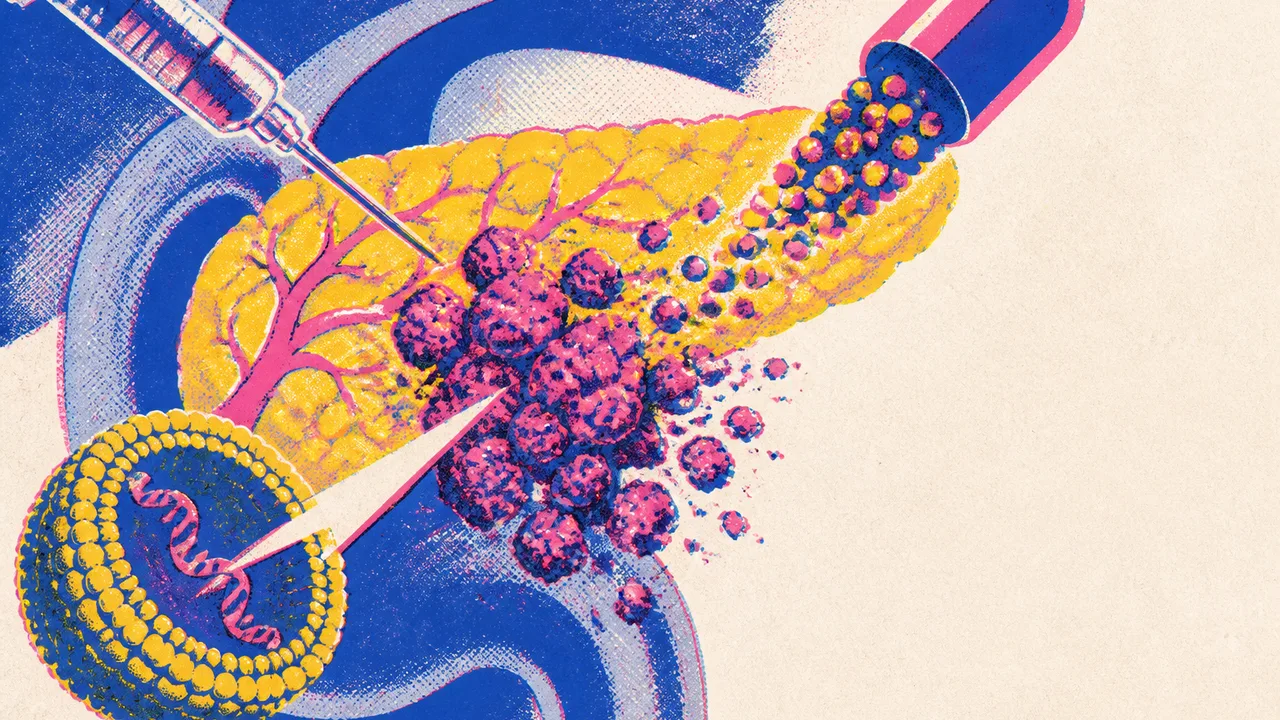
Photo: AI. Jorah Maktoum
Pancreatic cancer has one of the most brutal statistical profiles in all of medicine. The overall five-year survival rate sits at 13%—the lowest of any major cancer. For patients diagnosed at stage four, which is most of them (over four out of five cases), that number drops to 3%. As one oncologist quoted in The Infographics Show's recent breakdown of the field put it: "Even with our best chemotherapies, the average benefit is around 6 months, sometimes as little as weeks or months. It's barely enough time for families to grasp the situation."
That's been the reality for decades. And researchers have been stuck—not for lack of trying, but because pancreatic cancer turns out to be almost architecturally designed to resist treatment.
The Fortress Problem
Here's what makes it so hard. Pancreatic tumors build what's called a desmoplastic stroma—a dense wall of scar-like fibrous tissue that the cancer essentially hijacks the body's own wound-healing system to construct. Think of it as a concrete bunker the tumor builds around itself. Most chemotherapy drugs, even if they reach the vicinity, can't get through.
It gets worse. Tumor cells produce a water-attracting sugar compound that causes swelling inside the stroma—but since the stroma won't flex, the pressure has nowhere to go. That pressure physically collapses the blood vessels that would otherwise carry medicine to the tumor. The result, as The Infographics Show describes it, is like "filling a balloon with water inside a concrete shell." Chemotherapy becomes, in their phrase, like "throwing spaghetti at a wall and expecting it to pass through."
On top of that, pancreatic tumors coat themselves with glycoproteins that mimic healthy cells, essentially telling the immune system nothing to see here. T cells—the immune system's primary cancer-fighting soldiers—can't infiltrate. The tumor grows while the body's defenses stand down.
Step One: A Better Chemotherapy Regimen
NALIRIFOX, which received FDA approval in February 2024, is the first meaningful update to the treatment frontline in years. To be clear about what this is: NALIRIFOX is a cytotoxic chemotherapy combination—it is not a targeted therapy in the precision-oncology sense. It combines liposomal irinotecan with oxaliplatin, leucovorin, and 5-FU. The liposomal formulation of irinotecan may improve how the drug accumulates in tumor tissue, but NALIRIFOX still works by attacking rapidly dividing cells broadly, not by seeking out a specific molecular target.
What it does do is outperform what came before it. The NAPOLI-3 trial enrolled 770 patients with metastatic pancreatic cancer across 18 countries. Patients on the standard first-line chemotherapy regimen had a median survival of 9.2 months. Patients on NALIRIFOX had a median survival of 11.1 months. That's a 20% improvement in survival for a disease that had barely budged in a generation. In oncology terms, that's enormous. Patients also stayed on treatment an average of six weeks longer, which compounds the benefit. For a disease where "a few more months" is the entire conversation, this matters.
FDA approval also matters practically: it clears a path for Medicare and Medicaid coverage, which is how most American patients access expensive drugs.
The KRAS Plot Twist 🧬
Okay, I need to stop here because this part of the story genuinely messes with me every time I think about it.
For forty years, scientists knew that somewhere between 90 and 95% of pancreatic cancers are driven by a mutation in a gene called KRAS. KRAS normally functions like a light switch—it signals cells to grow, then turns off. In pancreatic cancer, the switch gets jammed in the on position. Cells multiply without stopping.
Scientists knew this. They knew exactly what they needed to shut off. The problem? The mutated KRAS protein has an almost perfectly smooth surface. No grooves, no ledges, no docking sites for drugs to grab onto. Researchers started calling it the "greased ball." Billions of dollars and decades of clinical trials later: nothing stuck. Literally nothing could bind to it.
And then—and this is the plot twist—someone asked the wrong question in exactly the right way.
In 2013, biochemist Kevan Shokat at UC San Francisco zeroed in on a specific KRAS variant called G12C. His team designed molecules that bonded to that mutation's reactive residue. When they did, something unexpected happened: the act of bonding shifted the protein's shape, revealing a small hidden cavity that hadn't been visible before. They called it the "switch two pocket."
A back door. There was a back door the whole time.
Shokat's discovery only applied to G12C, which drives less than 1% of pancreatic cancers—so it wasn't the complete answer. But it proved something researchers had genuinely started to doubt: KRAS could be targeted. The protein wasn't invincible; scientists had just been looking at the wrong surface.
Daraxonrasib: Broader, Smarter
That breakthrough kicked off a search for something that could exploit the switch two pocket across more KRAS variants. The result is daraxonrasib, a RAS-on-RAS inhibitor that works by recruiting a helper molecule called cyclophilin A. That molecule acts as molecular glue, letting the drug lock onto mutated KRAS proteins and shut down the growth signals—not just for G12C, but across a broader range of KRAS mutations.
This matters because the earlier generation of KRAS inhibitors had a precision problem: they were so narrowly targeted that if the protein mutated even slightly, the drug lost its grip entirely. Daraxonrasib is designed to be more robust against that resistance.
According to a study published in the New England Journal of Medicine, the results in previously treated metastatic pancreatic cancer patients were significant enough to get the research community's attention. The drug also appears to carry a more tolerable side effect profile than standard chemotherapy, with patients experiencing fewer severe reactions and fewer treatment discontinuations—which in practice means they can stay on the treatment longer.
The implications reach well beyond pancreatic cancer. KRAS mutations drive lung, colorectal, ovarian, and endometrial cancers too. Over five million people are diagnosed with KRAS-driven cancers annually. A drug class that can reliably shut down KRAS signaling isn't just a pancreatic cancer story—it's potentially one of the most significant developments in oncology in decades. Johnson & Johnson, per a report from STAT News, has committed $1 billion to enter the KRAS treatment race, and pharmaceutical companies are now competing to develop their own compounds targeting the same mechanism. Competition, theoretically, should push prices down.
The Vaccine Waiting in the Wings
Then there's BioNTech's personalized mRNA vaccine—and yes, this is exactly what it sounds like. The same mRNA technology platform that produced COVID-19 vaccines is being adapted to train the immune system to recognize and attack a specific patient's tumor.
The approach is bespoke by design. Each vaccine is manufactured based on the unique genomic signature of an individual patient's tumor—because pancreatic cancer mutations vary enough between patients that a one-size-fits-all immune target doesn't exist. After surgery to remove the tumor, patients receive the vaccine alongside chemotherapy and immunotherapy.
The phase one trial enrolled 16 patients. In eight of them, the vaccine successfully activated tumor-specific immune cells—essentially teaching T cells to recognize the cancer's fingerprint. Of those eight patients, seven were still alive four to six years after surgery. That's a survival rate approaching 90%, in a disease with a baseline survival rate of 13%.
The caveat is real and significant: researchers don't yet understand why the vaccine activated an immune response in half the patients and not the other half. That question will define the next phase of research. A treatment that works brilliantly in some people and not at all in others requires understanding why before it can be deployed broadly.
Who Actually Gets Any of This
Here is where the story gets uncomfortable in a way that good science communication can't skip over.
NALIRIFOX costs roughly $7,800 per treatment cycle. Over a full course of treatment, the lifetime cost can reach $150,000 to $200,000. FDA approval creates a pathway to insurance coverage, but "a pathway" and "accessible" are not the same thing—especially for uninsured or underinsured patients.
Daraxonrasib is not yet commercially approved, so no pricing exists in the public record. The mRNA vaccine is still in phase one trials, and BioNTech has not publicly stated what it would cost at scale. What we do know is that personalized medicine—treatments manufactured uniquely for each patient—carries an inherently high production cost. The economics of bespoke oncology are genuinely unresolved.
And the equity math is stark. The communities most likely to receive a pancreatic cancer diagnosis late—when the disease has already spread and the survival calculus is worst—are disproportionately lower-income and less likely to have comprehensive insurance. The people who most need the newest treatments are the least positioned to access them. That's not a new problem in American healthcare, but these breakthroughs make it acute in a way that's hard to look away from.
Pharmaceutical competition and regulatory pressure may eventually bring prices down. But "eventually" means something different when you're measuring survival in months.
The science has cleared the first hurdle. The healthcare system hasn't even acknowledged it's in the race.
More Like This

How Maxwell Unified Electricity and Magnetism
A compass needle twitched in 1820 and set off a chain of discoveries that now powers every wireless signal in your life. Here's the physics behind it.
ALS Gene Therapy Hits Multiple Targets At Once—Finally
UC San Diego researchers developed a gene therapy that can target up to nine disease pathways simultaneously in ALS, solving a problem that's plagued the field.
OpenAI's Bold Move: Profit Sharing in Drug Discovery
Exploring OpenAI's plan to share drug discovery profits and its implications for AI's role in pharma.
The Neuroscience of Discipline: Automation Over Motivation
Explore how discipline evolves from motivation to neural automation, making actions automatic and emotions irrelevant.

Surgeons Used Humanoid Robots to Operate on Pigs
Humanoid robots remotely controlled by surgeons removed gallbladders from live pigs. Here's what the milestone actually means—and what it doesn't.

Black Hole Paradox: Are Reference Frames the Key?
Exploring how reference frames might resolve the black hole information paradox.

Ancient Egyptian Princesses Were Trained Weapon Users
New skeletal analysis of five Middle Kingdom mummies reveals ancient Egyptian princesses used bows and daggers — and a bias that buried that fact for decades.

SpaceX Starship Flight 13 Aborts at Launch
SpaceX's Starship Flight 13 aborted at the last second when engines failed to ignite. What the scrub reveals about iterative testing, redundancy, and real stakes.