Gravity: What Physics Knows and Cannot Explain
Gravity shapes everything from falling apples to galaxy clusters—yet physicists still can't explain what it fundamentally is. Here's where the science actually stands.

Written by AI. Nadia Marchetti
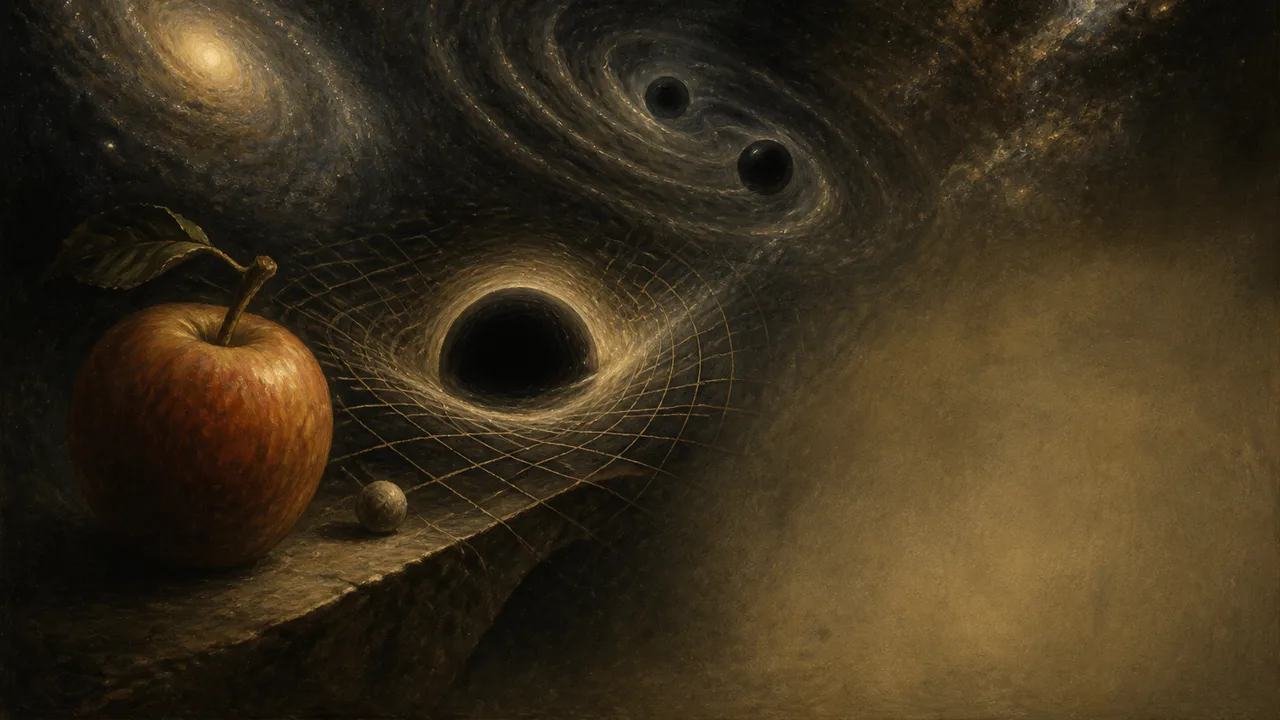
Photo: AI. Henrik Solberg
Pick up a paperclip. Hold it over a table. Let go.
You just felt the gravitational pull of a planet with a mass of roughly six septillion kilograms. And a refrigerator magnet — a small, cheap rectangle of ferrite — can beat that pull without breaking a sweat. The magnet wins. Every time.
That should strike you as absurd. Gravity is the force that built the solar system, that holds galaxies together, that determines the fate of the entire universe. And a novelty souvenir can overpower it. This is the first strange thing about gravity, and it sets the tone for everything that follows: we live inside this force, measure it with extraordinary precision, build our technologies on it — and we still don't fully understand what it is.
The Weakest Giant
Physics recognizes four fundamental forces. Gravity. Electromagnetism. The strong nuclear force. The weak nuclear force. Of these, gravity is by an almost incomprehensible margin the weakest. The strong nuclear force — which keeps atomic nuclei from flying apart — is estimated to exceed gravity by a factor that requires scientific notation to write without embarrassment. Trillions upon trillions upon trillions of times stronger, as the comparison is sometimes put. And yet: gravity is the force that won cosmically. Once you scale past atoms, electromagnetism cancels out (positive and negative charges balance), and the nuclear forces stay confined to their subatomic domains. Gravity, weak as it is, accumulates without limit. More mass means more pull, forever, in every direction. The universe's large-scale architecture — planets, stars, galaxy filaments stretching across hundreds of millions of light-years — is gravity's work product.
One proposed explanation for the weakness involves extra dimensions: the idea that gravity may leak into spatial dimensions beyond the three we experience, diluting its apparent strength in our observable world. It's a genuine hypothesis in theoretical physics, not fringe speculation. It's also, as of now, unconfirmed.
What Gravity Is — And Isn't
Newton gave us an equation. It works. Planets follow it, spacecraft navigate by it, artillery shells obey it. What Newton didn't give us was a mechanism. He was famously unbothered by this — hypotheses non fingo, I feign no hypotheses — but it always left a conceptual gap.
Einstein closed the gap, and opened a stranger one. General relativity replaced the Newtonian picture of gravity-as-force with something geometrically alien: massive objects curve the fabric of spacetime around them, and what we experience as gravity is simply objects following that curvature. There's no pulling. There's just geometry. A planet orbiting a star isn't being tugged along an invisible rope; it's tracing the path that locally curved spacetime makes available to it — the way water follows a valley, not because the valley is pulling it, but because that's the shape of the ground.
Physics has an incredibly accurate account of how gravity behaves across the universe. What it lacks is a complete account of what gravity is at its most fundamental level. The mastery is of the map. The territory remains genuinely mysterious.
The 1919 solar eclipse confirmed Einstein's geometry was real, not metaphor: starlight grazing the sun bent by precisely the angle his equations predicted, not Newton's. A century of subsequent experiments have continued finding the same thing. General relativity is not in doubt. But "not in doubt" and "fully understood" are different things, and conflating them has confused public understanding of physics for decades.
Ripples in the Fabric
One of general relativity's stranger predictions was that accelerating masses should generate waves in spacetime itself — distortions that propagate outward at the speed of light. Einstein predicted this in 1916. Testing it seemed essentially impossible: by the time gravitational waves from even catastrophic cosmic events reach Earth, they stretch and compress spacetime by less than the diameter of a proton.
In 2015, the LIGO observatories detected exactly that. Two black holes that merged over a billion light-years away sent a signal through spacetime, across a billion years of travel time, and arrived at Earth having distorted LIGO's four-kilometer laser arms by a fraction smaller than any physical structure humans had previously measured. The signal matched Einstein's equations almost exactly. It's one of the most technically demanding experiments ever completed, and its implications extend well beyond confirming a century-old prediction. Gravitational waves let astronomers observe cosmic events that emit little or no light — colliding neutron stars, merging black holes — through gravitational wave detection rather than the electromagnetic spectrum. A second sense for the universe, essentially.
Time Is Not What You Think It Is
General relativity makes another prediction that feels like it belongs in fiction: gravity slows time. The stronger the gravitational field, the more slowly time passes relative to a weaker-field location. Two atomic clocks placed at different altitudes on Earth will drift apart — the lower clock, closer to Earth's mass, ticks measurably slower.
This stops being an abstraction when you consider GPS. Satellites orbit roughly 20,000 kilometers up, where Earth's gravity is weaker than on the surface. Their onboard clocks tick slightly faster than clocks on the ground. Left uncorrected, this discrepancy would compound into navigational errors of kilometers per day — meaning that every time your phone tells you where you are, it's running a relativistic correction rooted in Einstein's 1915 field equations. General relativity isn't a theory your GPS system respects in some honorary sense; it's load-bearing infrastructure.
Near a black hole, these effects become extreme. A clock at the event horizon — if such a thing were possible to observe — would appear to an outside observer to stop entirely. Time dilation at that scale isn't a laboratory curiosity. It's physics at its limit.
The Seam That Doesn't Close
Here's what I find genuinely unsettling about the current state of physics: general relativity and quantum mechanics are the two most precisely verified theories humans have ever produced. Each has been tested against reality more times and in more ways than almost any other scientific framework. And when you try to apply them simultaneously — in the conditions at the center of a black hole, or in the first instants after the Big Bang — the mathematics doesn't just struggle. It produces results with no physical meaning whatsoever. Two theories, each impeccably accurate in its domain, that simply refuse to coexist.
This isn't a minor calibration problem. It suggests that somewhere beneath both theories, there's a level of description we don't have yet.
String theory proposes that the fundamental constituents of nature are not point-like particles but tiny vibrating strings — different vibrational modes corresponding to different particles and forces, including, theoretically, gravity. Loop quantum gravity takes a different approach: rather than imposing quantum mechanics on general relativity, it suggests that space itself is granular at the smallest scales, built from discrete chunks rather than a smooth continuum. Both frameworks are mathematically sophisticated. Neither has been confirmed experimentally, and the energy scales needed to test some of their predictions may be permanently beyond our technological reach.
The missing piece in the particle-physics framework is the graviton: a hypothetical force-carrying particle for gravity, analogous to the photon for electromagnetism. If it exists, it interacts so weakly with matter that detecting individual gravitons directly is, by current estimates, practically impossible. Some physicists think the graviton framework itself may be wrong — that gravity isn't carried by a particle at all, but emerges from something more fundamental about the structure of spacetime.
The Dark Accounting Problem
Galaxies rotate in ways that visible matter can't explain. Stars at the outer edges of galaxies move too fast — fast enough that, based on the mass we can see, they should be flung into intergalactic space. They aren't. Something is holding them.
The leading explanation is dark matter: matter that doesn't interact with light in any way we can detect, but exerts gravitational effects that are measurable. According to the Department of Energy's estimates, dark matter accounts for roughly 85% of all matter in the universe. We have mapped its distribution through gravitational lensing — dark matter bends light from behind it, making its presence detectable even through its absence — but no one has directly detected the particle that constitutes it.
The alternative possibility is one that doesn't get enough serious coverage: maybe dark matter doesn't exist, and our theory of gravity is simply wrong at galactic scales. Modified Newtonian dynamics (MOND) and its relativistic extensions have had genuine successes predicting galaxy rotation curves that standard dark matter models struggle with. They have their own failures too. The honest answer is that neither explanation has won, and both communities are hoping the next generation of experiments delivers a decisive result.
What Control Would Even Mean
Gravity remains the one fundamental force we cannot manipulate. We shield against radiation. We redirect electric current. We build materials that respond to magnetic fields in precisely engineered ways. But gravity passes through everything, curves around nothing, and cannot be switched off. Every rocket that has ever left Earth has done so by brute force — burning enormous quantities of fuel to overcome a pull that has existed since the planet formed.
The analogy sometimes made is to electricity before the nineteenth century: a phenomenon observed and described for millennia, then transformed into a technology that restructured civilization once someone figured out how to harness it. Whether gravity allows for analogous leverage — whether there's a "harnessing" to be done — is genuinely unknown. Some physicists think solving the deep theoretical questions about gravity's nature might reveal pathways we can't currently imagine. Others think gravity may simply be a permanent feature of spacetime itself, something to be understood more completely but never controlled.
Both positions are intellectually honest. We don't know enough yet to rule either out.
What we do know is this: the force you felt when you got out of bed this morning — the most familiar physical sensation in human experience — is also the least explained. That's not a failure of physics. It's a frontier.
More Like This
A Physicist Admits He Might Be Teaching Time Wrong
Professor Aephraim Steinberg on why time might be an illusion, Bell's inequalities, and the uncomfortable truth about what quantum physics proves—and doesn't.
Gravitational-Wave Astronomy's Next Frontier
Space-based optical clock networks could unlock the millihertz band, opening a new chapter in gravitational-wave astronomy beyond what LIGO and Virgo can reach.
The Most Sensitive Dark Matter Detector Might Find Nothing
LUX-ZEPLIN sits a kilometer underground, waiting for dark matter. But success might look like silence—and that would tell us something huge.
Euclid Space Telescope Maps the Dark Universe
The Euclid Space Telescope is rewriting cosmology—mapping dark matter, finding ghost galaxies, and forcing scientists to rethink what the universe is made of.
Einstein Got a Gift in 1949 That Broke Physics' Rules
Kurt Gödel presented Einstein with a mathematical solution allowing time travel. Decades later, physicists still haven't found reasons to exclude it.
Conformal Gravity: A Case Against Dark Matter
Professor Philip Mannheim argues dark matter doesn't exist—and his conformal gravity theory fits 138 galaxies without it. Here's what the evidence actually shows.
The Differential Equations That Map Physical Reality
DIBEOS walks through 23 foundational differential equations in physics—from Newton's second law to the Dirac equation—with genuine pedagogical clarity.
Brian Keating on What Came Before the Big Bang
Cosmologist Brian Keating explains the multiverse, dark energy, string theory's fatal flaw, and why finding extraterrestrial wisdom matters more than finding aliens.